



Polydextrose

Based on 1 Customer Validation
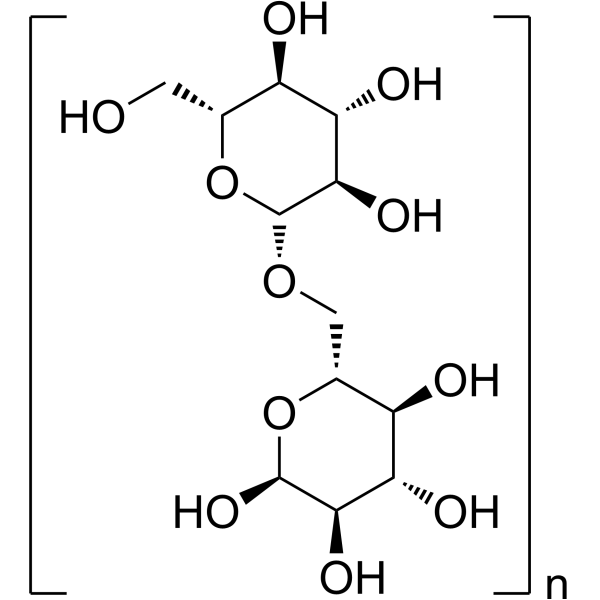
Polydextrose is an orally active prebiotic. Polydextrose promotes the growth of Pediococcus pentosaceus ATCC 43200. Polydextrose reduces cholesterol and synergistically lowers blood sugar with Sitagliptin (HY-13749). Currently, it is mainly used in the research of diseases such as hyperlipidemia, type 2 diabetes, and postoperative iron deficiency anemia.
For research use only. We do not sell to patients.
- Assay : 95.30%
- CAS No.: 68424-04-4
- Formula: C12H22O11
-
Storage:Powder -20°C, 3 years , 4°C, 2 years ; In solvent -80°C, 6 months , -20°C, 1 month

To place orders, for customer services and technical support, please contact: MedChemExpress USA
Tel: 609-228-6898 E-mail: [email protected] [email protected]


-
 Biological Activity
-
Chemical Information
-
Solvent & Solubility
- Protocols
- Purity & Documentation
- References
-
 Help & FAQs


-
HY-119109
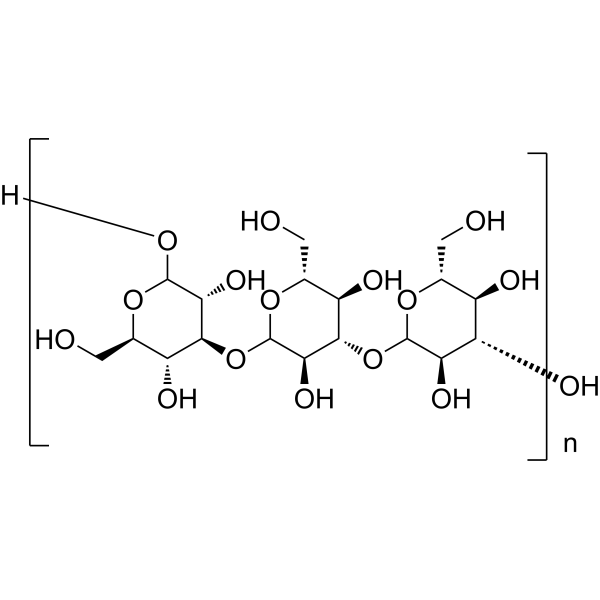
LaminaranImmunotherapy Agent -

HY-N7075
InulinEndogenous Metabolite -

HY-N6653
LentinanNrf2 Activator -
HY-W250113
Zymosan ATLR2 Agonist -
HY-132179
FucoidanAnticoagulant/Cancer Agent -
HY-113511
Glycogen, MusselGlycolytic Intermediates -
HY-131166
CurdlanPolysaccharide -

HY-W145667
MannanPolysaccharide Compound -

HY-N6664
Gum arabicComplex Branched Polysaccharide -

HY-113511C
Glycogen, from bovine liver, ≥85%Biochemical Assay Reagent -
HY-113511A
Glycogen, OystersEndogenous Metabolite -
HY-113511B
Glycogen, from rabbit liver, ≥85%Endogenous Metabolite


Biological Activity
Description
In Vitro
Polydextrose (0.5%-1.5%; 24 h; pH 6.0, 35°C, 50-150 rpm) significantly promotes the growth of Pediococcus pentosaceus ATCC 43200 in MRS medium and increases the lactic acid yield[3].
MedChemExpress (MCE) has not independently confirmed the accuracy of these methods. They are for reference only.
In Vivo
Polydextrose (7.5%; p.o. via diets; 60-day administration period) increases cecal SCFAs concentration (acetate by 198.4%), decreases cecal pH, and increases hemoglobin (29.2%) and hematocrit (55.8%) in rats undergoing partial gastrectomy (Billroth II procedure + vagotomy)[4]
Polydextrose (0.25 g/day; p.o.; daily; 6 weeks) combined with Sitagliptin (HY-13749) significantly reduces the area under the curve of the oral glucose tolerance test (by 28%) and glycaemia in high-fat diet-induced diabetic mice, and increases portal vein GLP-1 concentration[5].
MedChemExpress (MCE) has not independently confirmed the accuracy of these methods. They are for reference only.
Clinical Trial
| NCT Number | Sponsor | Condition | Start Date |
Phase

|
|---|---|---|---|---|
| NCT01329991 | Plexxikon| | 2011-05 | PHASE1 |


Chemical Information
-
CAS No. 68424-04-4
-
Appearance Solid
-
Formula C12H22O11
-
Color White to off-white
-
SMILES
O[C@H]1[C@H](O)[C@@H](O)[C@@H](O)O[C@@H]1CO[C@@H]2O[C@H](CO)[C@@H](O)[C@H](O)[C@H]2O.[n]
-
Shipping
Room temperature in continental US; may vary elsewhere.
-
Storage
Powder -20°C 3 years 4°C 2 years In solvent -80°C 6 months -20°C 1 month


Solvent & Solubility
In Vitro:
DMSO : 100 mg/mL (Need ultrasonic; Hygroscopic DMSO has a significant impact on the solubility of product, please use newly opened DMSO)
H2O : 100 mg/mL (Need ultrasonic)


Purity & Documentation
-
Data Sheet (288 KB)
-
SDS (393 KB)
- English - EN (393 KB)
- Français - FR (393 KB)
- Deutsch - DE (393 KB)
- Norwegian - NO (393 KB)
- Español - ES (393 KB)
- Swedish - SV (393 KB)
- Italian - IT (393 KB)
- Korean - KR (393 KB)
- Portuguese - PT (393 KB)
-
Handling Instructions (2659 KB)
References
[2]. Mäkeläinen HS, et al. The effects of polydextrose and xylitol on microbial community and activity in a 4-stage colon simulator. J Food Sci. 2007 Jun;72(5):M153-9. [Content Brief]
[3]. Wanderley Porto MC, et al. Effect of Polydextrose on the Growth of Pediococcus pentosaceus as Well as Lactic Acid and Bacteriocin-like Inhibitory Substances (BLIS) Production. Microorganisms. 2022 Sep 24;10(10):1898. [Content Brief]
[4]. do Carmo MMR, et al. Intake of Polydextrose Alters Hematology and the Profile of Short Chain Fatty Acids in Partially Gastrectomized Rats. Nutrients. 2018 Jun 20;10(6):792. [Content Brief]
[5]. Stenman LK, et al. Probiotic B420 and prebiotic polydextrose improve efficacy of antidiabetic drugs in mice. Diabetol Metab Syndr. 2015 Sep 12;7:75. [Content Brief]

Calculators
Concentration (start) × Volume (start) = Concentration (final) × Volume (final)


Polydextrose Related Classifications
HY-W134326 Related Classifications
 Powered by Bioz