



Polyvinyl alcohol (Mw 31000-50000, 98-99% hydrolyzed)
Based on 3 publication(s) in Google Scholar
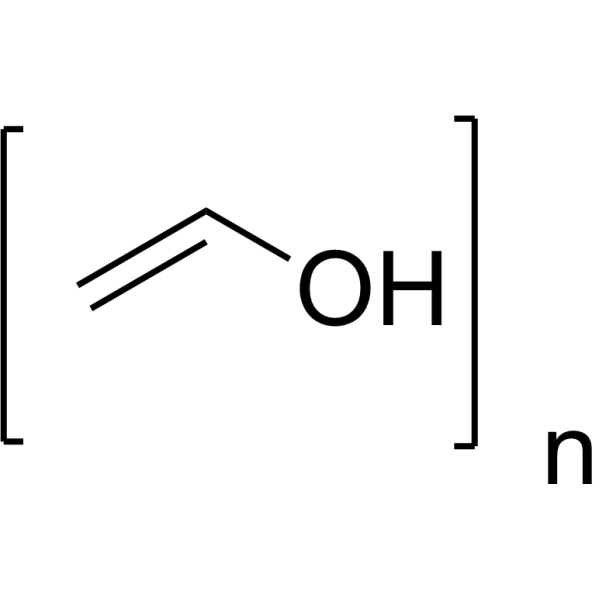
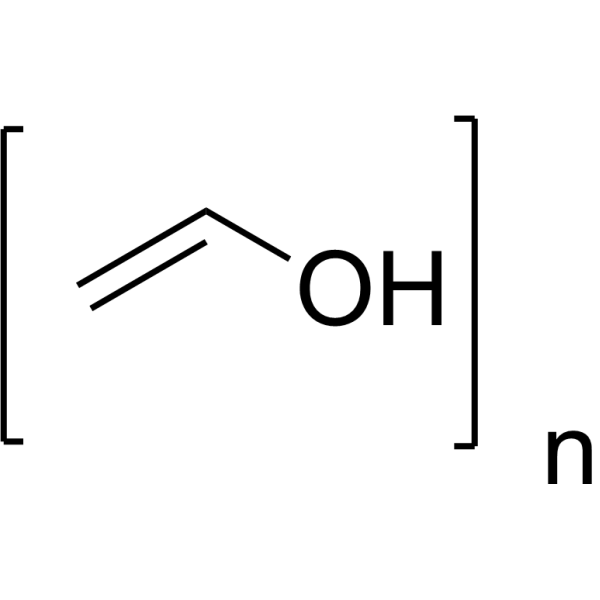
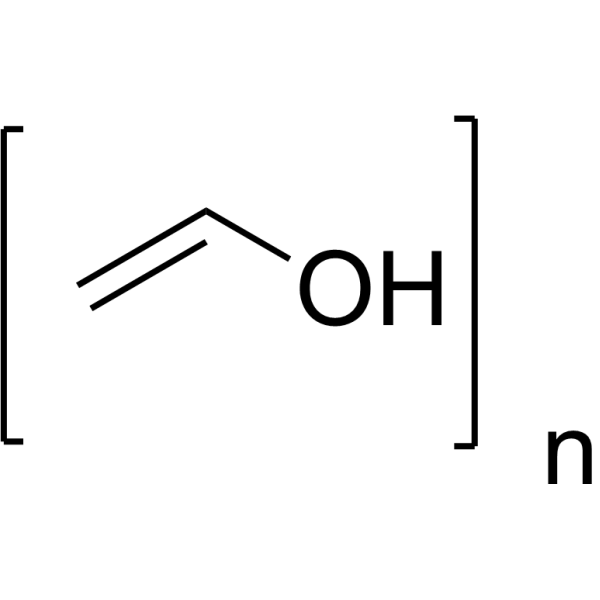
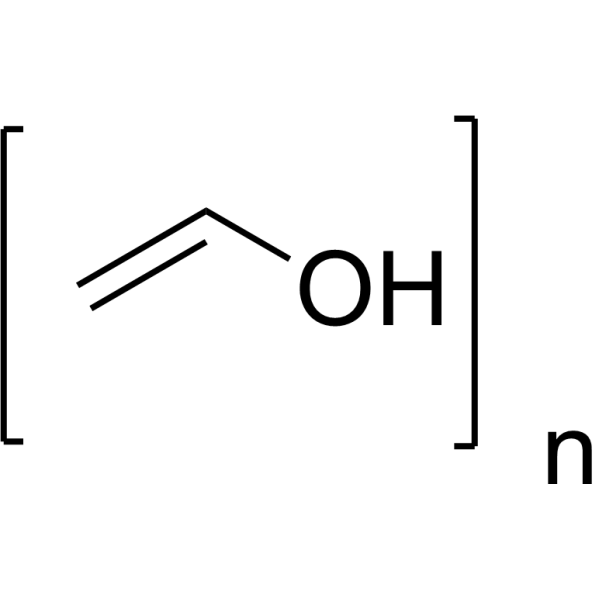
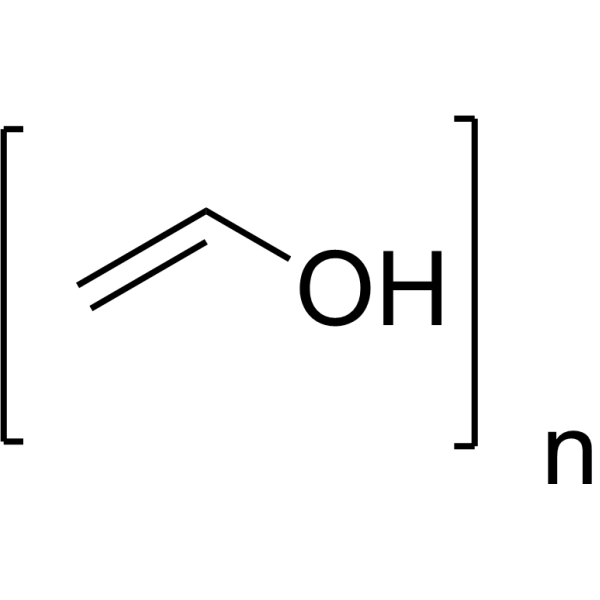
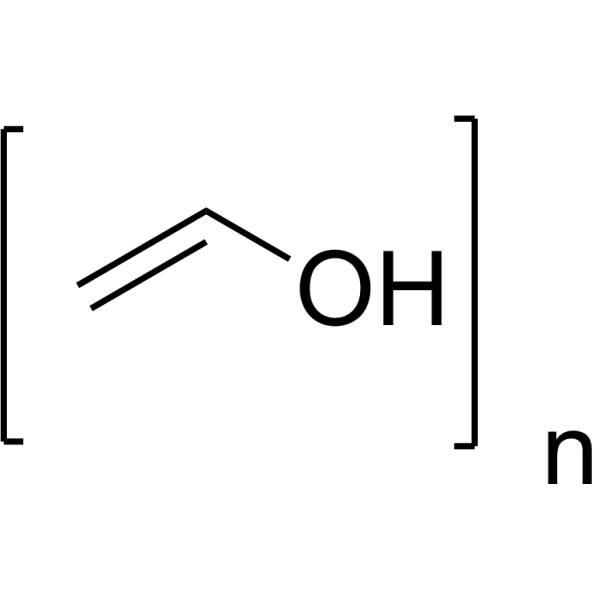
Polyvinyl alcohol (Mw 31000-50000, 98-99% hydrolyzed), also known as PVA, is a vinyl water-soluble polymer that can be used as a non-ionic surfactant. It can also be used as a biodegradable polymer and can be used in adhesives, coatings, textiles, ceramics and cosmetics. Polyvinyl alcohol can be used in tissue engineering by electrospinning. Polyvinyl alcohol can achieve high cellular density, infiltration, and uniform distribution, facilitating functional connections between cells. Polyvinyl alcohol can improve cell vitality through in vitro cultivation. Polyvinyl alcohol demonstrates promising inhibition of ostersarcoma cancer cells with Doxorubicin (HY-15142A).
For research use only. We do not sell to patients.
- Assay : 98.5%
- CAS No.: 9002-89-5
- Formula: (C2H4O)n
- Molecular Weight:31000-50000 (Approximately)
-
Storage:Powder -20°C, 3 years , 4°C, 2 years ; In solvent -80°C, 6 months , -20°C, 1 month

To place orders, for customer services and technical support, please contact: MedChemExpress USA
Tel: 609-228-6898 E-mail: [email protected] [email protected]


-
 Biological Activity
-
Chemical Information
-
Solvent & Solubility
- Protocols
- Purity & Documentation
- References
-
 Help & FAQs


-
HY-Y0873O
PEG35000Biochemical Assay Reagents -
HY-Y0850E
Polyvinyl alcohol (Mw 30000-70000, 87-90% hydrolyzed)Dressing Meterial -
HY-Y0850
Polyvinyl alcohol (Mw 146000-186000, 99+% hydrolyzed)Biochemical reagents -
HY-Y0850J
Polyvinyl alcohol (Mw 13000-23000, 87-89% hydrolyzed)Polyvinyl Alcohol -

HY-Y0850U4
PVA (Mw 145000, 99+% hydrolyzed, ~3300 polymerization)Polyvinyl Alcohol -

HY-Y0850U
PVA (Mw 31000, 87-89% hydrolyzed, ~630 polymerization)Polymer -
HY-Y0850O
Polyvinyl alcohol (Mw 31000-50000, 87-89% hydrolyzed)Emulsification Stabilizer -
HY-Y0850H
Polyvinyl alcohol (Mw 89000-98000, 99+% hydrolyzed)Biochemical Reagent -
HY-Y0850I
Polyvinyl alcohol (Mw 9000-10000, 80% hydrolyzed)Biochemical Reagent -

HY-Y0850U6
PVA (Mw 205000)Polyvinyl Alcohol -
HY-Y0850N
Polyvinyl alcohol (Mw 13000-23000, 98% hydrolyzed)Biochemical Reagent -

HY-Y0850U3
PVA (Mw 125000, 98-99% hydrolyzed, ~2800 polymerization)Wound Dressing
Publications Citing Use of MedChemExpress (MCE) Polyvinyl alcohol (Mw 31000-50000, 98-99% hydrolyzed)
More

Biological Activity
Description
In Vitro
Polyvinyl alcohol during in vitro cultivation enables adherent growth on the membrane post PVA degradation with cells still enveloped by PVA after 24 h[2].
MedChemExpress (MCE) has not independently confirmed the accuracy of these methods. They are for reference only. Further protocols information, click here.
In Vivo
MedChemExpress (MCE) has not independently confirmed the accuracy of these methods. They are for reference only.


Chemical Information
-
CAS No. 9002-89-5
-
Appearance Solid
-
Molecular Weight 31000-50000 (Approximately)
-
Formula (C2H4O)n
-
Color White to off-white
-
SMILES
CCC(O)C.[n]
-
Synonyms
PVA (Mw 31000-50000, 98-99% hydrolyzed); Poly(Ethenol) (Mw 31000-50000, 98-99% hydrolyzed)
-
Shipping
Room temperature in continental US; may vary elsewhere.
-
Storage
Powder -20°C 3 years 4°C 2 years In solvent -80°C 6 months -20°C 1 month


Publications (3)
-
Journal Impact Factor
-
Most Recent
-
Nanoscale Adv
Dexamethasone-loaded lipid-polymeric nanoparticles to improve therapy for cisplatin-induced sensorineural hearing loss. [Abstract]2025 Nov 21. PMID: 41278499 -
-


Solvent & Solubility
In Vitro:
H2O : 4 mg/mL (ultrasonic and warming and heat to 60°C)
In Vivo:
Select the appropriate dissolution method based on your experimental animal and administration route.
- For the following dissolution methods, please ensure to first prepare a clear stock solution using an In Vitro approach and then sequentially add co-solvents:
- To ensure reliable experimental results, the clarified stock solution can be appropriately stored based on storage conditions. As for the working solution for In Vivo experiments, it is recommended to prepare freshly and use it on the same day.
- The percentages shown for the solvents indicate their volumetric ratio in the final prepared solution. If precipitation or phase separation occurs during preparation, heat and/or sonication can be used to aid dissolution.
Add each solvent one by one: 10% DMSO 40% PEG300 5% Tween-80 45% Saline
Solubility: 2.5 mg/mL; Suspended solution; Need ultrasonic
This protocol yields a suspended solution of 2.5 mg/mL. Suspended solution can be used for oral and intraperitoneal injection.
Taking 1 mL working solution as an example, add 100 μL DMSO stock solution (25.0 mg/mL) to 400 μL PEG300, and mix evenly; then add 50 μL Tween-80 and mix evenly; then add 450 μL Saline to adjust the volume to 1 mL.
Preparation of Saline: Dissolve 0.9 g sodium chloride in ddH₂O and dilute to 100 mL to obtain a clear Saline solution.
Add each solvent one by one: 10% DMSO 90% (20% SBE-β-CD in Saline)
Solubility: ≥ 2.5 mg/mL; Clear solution
This protocol yields a clear solution of ≥ 2.5 mg/mL (saturation unknown).
Taking 1 mL working solution as an example, add 100 μL DMSO stock solution (25.0 mg/mL) to 900 μL 20% SBE-β-CD in Saline, and mix evenly.
Preparation of 20% SBE-β-CD in Saline (4°C, storage for one week): 2 g SBE-β-CD powder is dissolved in 10 mL Saline, completely dissolve until clear.
In Vivo Dissolution Calculator
Please enter the basic information of animal experiments:
-
-
-
-
Recommended: Prepare an additional quantity of animals to account for potential losses during experiments.
Working solution concentration: 0.22 mg/mL

Protocols
-
3D Hydrogel Synthetic Scaffold Culture
3D hydrogel synthetic scaffold culture embeds cells, spheroids, organoids, or tissue fragments inside a hydrated crosslinked polymer network so that cells receive matrix and cell-cell cues in three dimensions rather than from a flat plastic surface. A literature-supported model protocol is PEG-4MAL hydrogel culture, in which four-arm maleimide-terminated PEG is functionalized with cysteine-containing adhesive peptides such as RGD and crosslinked with protease-degradable peptides such as GPQ-W; this creates a defined, modular scaffold that supports human organoid generation and culture. The readouts are scaffold-supported growth, morphology, lumen formation, budding, viability, proliferation, lineage-marker expression, and matrix-dependent expansion or differentiation; reported assays include transmitted-light imaging, immunofluorescence, in situ hybridization, qRT-PCR, and rheological characterization.


Purity & Documentation
-
Data Sheet (272 KB)
-
SDS (254 KB)
- English - EN (254 KB)
- Français - FR (254 KB)
- Deutsch - DE (254 KB)
- Norwegian - NO (254 KB)
- Español - ES (254 KB)
- Swedish - SV (254 KB)
- Italian - IT (254 KB)
- Korean - KR (254 KB)
- Portuguese - PT (254 KB)
-
Handling Instructions (2659 KB)
References
[1]. DeMerlis CC, et al. Review of the oral toxicity of polyvinyl alcohol (PVA). Food Chem Toxicol. 2003 Mar;41(3):319-26. [Content Brief]
[2]. Türkoğlu, G. C., et al., (2024). PVA-Based Electrospun Materials-A Promising Route to Designing Nanofiber Mats with Desired Morphological Shape-A Review. International journal of molecular sciences, 25(3), 1668. [Content Brief]

Calculators
Concentration (start) × Volume (start) = Concentration (final) × Volume (final)


Polyvinyl alcohol (Mw 31000-50000, 98-99% hydrolyzed) Related Classifications
HY-Y0850K Related Classifications
 Powered by Bioz