



4-1BB/TNFRSF9 Protein, Human (HEK293, His)
Based on 1 Customer Validation
4-1BB (CD137; TNFRSF9), a receptor of TNFSF9/4-1BBL, belongs to the tumor necrosis factor (TNF) receptor superfamily. 4-1BB is helpful for T cell activation and development, and also induces peripheral mononuclear cell proliferation and migration to the tumor microenvironment. 4-1BB is also involved in enhancing Nrf2 and NF-κB pathway mediated apoptosis of endothelial cells. Human 4-1BB protein is a surface glycoprotein with a transmembrane domain (187-213 a.a.). 4-1BB/TNFRSF9 Protein, Human (HEK293, His) is the extracellular part (L24-Q186) of 4-1BB protein, produced by HEK293 cells with C-terminal 6*His-tag.
- Species: Human
- Source: HEK293
-
Storage:Stored at -20°C for 2 years from date of receipt. After reconstitution, it is stable at 4°C for 1 week or -20°C for longer (with carrier protein). It is recommended to freeze aliquots at -20°C or -80°C for extended storage.


To place orders, for customer services and technical support, please contact: MedChemExpress USA
Tel: 609-228-6898 E-mail: [email protected] [email protected]


-
 Biological Activity
-
Technical Parameters
-
Product Properties
- Documentation
- References
- Help & FAQs




Biological Activity
Description
4-1BB (CD137; TNFRSF9), a receptor of TNFSF9/4-1BBL, belongs to the tumor necrosis factor (TNF) receptor superfamily[1]. 4-1BB is helpful for T cell activation and development, and also induces peripheral mononuclear cell proliferation and migration to the tumor microenvironment[2]. 4-1BB is also involved in enhancing Nrf2 and NF-κB pathway mediated apoptosis of endothelial cells[3]. Human 4-1BB protein is a surface glycoprotein with a transmembrane domain (187-213 a.a.). 4-1BB/TNFRSF9 Protein, Human (HEK293, His) is the extracellular part (L24-Q186) of 4-1BB protein, produced by HEK293 cells with C-terminal 6*His-tag.
Background
4-1BB, is encoded by TNFRSF9 (CD137, ILA), belongs to tumor necrosis factor (TNF) receptor superfamily. 4-1BB is a surface glycoprotein, expressed in a variety of cells, for example, T cells, B cells, natural killer (NK) cells, dendritic (DCs), eosinophils, and mast cells; even a variety of tumor cells such as human leukemia cells. It is widely spread in vascular smooth muscles, tumor vessel walls, and liver tissue of hepatocellular carcinoma. 4-1BB has a preference on CD8+ cells rather than CD4+ cells. It provides co-stimulatory signals and activates cytotoxic effects of CD8+ T cells and helps to form memory T cells. Finally, it promotes the immune system fighting against tumors. Moreover, CD137 binds CD137L to signal monocytes, increase their survival, proliferation and stimulate their migration and extravasation. In addition, it induces the release of various proinflammatory factors, leads to the influx of inflammatory monocytes into tissues and form an inflammatory environment[1]. Specifically, CD137 promotes the migration of monocytes/macrophages to tumor microenvironment by upregulating the expression of Fra1. It also promoted the differentiation of monocytes/macrophages into osteoclasts at the same time, thus providing a favorable microenvironment for the colonization and growth of breast cancer cells in bone. It provides a promising therapeutic strategy for metastasis of breast cancer[2]. Furthermore, CD137 signaling promotes endothelial cells (ECs) apoptosis through prooxidative and proinflammatory mechanisms, mediated by Nrf2 and NF-κB pathways, respectively[3]. The homology of 4-1BB protein in human and mouse was low, and the sequence similarity was 56.75%.
In Vitro
4-1BB (human; 1 μg/mL; 16 h) leads to induction of monocyte activation and induces Myc protein production[4].
4-1BB (human; 1 μg/mL; 10 d) prolongs survival of peripheral monocytes and (1 μg/mL; 1 h) induces expression of M-CSF[5].
4-1BB (human; 1.2-40 μg/mL; 7 d) exhibits nhancement of cell numbers dose-dependently[6].
Verified Bioactivity
1.Loaded Human 4-1BB-His on HIS1K Biosensor, can bind Anti-Human CD137 mAb-Fc with an affinity constant of 25.5 nM as determined in BLI assay.
2.Immobilized Human 4-1BB-His at 10 μg/mL (100 μL/well) can bind Human 4-1BBL-Fc. The ED50 of Human IL-23-His is 1-2 μg/mL.
3.Loaded Tecaginlimab (HY-P99572) on AHC2 biosensor, can bind 4-1BB/TNFRSF9 Protein, Human (HEK293, His) with an affinity constant of 5.270 x 10¹¹ M as determined in BLI assay.
4.Immobilized Human 4-1BB-His at 10 μg/mL (100 μL/well) can bind Recombinant anti-Human 4-1BB mAb. The ED50 of Recombinant anti-Human 4-1BB mAb is 1.0-5.0 ug/mL.
5.Human 4-1BB Protein, His Tag captured on Protein A chip via anti-His antibody, can bind Urelumab (HY-P99055) with an affinity constant of 6.18 nM as determined in SPR assay.
MCE Validation Data
-
Purity - SDS-PAGE
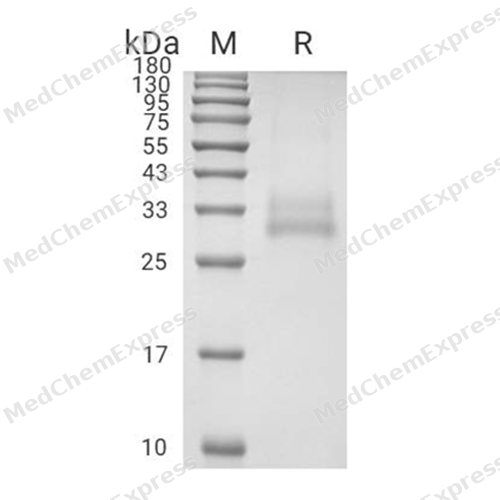
Purity - SDS-PAGE
-
Bioactivity - BLI
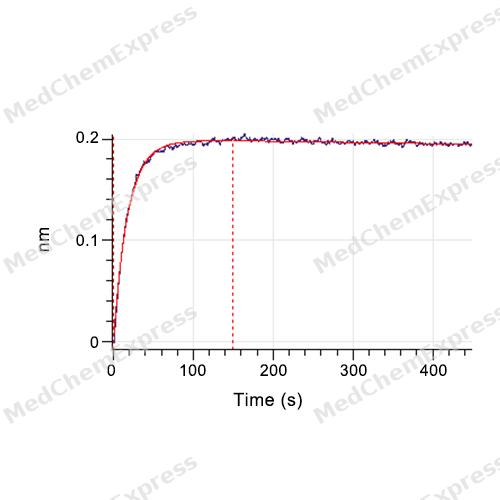
Bioactivity - BLI
-
Bioactivity - SPR

Bioactivity - SPR


Technical Parameters
-
Species Human
-
Source HEK293
-
Tag C-6*His
-
Accession
Q07011 (L24-Q186)
-
Molecular Construction
-
N-term
-
4-1BB (L24-Q186)
Accession # Q07011 -
6*His
-
C-term
-
-
Protein Length
Extracellular Domain
-
Synonyms
TNFRSF9; CDw137; Prev. ILA; Tumor Necrosis Factor Receptor Superfamily, Member 9; CD137; Induced By Lymphocyte Activation (ILA); 4-1BB; Homolog Of Mouse 4-1BB; Tumor Necrosis Factor Receptor Superfamily Member 9; Receptor Protein 4-1BB; T-Cell Antigen 4-1
-
AA Sequence
LQDPCSNCPAGTFCDNNRNQICSPCPPNSFSSAGGQRTCDICRQCKGVFRTRKECSSTSNAECDCTPGFHCLGAGCSMCEQDCKQGQELTKKGCKDCCFGTFNDQKRGICRPWTNCSLDGKSVLVNGTKERDVVCGPSPADLSPGASSVTPPAPAREPGHSPQ
-
Predicted Molecular Mass
18.1 kDa
-
Molecular Weight
Approximately 28-35 kDa, based on SDS-PAGE under reducing conditions, due to the glycosylation.
-
Glycosylation
Yes
-
Purity
≥ 95%, as determined by reducing SDS-PAGE.


Product Properties
Lyophilized powder
Lyophilized from a 0.22 μm filtered solution of PBS, pH 7.4.
<1 EU/μg, determined by LAL method.
It is not recommended to reconstitute to a concentration less than 100 μg/mL in ddH2O. For long term storage it is recommended to add a carrier protein (0.1% BSA, 5% HSA, 10% FBS or 5% Trehalose).
Stored at -20°C for 2 years from date of receipt. After reconstitution, it is stable at 4°C for 1 week or -20°C for longer (with carrier protein). It is recommended to freeze aliquots at -20°C or -80°C for extended storage.
Room temperature in continental US; may vary elsewhere.


Documentation
-
Data Sheet (265 KB)
-
SDS (252 KB)
- English - EN (252 KB)
- Français - FR (252 KB)
- Deutsch - DE (252 KB)
- Norwegian - NO (252 KB)
- Español - ES (252 KB)
- Swedish - SV (252 KB)
- Italian - IT (252 KB)
- Korean - KR (252 KB)
- Portuguese - PT (252 KB)
-
Handling Instructions (2659 KB)


References
[1]. Ye L, et al. CD137, an attractive candidate for the immunotherapy of lung cancer. Cancer Sci. 2020 May;111(5):1461-1467. [Content Brief]
[2]. Wilcox RA, et al. Provision of antigen and CD137 signaling breaks immunological ignorance, promoting regression of poorly immunogenic tumors. J Clin Invest. 2002 Mar;109(5):651-9. [Content Brief]
[3]. Jiang P, et al. CD137 promotes bone metastasis of breast cancer by enhancing the migration and osteoclast differentiation of monocytes/macrophages. Theranostics. 2019 May 9;9(10):2950-2966. [Content Brief]
[4]. Geng T, et al. CD137 Signaling Promotes Endothelial Apoptosis by Inhibiting Nrf2 Pathway, and Upregulating NF-κB Pathway. Mediators Inflamm. 2020 Jun 6;2020:4321912. [Content Brief]
[5]. Langstein J, et al. Comparative analysis of CD137 and LPS effects on monocyte activation, survival, and proliferation. Biochem Biophys Res Commun. 2000 Jun 24;273(1):117-22. [Content Brief]
[6]. Langstein J, et al. Identification of CD137 as a potent monocyte survival factor. J Leukoc Biol. 1999 Jun;65(6):829-33. [Content Brief]
[7]. Jiang D, et al. CD137 induces proliferation of murine hematopoietic progenitor cells and differentiation to macrophages. J Immunol. 2008 Sep 15;181(6):3923-32. [Content Brief]

Calculators
Concentration (start) × Volume (start) = Concentration (final) × Volume (final)


 Powered by Bioz

