



BRD4 Protein, Human (His-Flag)
Based on 4 publication(s) in Google Scholar
The BRD4 protein is a chromatin reader that recognizes and binds acetylated histones, transmits epigenetic memory and regulates transcription during cell division. It associates with acetylated chromatin throughout the cell cycle, maintaining chromatin structure and contributing to epigenetic memory. BRD4 Protein, Human (His-Flag) is the recombinant human-derived BRD4 protein, expressed by E. coli , with N-10*His, N-Flag labeled tag.
- Species: Human
- Source: E. coli
-
Storage:Stored at -80°C for 1 year from date of receipt. It is stable at -20°C for 3 months after opening. It is recommended to freeze aliquots at -80°C for extended storage. Avoid repeated freeze-thaw cycles.


To place orders, for customer services and technical support, please contact: MedChemExpress USA
Tel: 609-228-6898 E-mail: [email protected] [email protected]


-
 Biological Activity
-
Technical Parameters
-
Product Properties
- Documentation
- Help & FAQs


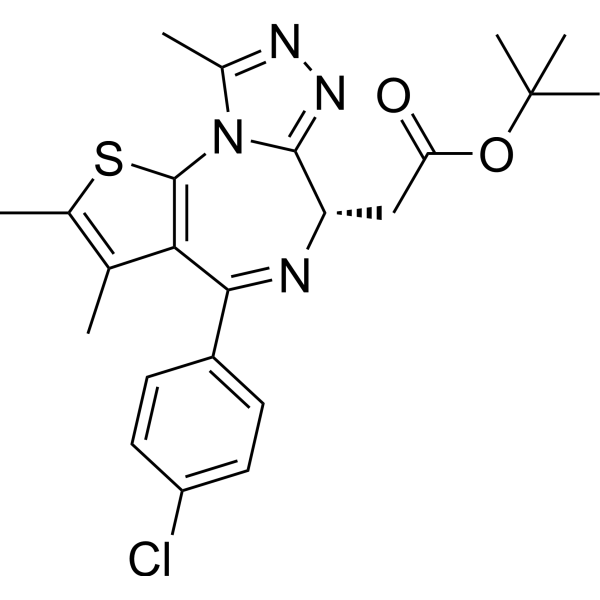
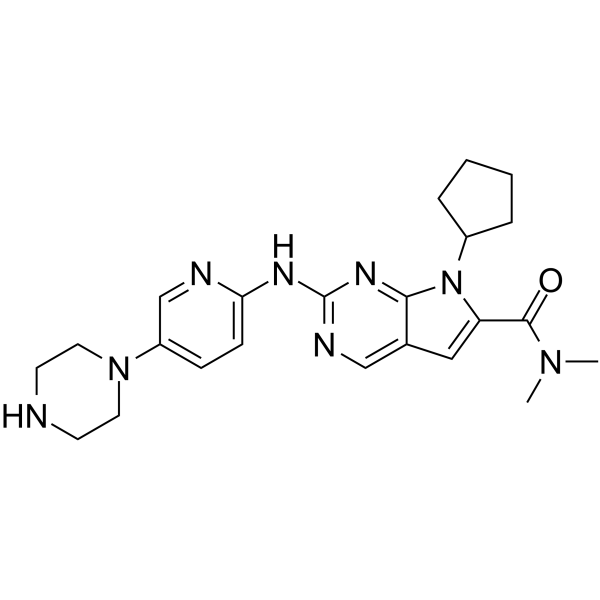


Biological Activity
Description
The BRD4 protein is a chromatin reader that recognizes and binds acetylated histones, transmits epigenetic memory and regulates transcription during cell division. It associates with acetylated chromatin throughout the cell cycle, maintaining chromatin structure and contributing to epigenetic memory. BRD4 Protein, Human (His-Flag) is the recombinant human-derived BRD4 protein, expressed by E. coli , with N-10*His, N-Flag labeled tag.
Background
BRD4 protein functions as a chromatin reader, specifically recognizing and binding acetylated histones, thereby playing a crucial role in transmitting epigenetic memory across cell divisions and regulating transcription. It remains associated with acetylated chromatin throughout the cell cycle, preserving the acetylated chromatin status and maintaining high-order chromatin structure, contributing to epigenetic memory for postmitotic G1 gene transcription. During interphase, BRD4 is pivotal in regulating the transcription of signal-inducible genes by associating with the P-TEFb complex and recruiting it to promoters. Additionally, it collaborates with JMJD6 in recruiting the P-TEFb complex to distal enhancers, known as anti-pause enhancers, displacing negative regulators and transforming P-TEFb into an active form that can phosphorylate the C-terminal domain of RNA polymerase II. BRD4 also acts as an atypical protein kinase, promoting phosphorylation of 'Ser-2' of the C-terminal domain of RNA polymerase II. Beyond histones, BRD4 recognizes and binds acetylated RELA, facilitating the recruitment of the P-TEFb complex and activating NF-kappa-B. Furthermore, it acts as a regulator of p53/TP53-mediated transcription, being recruited to specific target promoters upon phosphorylation by CK2. In the DNA damage response pathway, BRD4 acts as a chromatin insulator, inhibiting DNA damage response signaling by recruiting the condensin-2 complex to acetylated histones and limiting the spreading of histone H2AX/H2A.x phosphorylation. These diverse functions underscore the versatile role of BRD4 in epigenetic regulation, transcriptional control, and maintenance of chromatin structure.
Verified Bioactivity
1. Measured in a cell proliferation assay using M-NFS-60 cells. The ED50 for this effect is ≤13.78 ng/mL, corresponding to a specific activity is ≥7.26×10⁴ units/mg.
2. Western blot analysis of protein Human SIRT5 (HY-P74545) (lane 2 (10ng) and lane 3 (20ng)) and Human BRD4 (HY-P7846) (lane 4 (10ng) and lane 5 (20ng)) using Flag Tag(HRP) (HY-P80111A) Mouse mAb. Proteins were transferred to a PVDF membrane and blocked with 5% non-fat milk in TBST for 2 hour at room temperature. The primary antibody (1/1000) in 5% non-fat milk in TBST at 4°C overnight.
MCE Validation Data
-
Purity - SDS-PAGE
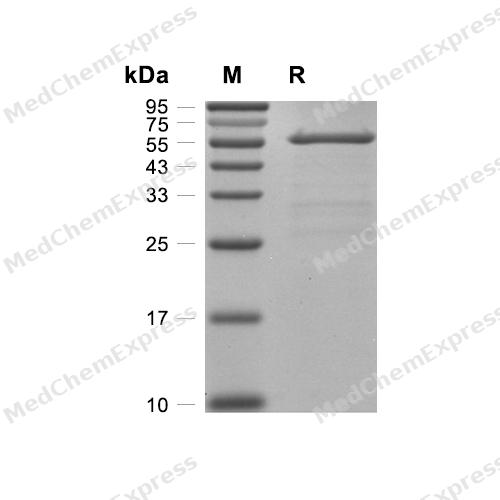
Purity - SDS-PAGE
-
Bioactivity - Cell-Based Assay
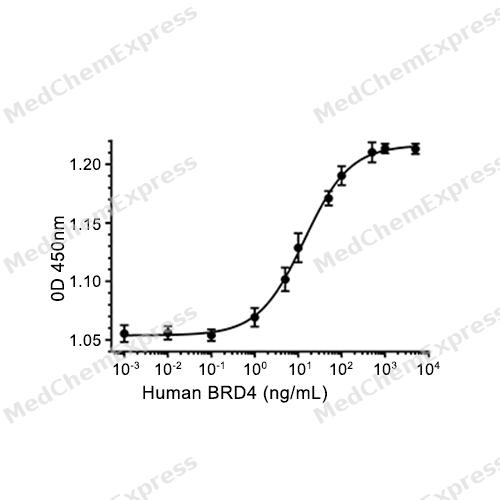
Bioactivity - Cell-Based Assay
-
Characterization - Western Blot
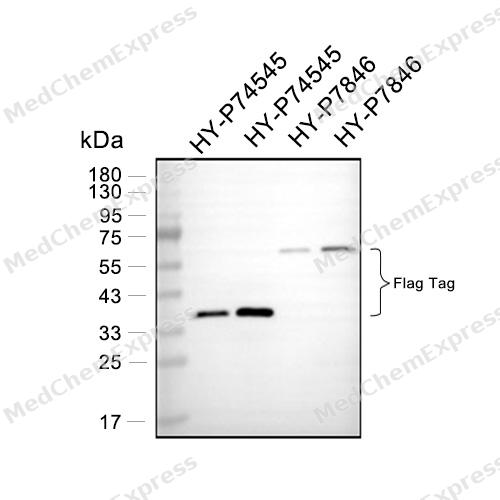
Characterization - Western Blot


Publications (4)
-
Journal Impact Factor
-
Most Recent
-
J Am Chem Soc
2023 Apr 12;145(14):7879-7887. PMID: 37001133 -
Biochem Pharmacol
Discovery of Bi-magnolignan as a novel BRD4 inhibitor inducing apoptosis and DNA damage for cancer therapy. [Abstract]2025 May:235:116843. PMID: 40024351 -
-


Technical Parameters
-
Species Human
-
Source E. coli
-
Tag N-10*His;N-Flag
-
Accession
O60885-1 (E49-E460)
-
Molecular Construction
-
N-term
-
10*His-Flag
-
BRD4 (E49-E460)
Accession # O60885-1 -
C-term
-
-
Protein Length
Partial
-
Synonyms
BRD4; Mitotic Chromosome-Associated Protein; Bromodomain Containing 4; Bromodomain-Containing Protein 4; HUNKI; Chromosome-Associated Protein; HUNK1; Bromodomain-Containing Protein 4 Variant; MCAP; Bromodomain-Containing 4; CAP; Protein HUNK1; FSHRG4; BRD4 Protein; Female Sterile Homeotic Related Gene 4; CDLS6
-
AA Sequence
ETSNPNKPKRQTNQLQYLLRVVLKTLWKHQFAWPFQQPVDAVKLNLPDYYKIIKTPMDMGTIKKRLENNYYWNAQECIQDFNTMFTNCYIYNKPGDDIVLMAEALEKLFLQKINELPTEETEIMIVQAKGRGRGRKETGTAKPGVSTVPNTTQASTPPQTQTPQPNPPPVQATPHPFPAVTPDLIVQTPVMTVVPPQPLQTPPPVPPQPQPPPAPAPQPVQSHPPIIAATPQPVKTKKGVKRKADTTTPTTIDPIHEPPSLPPEPKTTKLGQRRESSRPVKPPKKDVPDSQQHPAPEKSSKVSEQLKCCSGILKEMFAKKHAAYAWPFYKPVDVEALGLHDYCDIIKHPMDMSTIKSKLEAREYRDAQEFGADVRLMFSNCYKYNPPDHEVVAMARKLQDVFEMRFAKMPDE
-
Molecular Weight
Approximately 55-60 kDa, based on SDS-PAGE under reducing conditions.
-
Purity
≥ 90%, as determined by reducing SDS-PAGE.


Product Properties
Solution
1.Supplied as a 0.22 μm filtered solution of 50 mM HEPES, 200 mM NaCl, 10% glycerol, 1 mM DTT, pH 7.5.
2.Supplied as a 0.22 μm filtered solution of 50 mM HEPES, 300 mM NaCl, 1 mM DTT, 10% glycerol, pH 7.5.
3.Supplied as a 0.22 μm filtered solution of 50 mM HEPES, 300 mM NaCl, pH 7.4, 1 mM DTT, 10% glycerol.
Please refer to the lot-specific COA for specific buffer information.
<1 EU/μg, determined by LAL method.
Stored at -80°C for 1 year from date of receipt. It is stable at -20°C for 3 months after opening. It is recommended to freeze aliquots at -80°C for extended storage. Avoid repeated freeze-thaw cycles.
Shipping with dry ice.


Documentation
-
Data Sheet (239 KB)
-
SDS (252 KB)
- English - EN (252 KB)
- Français - FR (252 KB)
- Deutsch - DE (252 KB)
- Norwegian - NO (252 KB)
- Español - ES (252 KB)
- Swedish - SV (252 KB)
- Italian - IT (252 KB)
- Korean - KR (252 KB)
- Portuguese - PT (252 KB)
-
Handling Instructions (2659 KB)

Calculators
Concentration (start) × Volume (start) = Concentration (final) × Volume (final)


 Powered by Bioz

