



PLA2G2E Protein, Mouse (HEK293, His)

Based on 1 Customer Validation
The PLA2G2E protein is a secreted calcium-dependent phospholipase A2 that targets extracellular phospholipids. It hydrolyzes the fatty acyl group at the sn-2 position, releasing unsaturated fatty acids, especially lysophosphatidylethanolamine. PLA2G2E Protein, Mouse (HEK293, His) is the recombinant mouse-derived PLA2G2E protein, expressed by HEK293 , with C-His labeled tag.
- Species: Mouse
- Source: HEK293
-
Storage:Stored at -20°C for 2 years from date of receipt. After reconstitution, it is stable at 4°C for 1 week or -20°C for longer (with carrier protein). It is recommended to freeze aliquots at -20°C or -80°C for extended storage.


To place orders, for customer services and technical support, please contact: MedChemExpress USA
Tel: 609-228-6898 E-mail: [email protected] [email protected]


-
 Biological Activity
-
Technical Parameters
-
Product Properties
- Documentation
- Help & FAQs




Biological Activity
Description
The PLA2G2E protein is a secreted calcium-dependent phospholipase A2 that targets extracellular phospholipids. It hydrolyzes the fatty acyl group at the sn-2 position, releasing unsaturated fatty acids, especially lysophosphatidylethanolamine. PLA2G2E Protein, Mouse (HEK293, His) is the recombinant mouse-derived PLA2G2E protein, expressed by HEK293 , with C-His labeled tag.
Background
PLA2G2E, a secretory calcium-dependent phospholipase A2, predominantly targets extracellular phospholipids and exhibits phospholipase A2 activity by hydrolyzing the ester bond of the fatty acyl group at the sn-2 position of phospholipids. This enzymatic action results in the release of various unsaturated fatty acids, including oleoate, linoleoate, arachidonate, docosahexaenoate, and lysophosphatidylethanolamines, with a preference for lysophosphatidylethanolamines over lysophosphatidylcholines. In response to a high-fat diet, PLA2G2E hydrolyzes minor lipoprotein phospholipids, such as phosphatidylserines, phosphatidylinositols, and phosphatidylglycerols, thereby influencing lipoprotein composition and fat storage in adipose tissue and liver. Operating in an autocrine and paracrine manner, PLA2G2E contributes to lipid remodeling in cellular membranes and the generation of lipid mediators vital for pathogen clearance. Additionally, it acts as a hair follicle phospholipase A2, selectively releasing lysophosphatidylethanolamines and various unsaturated fatty acids in the skin to regulate hair follicle homeostasis. Furthermore, PLA2G2E may play a role in regulating the inflammatory response by releasing arachidonate, a precursor of prostaglandins and leukotrienes. Upon allergen exposure, it potentially participates in the allergic inflammatory response by enhancing leukotriene C4 synthesis and degranulation in mast cells.
Verified Bioactivity
Measured by its ability to hydrolyze 80 μΜ 1-Hexadecanoyl-2-(1-pyrene-decanoyl)-sn-glycero-3-phosphocholine that incubate at room temperature in kinetic mode for 3 minutes. The specific activity is >3.5 pmol/min/μg.
MCE Validation Data
-
Purity - SDS-PAGE
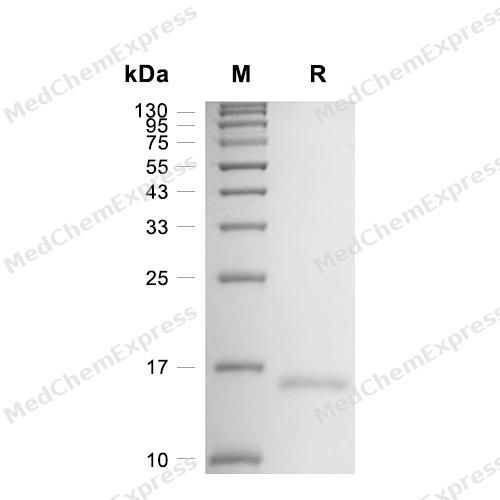
Purity - SDS-PAGE


Technical Parameters
-
Species Mouse
-
Source HEK293
-
Tag C-6*His
-
Accession
Q9QUL3 (N20-C142)
-
Molecular Construction
-
N-term
-
PLA2G2E (N20-C142)
Accession # Q9QUL3 -
His
-
C-term
-
-
Protein Length
Full Length of Mature Protein
-
Synonyms
PLA2G2E; GIIE SPLA2; Phospholipase A2 Group IIE; SPLA2-IIE; Phosphatidylcholine 2-Acylhydrolase 2E; Phospholipase A2, Group IIE; Group IIE Secretory Phospholipase A2
-
AA Sequence
NLVQFGVMIERMTGKPALQYNDYGCYCGVGGSHWPVDETDWCCHAHDCCYGRLEKLGCDPKLEKYLFSITRDNIFCAGRTACQRHTCECDKRAALCFRHNLNTYNRKYAHYPNKLCTGPTPPC
-
Molecular Weight
Approximately 15-18 kDa, based on SDS-PAGE under reducing conditions.
-
Purity
≥ 95%, as determined by reducing SDS-PAGE.


Product Properties
Lyophilized powder
Lyophilized from a 0.22 μm filtered solution of PBS, 10% glycerol, pH 7.4.
<1 EU/μg, determined by LAL method.
It is not recommended to reconstitute to a concentration less than 100 μg/mL in ddH2O. For long term storage it is recommended to add a carrier protein (0.1% BSA, 5% HSA, 10% FBS or 5% Trehalose).
Stored at -20°C for 2 years from date of receipt. After reconstitution, it is stable at 4°C for 1 week or -20°C for longer (with carrier protein). It is recommended to freeze aliquots at -20°C or -80°C for extended storage.
Room temperature in continental US; may vary elsewhere.


Documentation
-
Data Sheet (236 KB)
-
SDS (252 KB)
- English - EN (252 KB)
- Français - FR (252 KB)
- Deutsch - DE (252 KB)
- Norwegian - NO (252 KB)
- Español - ES (252 KB)
- Swedish - SV (252 KB)
- Italian - IT (252 KB)
- Korean - KR (252 KB)
- Portuguese - PT (252 KB)
-
Handling Instructions (2659 KB)

Calculators
Concentration (start) × Volume (start) = Concentration (final) × Volume (final)


 Powered by Bioz

