



XIAP Protein, Human (His)

Based on 1 Customer Validation
XIAP protein is a multifunctional regulator that controls apoptosis, inflammation, immunity, copper homeostasis, and various signaling pathways. As a caspase inhibitor, it blocks CASP3 and CASP7 substrate access, keeping CASP9 inactive. XIAP Protein, Human (His) is the recombinant human-derived XIAP protein, expressed by E. coli , with N-His labeled tag.
- Species: Human
- Source: E. coli
-
Storage:Stored at -80°C for 1 year from date of receipt. It is stable at -20°C for 3 months after opening. It is recommended to freeze aliquots at -80°C for extended storage. Avoid repeated freeze-thaw cycles.


To place orders, for customer services and technical support, please contact: MedChemExpress USA
Tel: 609-228-6898 E-mail: [email protected] [email protected]


-
 Biological Activity
-
Technical Parameters
-
Product Properties
- Documentation
- Help & FAQs




Biological Activity
Description
XIAP protein is a multifunctional regulator that controls apoptosis, inflammation, immunity, copper homeostasis, and various signaling pathways. As a caspase inhibitor, it blocks CASP3 and CASP7 substrate access, keeping CASP9 inactive. XIAP Protein, Human (His) is the recombinant human-derived XIAP protein, expressed by E. coli , with N-His labeled tag.
Background
The XIAP protein serves as a multifunctional regulator with diverse roles spanning apoptosis, inflammatory signaling, immunity, copper homeostasis, mitogenic kinase signaling, cell proliferation, invasion, and metastasis. As a direct caspase inhibitor, XIAP impedes substrate entry into the active site pockets of CASP3 and CASP7, while also maintaining CASP9 in a monomeric, inactive state. Functioning as an E3 ubiquitin-protein ligase, XIAP orchestrates ubiquitination of several target proteins, including RIPK1, RIPK2, MAP3K2/MEKK2, DIABLO/SMAC, AIFM1, CCS, PTEN, and BIRC5/survivin, thereby regulating NF-kappa-B signaling and other crucial pathways. In the realm of innate immunity, XIAP mediates 'Lys-63'-linked polyubiquitination of RIPK2 downstream of NOD1 and NOD2, activating NF-kappa-B and MAP kinases signaling. Additionally, XIAP influences the BMP signaling pathway, SMAD and MAP3K7/TAK1 dependent pathways, and the Wnt signaling cascade. It plays a role in copper homeostasis by ubiquitinating COMMD1 and also functions as an E3 ubiquitin-protein ligase in the NEDD8 conjugation pathway. Moreover, XIAP protects cells from spontaneous ripoptosome formation, suppresses ripoptosome formation by ubiquitinating RIPK1 and CASP8, and positively regulates Wnt signaling by ubiquitinating TLE proteins. These diverse functions underscore the intricate and pivotal role of XIAP in governing cellular processes across multiple signaling pathways.
MCE Validation Data
-
Purity - SDS-PAGE
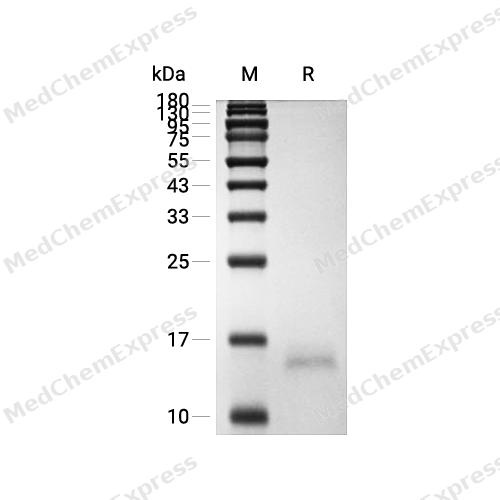
Purity - SDS-PAGE


Technical Parameters
-
Species Human
-
Source E. coli
-
Tag N-His
-
Accession
P98170 (N252-T356)
-
Molecular Construction
-
N-term
-
His
-
XIAP (N252-T356)
Accession # P98170 -
C-term
-
-
Protein Length
Partial
-
Synonyms
XIAP; X-Linked Inhibitor Of Apoptosis; BIRC4; API3; E3 Ubiquitin-Protein Ligase XIAP; X-Linked Inhibitor Of Apoptosis, E3 Ubiquitin Protein Ligase; Baculoviral IAP Repeat-Containing Protein 4; RING-Type E3 Ubiquitin Transferase XIAP; Inhibitor Of Apoptosi
-
AA Sequence
NSTNLPRNPSMADYEARIFTFGTWIYSVNKEQLARAGFYALGEGDKVKCFHCGGGLTDWKPSEDPWEQHAKWYPGCKYLLEQKGQEYINNIHLTHSLEECLVRTT
-
Predicted Molecular Mass
14.3 kDa
-
Molecular Weight
Approximately 15 kDa, based on SDS-PAGE under reducing conditions.
-
Purity
≥ 95%, as determined by reducing SDS-PAGE.


Product Properties
Solution
Supplied as a 0.22 μm filtered solution of PBS, pH 7.4.
<1 EU/μg, determined by LAL method.
Stored at -80°C for 1 year from date of receipt. It is stable at -20°C for 3 months after opening. It is recommended to freeze aliquots at -80°C for extended storage. Avoid repeated freeze-thaw cycles.
Shipping with dry ice.


Documentation
-
Data Sheet (235 KB)
-
SDS (251 KB)
- English - EN (251 KB)
- Français - FR (251 KB)
- Deutsch - DE (251 KB)
- Norwegian - NO (251 KB)
- Español - ES (251 KB)
- Swedish - SV (251 KB)
- Italian - IT (251 KB)
- Korean - KR (251 KB)
- Portuguese - PT (251 KB)
-
Handling Instructions (2659 KB)

Calculators
Concentration (start) × Volume (start) = Concentration (final) × Volume (final)


 Powered by Bioz

