



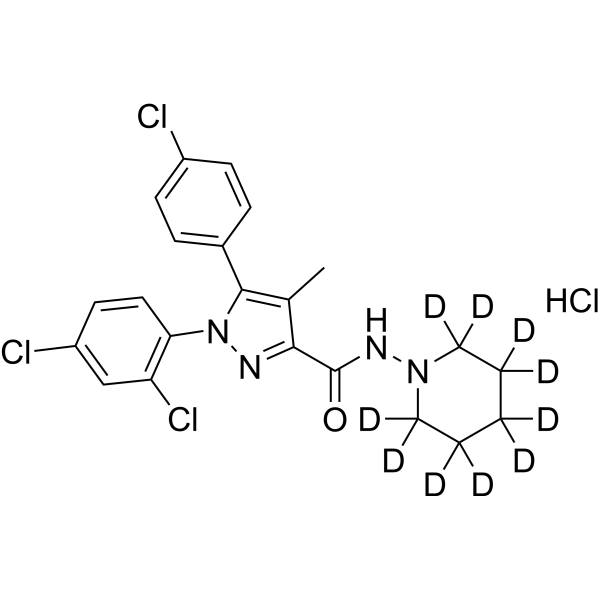
Rimonabant-d10 hydrochloride
Rimonabant-d10 (hydrochloride) is the deuterium labeled Rimonabant hydrochloride. Rimonabant hydrochloride (SR 141716A hydrochloride) is a highly potent and selective central cannabinoid receptor (CB1) antagonist with an Ki of 1.8 nM. Rimonabant hHydrochloride (SR 141716A Hydrochloride) also inhibits Mycobacterial membrane protein Large 3 (MMPL3).
For research use only. We do not sell to patients.
- CAS No.: 1044909-61-6
- Formula: C22H12D10Cl4N4O
- Molecular Weight:510.31
-
Storage:
Please store the product under the recommended conditions in the Certificate of Analysis.

To place orders, for customer services and technical support, please contact: MedChemExpress USA
Tel: 609-228-6898 E-mail: [email protected] [email protected]


-
 Biological Activity
-
Chemical Information
- Protocols
- Purity & Documentation
- References
-
 Help & FAQs




Biological Activity
Description
In Vitro
Stable heavy isotopes of hydrogen, carbon, and other elements have been incorporated into drug molecules, largely as tracers for quantitation during the drug development process. Deuteration has gained attention because of its potential to affect the pharmacokinetic and metabolic profiles of drugs[1].
MedChemExpress (MCE) has not independently confirmed the accuracy of these methods. They are for reference only. Further protocols information, click here.
Application
1. This compound can be used as a tracer
2. This compound can be used as an internal standard for quantitative analysis by NMR, GC-MS, or LC-MS.


Chemical Information
-
CAS No. 1044909-61-6
-
Unlabeled CAS 158681-13-1
-
Molecular Weight 510.31
-
Formula C22H12D10Cl4N4O
-
SMILES
CC1=C(N(N=C1C(NN2C(C(C(C(C2([2H])[2H])([2H])[2H])([2H])[2H])([2H])[2H])([2H])[2H])=O)C3=C(Cl)C=C(Cl)C=C3)C4=CC=C(Cl)C=C4.Cl
-
Shipping
Room temperature in continental US; may vary elsewhere.
-
Storage
Please store the product under the recommended conditions in the Certificate of Analysis.

Protocols
-
Membrane Protein Extraction Using Detergents and Chaotropes
Membrane protein extraction with detergents and chaotropes solubilizes lipid-bilayer-associated proteins by disrupting protein-lipid and protein-protein interactions while maintaining proteins in a soluble state for downstream electrophoresis, purification, or mass spectrometry. Chaotropes such as urea and thiourea improve solubilization of difficult proteins, while nonionic and zwitterionic detergents such as CHAPS, ASB-14, SB 3-10, MEGA-10, dodecyl maltoside, and Triton X-100 differ in extraction efficiency depending on sample type and membrane protein properties.


Purity & Documentation
References
[1]. Russak EM, et al. Impact of Deuterium Substitution on the Pharmacokinetics of Pharmaceuticals. Ann Pharmacother. 2019;53(2):211-216. [Content Brief]
[2]. Seely KA, et al. AM-251 and rimonabant act as direct antagonists at mu-opioid receptors: Implications for opioid/cannabinoid interaction studies. Neuropharmacology. 2012 Oct;63(5):905-15. [Content Brief]
[3]. Zhang B, et al. Crystal Structures of Membrane Transporter MmpL3, an Anti-TB Drug Target. Cell. 2019 Jan 24;176(3):636-648.e13. [Content Brief]
[4]. Erdozain, A. M. et al. The inverse agonist effect of rimonabant on G protein activation is not mediated by the cannabinoid CB1 receptor: Evidence from postmortem human brain Biochemical Pharmacology (2012), 83(2), 260-268. [Content Brief]

Calculators
Concentration (start) × Volume (start) = Concentration (final) × Volume (final)


Rimonabant-d10 hydrochloride Related Classifications
HY-14137S Related Classifications
 Powered by Bioz