



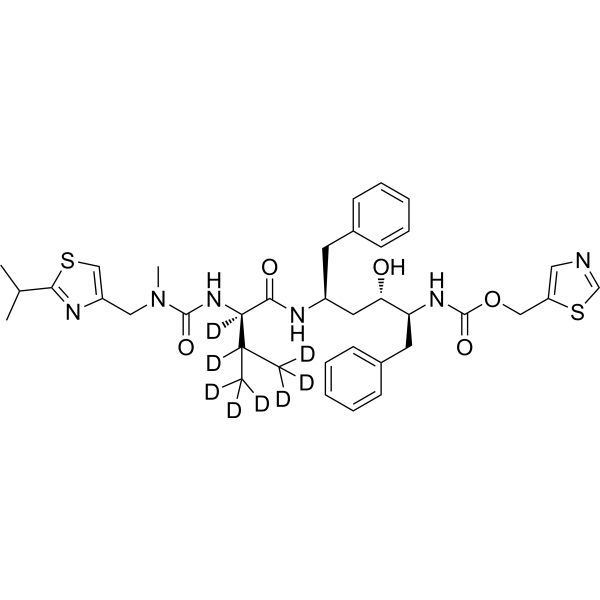
Ritonavir-d8
Ritonavir-d8 is deuterated labeled Ritonavir (HY-90001). Ritonavir (ABT 538) is an inhibitor of HIV protease used to treat HIV infection and AIDS. Ritonavir is also a SARS-CoV 3CLpro inhibitor with an IC50 of 1.61 μM.
연구목적의 판매만을 진행합니다. 환자를 대상으로 한 판매는 하지 않습니다.
- 화학식: C37H40D8N6O5S2
- 분자량:728.99
-
보관:
Please store the product under the recommended conditions in the Certificate of Analysis.

To place orders, for customer services and technical support, please contact: MedChemExpress USA
Tel: 609-228-6898 E-mail: [email protected] [email protected]


-
 Biological Activity
-
Chemical Information
- Protocol
- 순도&문서
- References
-
 Help & FAQs




Biological Activity
제품 설명
In Vitro
Stable heavy isotopes of hydrogen, carbon, and other elements have been incorporated into drug molecules, largely as tracers for quantitation during the drug development process. Deuteration has gained attention because of its potential to affect the pharmacokinetic and metabolic profiles of drugs[1].
Ritonavir (ABT 538) is an inhibitor of CYP3A4 mediated testosterone 6β-hydroxylation with mean Ki of 19 nM and also inhibits tolbutamide hydroxylation with IC50 of 4.2 μM[2].
Ritonavir (ABT 538) is found to be a potent inhibitor of CYP3A-mediated biotransformations (nifedipine oxidation with IC50 of 0.07 mM, 17alpha-ethynylestradiol 2-hydroxylation with IC50 of 2 mM; terfenadine hydroxylation with IC50 of 0.14 mM). Ritonavir is also an inhibitor of the reactions mediated by CYP2D6 (IC50=2.5 mM) and CYP2C9/10 (IC50=8.0 mM)[3].
Ritonavir results in an increase in cell viability in uninfected human PBMC cultures. Ritonavir markedly decreases the susceptibility of PBMCs to apoptosis correlated with lower levels of caspase-1 expression, decreases in annexin V staining, and reduces caspase-3 activity in uninfected human PBMC cultures. Ritonavir inhibits induction of tumor necrosis factor (TNF) production by PBMCs and monocytes in a time- and dose-dependent manner at nontoxic concentrations[4].
Ritonavir inhibits p-glycoprotein-mediated extrusion of saquinavir with an IC50 of 0.2 μM, indicating a high affinity of ritonavir for p-glycoprotein[5].
Ritonavir inhibits human liver microsomal metabolism of ABT-378 potently with Ki of 13 nM. Ritonavir combined with ABT-378 (at 3:1 and 29:1 ratios) inhibits CYP3A (IC50=1.1 and 4.6 μM), albeit less potently than Ritonavir (IC50=0.14 μM)[6].
MedChemExpress (MCE) has not independently confirmed the accuracy of these methods. They are for reference only.
신청
1. This compound can be used as a tracer
2. This compound can be used as an internal standard for quantitative analysis by NMR, GC-MS, or LC-MS.


Chemical Information
-
Unlabeled CAS 155213-67-5
-
분자량 728.99
-
화학식 C37H40D8N6O5S2
-
SMILES
O[C@@H](C[C@H](CC1=CC=CC=C1)NC([C@@](NC(N(CC2=CSC(C(C)C)=N2)C)=O)([2H])C(C([2H])([2H])[2H])(C([2H])([2H])[2H])[2H])=O)[C@H](CC3=CC=CC=C3)NC(OCC4=CN=CS4)=O
-
Synonyms
ABT 538-d8; RTV-d8
-
선적
Room temperature in continental US; may vary elsewhere.
-
보관
Please store the product under the recommended conditions in the Certificate of Analysis.


순도&문서
References
[1]. Russak EM, et al. Impact of Deuterium Substitution on the Pharmacokinetics of Pharmaceuticals. Ann Pharmacother. 2019 Feb;53(2):211-216. [Content Brief]
[2]. Eagling VA, et al. Differential inhibition of cytochrome P450 isoforms by the protease inhibitors, ritonavir, saquinavir and indinavir. Br J Clin Pharmacol. 1997 Aug;44(2):190-4. [Content Brief]
[3]. Qi Sun, et al. Bardoxolone and bardoxolone methyl, two Nrf2 activators in clinical trials, inhibit SARS-CoV-2 replication and its 3C-like protease. Signal Transduct Target Ther. 2021 May 29;6(1):212. [Content Brief]
[4]. Kumar GN, et al. Potent inhibition of the cytochrome P-450 3A-mediated human liver microsomal metabolism of a novel HIV protease inhibitor by ritonavir: A positive drug-drug interaction. Drug Metab Dispos. 1999 Aug;27(8):902-8. [Content Brief]
[5]. Kumar GN, et al. Cytochrome P450-mediated metabolism of the HIV-1 protease inhibitor ritonavir (ABT-538) in human liver microsomes. J Pharmacol Exp Ther. 1996 Apr;277(1):423-31. [Content Brief]
[6]. Drewe J, et al. HIV protease inhibitor ritonavir: a more potent inhibitor of P-glycoprotein than the cyclosporine analog SDZ PSC 833. Biochem Pharmacol. 1999 May 15;57(10):1147-52. [Content Brief]
[7]. Weichold FF, et al. HIV-1 protease inhibitor ritonavir modulates susceptibility to apoptosis of uninfected T cells. J Hum Virol. 1999 Sep-Oct;2(5):261-9. [Content Brief]

Calculators
Concentration (start) × Volume (start) = Concentration (final) × Volume (final)


Ritonavir-d8 Related Classifications
HY-90001S2 Related Classifications
 Powered by Bioz