



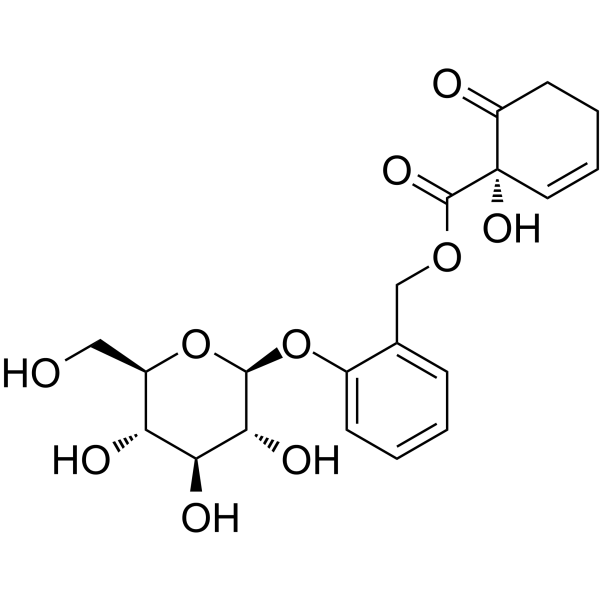
Salicortin
Salicortin, a phenolic glycoside, has been isolated from many plants such as Populus and Salix species. Salicortin inhibits osteoclast differentiation and bone resorption by down-regulating JNK and NF-κB/NFATc1 signaling pathways. Salicortin has anti-amnesic, anti-adipogenic, and immune-modulatory activity.
For research use only. We do not sell to patients.
- CAS No.: 1887055-63-1
- Formula: C20H24O10
- Molecular Weight:424.40
-
Storage:
Please store the product under the recommended conditions in the Certificate of Analysis.

To place orders, for customer services and technical support, please contact: MedChemExpress USA
Tel: 609-228-6898 E-mail: [email protected] [email protected]


-
 Biological Activity
-
Chemical Information
- Protocols
- Purity & Documentation
- References
-
 Help & FAQs




Biological Activity
Description
IC50 & Target
[1]|
JNK |
NF-κB |
In Vitro
Salicortin (100 μM; 2 hours) almost completely retards the phosphorylation of IκBα[1].
MedChemExpress (MCE) has not independently confirmed the accuracy of these methods. They are for reference only.
-
Cell Line:Mouse bone marrow macrophage (BMM)
-
Concentration:100 μM
-
Incubation Time:2 hours
-
Result:Retarded the phosphorylation of IκBα.


Chemical Information
-
CAS No. 1887055-63-1
-
Molecular Weight 424.40
-
Formula C20H24O10
-
SMILES
O[C@H]([C@H]([C@@H]([C@@H](CO)O1)O)O)[C@@H]1OC2=CC=CC=C2COC([C@]3(O)C=CCCC3=O)=O
-
Structure Classification
-
Initial Source
-
Shipping
Room temperature in continental US; may vary elsewhere.
-
Storage
Please store the product under the recommended conditions in the Certificate of Analysis.


Purity & Documentation
References

Calculators
Concentration (start) × Volume (start) = Concentration (final) × Volume (final)


Salicortin Related Classifications
HY-123503 Related Classifications
 Powered by Bioz