209 Results for "

proteasome system

" in MedChemExpress (MCE) Product Catalog:
Products (209)

209 Results for "proteasome system" in MCE Product Catalog:

Cat. No.: HY-180965
CAS No.: 3057939-64-4
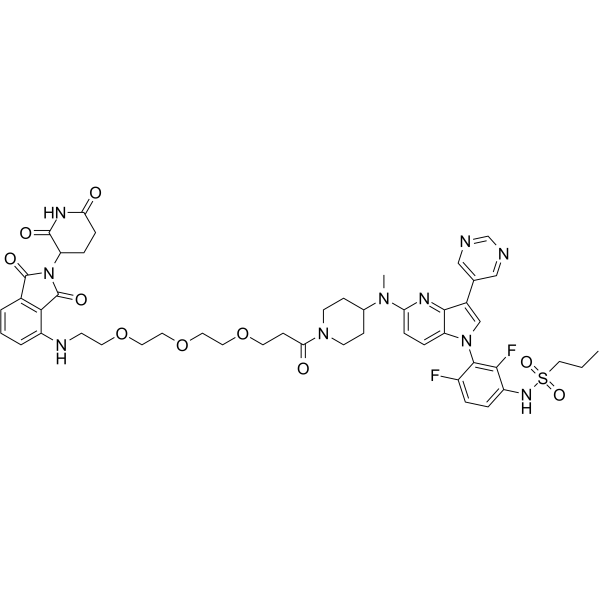
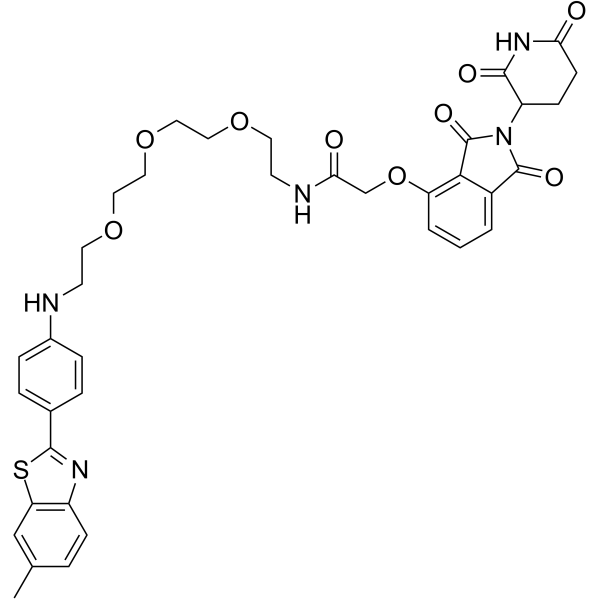
Pro-PEG3-BA is an EML4-ALK/EGFR PROTAC degrader, degrading EML4 ALK and EGFR mutant (L858R/T790M) with DC50 values of 0.42 and 13.50 μM, respectively. Pro-PEG3-BA hinders proliferation and induces cell cycle arrest and apoptosis of NSCLC cells in vitro. Pro-PEG3-BA shows safety profile and decreases EML4-ALK protein via rewiring the ubiquitin- proteasome system in vivo. Pro-PEG3-BA can be used for non-small cell lung cancer research .
loading...
    loading...
Cat. No.: HY-181967
Research Areas:  

Cancer

PROTAC PARP1 degrader-5 is a PARP1 PROTAC degrader with a DC50 of 0.12 μM. PROTAC PARP1 degrader-5 hijacks the ubiquitin-proteasome system via catalytic ternary complex formation to drive sustained PARP1 degradation. PROTAC PARP1 degrader-5 induces DNA damage, drives marginal cytosolic double-stranded DNA accumulation in tumor cells, and up-regulates PD-L1 surface expression in tumor cells. PROTAC PARP1 degrader-5 shows tumor growth inhibition activity in murine melanoma models when encapsulated in lipid nanoparticles. PROTAC PARP1 degrader-5 can be used for the research of cancer, such as melanoma .
loading...
    loading...
Cat. No.: HY-187470
CAS No.: 3135155-78-8
Research Areas:  

Cancer

PROTAC AURKA degrader-4 is a AURKA PROTAC degrader with a DC50 of 25.62 nM (Jurkat cells). PROTAC AURKA degrader-4 recruits the CRBN E3 ubiquitin ligase via the ubiquitin-proteasome system. PROTAC AURKA degrader-4 disrupts both the catalytic and non-catalytic functions of AURKA, including its interactions with TPX2 and c-Myc. PROTAC AURKA degrader-4 induces G2/M phase arrest and apoptosis. PROTAC AURKA degrader-4 exhibits enhanced antiproliferative activity and in vivo antitumor efficacy in models with high CRBN and AURKA expression. PROTAC AURKA degrader-4 can be used for the research of acute lymphoblastic leukemia .
loading...
    loading...
Cat. No.: HY-40178S
CAS No.: 2102057-88-3
NH2-C4-NH-Boc-d8 is the deuterium labeled NH2-C4-NH-Boc (HY-40178). NH2-C4-NH-Boc (compound 15) is a PROTAC linker, which refers to the Alkyl/ether composition. NH2-C4-NH-Boc can be used in the synthesis of a series of PROTACs. PROTACs contain two different ligands connected by a linker; one is a ligand for an E3 ubiquitin ligase and the other is for the target protein. PROTACs exploit the intracellular ubiquitin-proteasome system to selectively degrade target proteins .
loading...
    loading...
Cat. No.: HY-129108
CAS No.: 205252-57-9
Synonyms: (9Z)-UAB-30
9-cis-UAB30 is a rexinoid agonist. 9-cis-UAB30 significantly decreases the proliferation, viability, and motility of both patient-derived xenografts (PDXs). 9-cis-UAB30 induced cell-cycle arrest as demonstrated by the significant increase in the percentage of cells in G1 and a decrease in the percentage of cells in S phase by downregulating SKP2 and/or 20S proteasome activity, which leads to increased p27kip1 protein stability. 9-cis-UAB30 downregulates the abundance of stem cell marker mRNAs (Oct4, Nanog, Sox2, nestin) and upregulates the abundance of differentiation marker mRNAs (β3-tubulin, NSE, HOXC9, GAP43). 9-cis-UAB30 has no adverse effects on the central nervous system and cardiovascular system at the tested dose. 9-cis-UAB30 can be used for the study of neuroblastoma, cutaneous T-cell lymphomas, and breast cancer .
loading...
    loading...
Cat. No.: HY-L934
122 compounds

CRBN, namely cereblon, is the substrate recognition subunit of the E3 ubiquitin ligase complex in the ubiquitin-proteasome system. A CRBN ligand library refers to a collection of numerous fragments that can specifically bind to the CRBN protein.

These ligands are mostly designed based on validated CRBN-binding warheads and modified through AI-driven molecular generation optimization systems. They not only include classic lenalidomide-derived structures but also cover novel non-lenalidomide scaffolds. After drug-likeness filtering, these ligands exhibit structural diversity and favorable druggable properties. They can be further optimized and modified to facilitate the development of novel molecular glue degraders, accelerate the discovery of molecular glues that induce interactions between CRBN and new substrate proteins, and enable the exploration of novel CRBN substrates for identifying previously unknown CRBN-binding proteins.

MCE compiles 122 fragments that can specifically bind to the CRBN protein, with molecular weights ranging from 200 to 500. Compounds developed based on the library ligands target multiple disease targets such as cancer and autoimmune diseases, further advancing the development of Molecular Glues and PROTACs therapeutic agents.

Cat. No.: HY-174379
Research Areas:  

Cancer

NTLiverTac PDE6D degrader-1 is a PDE6D NTLiverTac degrader with a DC50 of 4.09 μM. NTLiverTac PDE6D degrader-1 is formed by conjugating a PDE6D PROTAC degrader with the NTCP ligand Cholic acid (HY-N0324). NTLiverTac PDE6D degrader-1 triggers the ubiquitin-proteasome system-mediated degradation process by forming a complex with PDE6D and MDM2, inducing proteasome-dependent and NTCP-dependent degradation. NTLiverTac PDE6D degrader-1 inhibits PDE6D-dependent KRAS trafficking and suppresses KRAS-related oncogenic signaling cascades. NTLiverTac PDE6D degrader-1 inhibits the activation of the PI3K/AKT/mTOR signaling pathway and induces cellular Apoptosis. NTLiverTac PDE6D degrader-1 enters cancer cells via NTCP-mediated endocytosis. NTLiverTac PDE6D degrader-1 can be used in the research of hepatoblastoma (MDM2 ligand: (4R,5S)-Nutlin carboxylic acid (HY-128836); NTCP ligand: Cholic acid (HY-N0324); PDE6D ligand: Sorafenib (HY-10201)) .
loading...
    loading...
Cat. No.: HY-108374R
CAS No.: 88192-20-5
Research Areas:  

Cancer

4-Azidobutylamine (Standard) is the analytical standard of 4-Azidobutylamine (HY-108374). This product is intended for research and analytical applications. 4-Azidobutylamine is a PROTAC linker, which refers to the alkyl chain composition. 4-Azidobutylamine can be used in the synthesis of a series of PROTACs. PROTACs contain two different ligands connected by a linker; one is a ligand for an E3 ubiquitin ligase and the other is for the target protein. PROTACs exploit the intracellular ubiquitin-proteasome system to selectively degrade target proteins . 4-Azidobutylamine is a click chemistry reagent, it contains an Azide group and can undergo copper-catalyzed azide-alkyne cycloaddition reaction (CuAAc) with molecules containing Alkyne groups. It can also undergo strain-promoted alkyne-azide cycloaddition (SPAAC) reactions with molecules containing DBCO or BCN groups.
loading...
    loading...
Cat. No.: HY-137487
CAS No.: 2417296-84-3
Purity:  98.02%
Target:  

PROTACs Raf

Research Areas:  

Cancer

PROTAC BRAF-V600E degrader-1 is a BRAF-V600E-selective PROTAC degrader and inhibitor. PROTAC BRAF-V600E degrader-1 induces degradation of BRAF-V600E via the cellular ubiquitin proteasome system, sparing wild-type BRAF. PROTAC BRAF-V600E degrader-1 suppresses the MEK/ERK kinase cascade in melanoma cells. PROTAC BRAF-V600E degrader-1 impairs growth of melanoma cells in culture. PROTAC BRAF-V600E degrader-1 can be used for the research of melanoma, colon cancer .
loading...
    loading...
Cat. No.: HY-157839
CAS No.: 3032208-24-2
Purity:  99.28%
Research Areas:  

Neurological Disease

PROTAC α-Synuclein/Tau degrader 1 is a blood-brain barrier-penetrant dual PROTAC degrader of α-synuclein (α-Syn) and tau, with DC50 of 1.57 μM and 4.09 μM, respectively. PROTAC α-Synuclein/Tau degrader 1 binds to α-Syn and tau PFF, with KDs of 0.47 and 2.78 μM, respectively. PROTAC α-Synuclein/Tau degrader 1 exhibits degradation effect mediated by the ubiquitin-proteasome system (UPS). PROTAC α-Synuclein/Tau degrader 6 can be used for the study of Parkinson’s disease (PD) (Pink: α-Synuclein/Tau ligand (HY-151035); Blue: CRBN ligase ligand (HY-14658); Black: Linker (HY-128803)) .
loading...
    loading...
Cat. No.: HY-177008
CAS No.: 2897640-93-4
Target:  

PROTACs EGFR ERK Akt Apoptosis

Research Areas:  

Cancer

PROTAC HER2 degrader-1 is a selective HER2 PROTAC degrader with a DC50 of 69 nM. PROTAC HER2 degrader-1 induces ubiquitination and degradation of HER2 via the ubiquitin-proteasome system, thereby inhibiting the downstream PI3K/AKT/mTOR and RAS/RAF/MEK/ERK signaling pathways. PROTAC HER2 degrader-1 inhibits the proliferation of HER2-positive cancer cells, induces apoptosis and arrests the cell cycle. PROTAC HER2 degrader-1 suppresses the growth of HER2-positive xenografts. PROTAC HER2 degrader-1 can be used in HER2-positive cancer-related research .
loading...
    loading...
Cat. No.: HY-179588
Research Areas:  

Cancer

PROTAC BET Degrader-14 is a highly efficient PROTAC targeting BET (bromodomain and extra-terminal domain). PROTAC BET Degrader-14 can degrade all BET (BRD2, BRD3, BRD4) family proteins. PROTAC BET Degrader-14 potently degrades BET proteins in U2OS osteosarcoma cell lines (BRD4 DC50 = 130 nM) and KYSE180 esophageal squamous cell carcinoma cell lines (DC50 = 40 nM). PROTAC BET Degrader-14’s dependence on the ubiquitin-proteasome system. PROTAC BET Degrader-14 decreases levels of BET-regulated gene products c-Myc, RUNX2, and KRT14. PROTAC BET Degrader-14 can be used for the study of osteosarcoma .
loading...
    loading...
Cat. No.: HY-W087008
CAS No.: 6515-36-2
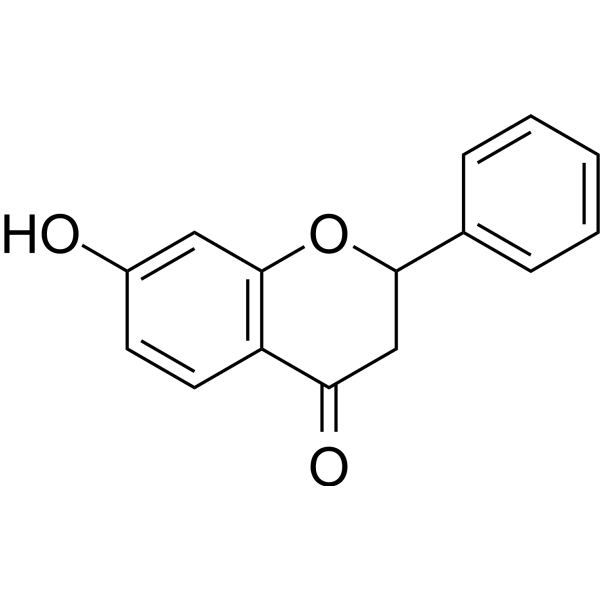
7-Hydroxyflavanone is an aromatase (CYP19) activity inhibitor found in plants with an IC50 of 65 μM, and it also possesses 20S proteasome inhibitory activity. 7-Hydroxyflavanone significantly inhibits primary humoral immunity to SRBC in mice and weakly suppresses DTH. 7-Hydroxyflavanone 1 attenuates Doxorubicin (HY-15142A)-induced oxidative stress, IL-6 inflammation, mitochondrial dysfunction, caspase 3/7 activation, apoptosis, and necrosis, and upregulates the PGC-1α/pAMPK/Beclin-1 autophagy-related pathway. 7-Hydroxyflavanone is extensively metabolized by various fungi, undergoing multiple structural modifications. 7-Hydroxyflavanone can be used in research related to Doxorubicin-induced cardiomyopathy and immune system diseases .
loading...
    loading...
Cat. No.: HY-163679
PROTAC ERα Degrader-9 is a dual-target degrader of estrogen receptor α (ERα) and aromatase (ARO/CYP19A), with a Ki value of 0.25 μM against human ERα and an IC50 value of 4.6 μM against human ARO. PROTAC ERα Degrader-9 degrades ERα and ARO via the ubiquitin-proteasome system, and inhibits the transcriptional activity of ERα and the enzymatic activity of ARO. PROTAC ERα Degrader-9 selectively inhibits cancer cell proliferation, induces cell cycle arrest, and triggers apoptosis. PROTAC ERα Degrader-9 exhibits antiproliferative activity and ERα-degrading activity against cancer cells carrying ERα mutations. PROTAC ERα Degrader-9 can be used in cancer-related research such as breast cancer .
loading...
    loading...
Cat. No.: HY-163944
CAS No.: 3081311-94-3
LL-K12-18 is a CDK12 kinase inhibitor and a dual-site molecular glue. LL-K12-18 inhibits human CDK12 with an IC50 value of 283.9 nM, and selectively degrades cyclin K via the ubiquitin-proteasome system by stabilizing the CDK12-DDB1 complex. LL-K12-18 downregulates DNA damage response genes, reduces the phosphorylation level of CTD Ser2 in RNA polymerase II, and modulates biomarkers such as ATM, RAD51, γ-H2AX and cleaved PARP, thereby effectively inducing apoptosis and inhibiting proliferation of breast cancer cells. LL-K12-18 exhibits high target selectivity and serves as a research tool for studies on triple-negative breast cancer .
loading...
    loading...
Cat. No.: HY-175527
ALK degrader 2 is an orally active ALK HyT degrader that degrades EML4-ALK levels (DC50 = 8 nM) and nucleophosmin (NPM)-ALK protein levels (DC50 = 102 nM). ALK degrader 2 mediates ALK degradation via the Hsp70 chaperone system and ubiquitin-proteasome pathway. ALK degrader 2 induces significant S-phase cell cycle arrest and apoptosis in H3122 cells. ALK degrader 2 shows anti-tumor activity in mice bearing H3122 xenografts. ALK degrader 2 can be used for the study of non-small cell lung cancer (NSCLC). (Pink: ALK ligand (HY-W754809), Blue: Hyt (HY-W013021), Black: Linker (HY-Y1760), ALK ligand-linker conjugate (HY-175528)) .
loading...
    loading...
Cat. No.: HY-175849
Research Areas:  

Cancer

ALK degrader 1 is a potent, hydrophobic tag (HyT)-based degrader that induces ubiquitin-proteasome system (UPS)-dependent EML4-ALK degradation (DC50 = 0.13 μM). ALK degrader 1 demonstrates potent ALK degradation and antiproliferative effects in ALK-dependent cell lines, while showing minimal cytotoxicity in ALK fusion-negative cells. ALK degrader 1 triggers cell cycle arrest at the G0/G1 phase and stimulates apoptosis. ALK degrader 1 not only facilitates efficient degradation of the ALK protein but also disrupts key downstream effectors, including the STAT3 signaling axis. ALK degrader 1 mediates robust EML4-ALK degradation in vivo. ALK degrader 1 can be used for ALK-related diseases research .
loading...
    loading...
Cat. No.: HY-180261
CAS No.: 3107761-81-6
Target:  

PROTACs mTOR PI3K Apoptosis

Research Areas:  

Cancer

GP262 is a PI3K/mTOR PROTAC degrader targeting PI3Kγ, PI3Kα and mTOR with DC50 values of 42.23 nM, 227.4 nM and 45.4 nM, respectively in MDA-MB-231 cells. GP262 induces degradation of p110α and p110γ with a DC50 of 227.4 and 42.23 nM. GP262 efficient modulates the PI3K/AKT/mTOR pathway, achieving degradation through the ubiquitin-proteasome system (UPS). GP262 also exhibits robust antiproliferative activity and induces apoptosis in vitro. GP262 exhibits tumor growth suppression capability and biosafety profile. GP262 can be used for leukemia and triple-negative breast cancer (TNBC) .
loading...
    loading...
Cat. No.: HY-181164
Research Areas:  

Infection

PROTAC BRD4 Degrader-43 is a BRD4 PROTAC degrader. PROTAC BRD4 Degrader-43 recruits the DCAF1-DDB1-Cul4A E3 ligase complex via a Vpr-derived peptide moiety to induce BRD4 ubiquitination and degradation through the ubiquitin-proteasome system. PROTAC BRD4 Degrader-43 exhibits potent HIV latency-reversing activity. PROTAC BRD4 Degrader-43 can be used for the research of HIV-1 latent infection . (Pink: BRD4 ligand (HY-13030); Blue: Cul4A-DDB1-DCAF1 ligand (HY-P11640); Black: conjugate of PEG linker + cell-penetrating peptide (HY-P2483))
loading...
    loading...
Cat. No.: HY-189213
Research Areas:  

Cancer

YZ-17 is a PROTAC degrader targeting PRMT5, with DC50 = 2.2 μM (HCC1806 cells). YZ-17 recruits CRBN E3 ligase and induces PRMT5 degradation through the ubiquitin-proteasome system, inhibiting PRMT5-mediated symmetric dimethylarginine modification. YZ-17 co-degrades the PRMT5 adaptor protein MEP50 via a CRBN-dependent mechanism. YZ-17 induces G1 phase cell cycle arrest and inhibits colony formation in cancer cells. YZ-17 exhibits antiproliferative activity in various cancer cells. YZ-17 shows antitumor efficacy in a triple-negative breast cancer xenograft mouse model. YZ-17 can be used for research on triple-negative breast cancer .
loading...
    loading...

