209 Results for "

proteasome system

" in MedChemExpress (MCE) Product Catalog:
Products (209)

209 Results for "proteasome system" in MCE Product Catalog:

Cat. No.: HY-168007
Target:  

p97

Research Areas:  

Neurological Disease Cancer

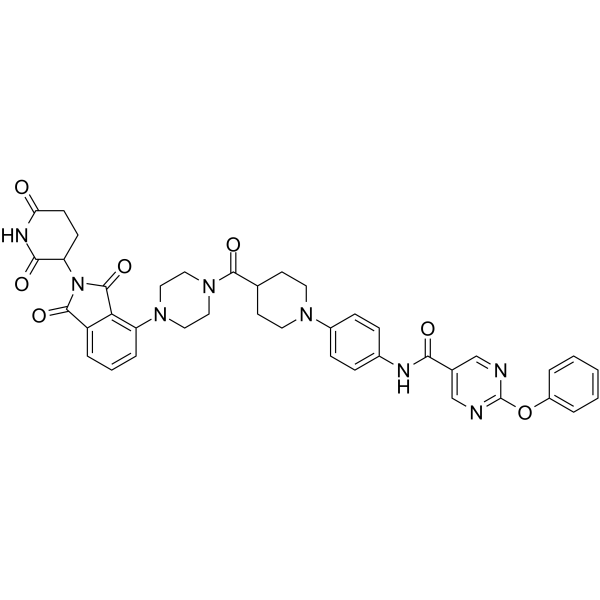
NSC804515 is an inhibitor of wild-type and R155H mutant p97/VCP ATPase, with an IC50 of about 15 nM for both targets. NSC804515 acts as an antiproliferative agent, disrupts the function of the ubiquitin-proteasome system, induces UbG76V-GFP accumulation, and shows reduced inhibitory potency against p97 variants carrying P510S, K512N, N616F and F618S mutations. NSC804515 can be used in research related to cancer, inclusion body myopathy with early-onset Paget's disease and frontotemporal dementia, as well as familial amyotrophic lateral sclerosis .
loading...
    loading...
Cat. No.: HY-174996
CAS No.: 3031840-36-2
Research Areas:  

Cancer

NEP162 is a BRD4 PROTAC degrader based on the E3 ubiquitin ligase GID4, with DC50 values of 1.2 μM and 1.6 μM in SW480 and U2OS cells, respectively, and a Kd value of 0.13 µM for GID4. NEP162 bridges the E3 ligase GID4 and BRD4 to form a ternary complex, promotes polyubiquitination and subsequent degradation of BRD4 via the ubiquitin-proteasome system, reduces the proliferation capacity of tumor cells and induces apoptosis. NEP162 can be used for research on cancers such as osteosarcoma, colorectal cancer and non-small cell lung cancer .
loading...
    loading...
Cat. No.: HY-178825A
Research Areas:  

Cancer

LD-110 triTFA is a PROTAC degrader targeting LSD1 with a DC50 of 0.44-1.24 μM. LD-110 triTFA acts through the CRBN E3 ubiquitin ligase and the ubiquitin-proteasome system, leading to H3K4me2 accumulation. LD-110 triTFA induces apoptosis and inhibits the growth and survival of multiple esophageal squamous cell carcinoma (ESCC) cell lines. LD-110 triTFA inhibits tumor growth in the KYSE-150 xenograft model. LD-110 triTFA can be used in research related to esophageal squamous cell carcinoma .
loading...
    loading...
Cat. No.: HY-183783
Target:  

PROTACs RET STAT ERK Apoptosis

Research Areas:  

Endocrinology Cancer

PROTAC RET Degrader 2 is a RET degrader with a target IC50 of 0.36 nM. PROTAC RET Degrader 2 is mainly composed of RET-IN-34 (HY-183729) and Thalidomide (HY-14658). PROTAC RET Degrader 2 mediates RET degradation via the ubiquitin-proteasome system. PROTAC RET Degrader 2 induces apoptosis, inhibits colony-forming ability, and exhibits antiproliferative activity in cancer cells. PROTAC RET Degrader 2 suppresses tumor growth in xenograft models. PROTAC RET Degrader 2 can be used in research related to medullary thyroid carcinoma, papillary thyroid carcinoma, and RET fusion-positive lung adenocarcinoma .
loading...
    loading...
Cat. No.: HY-184657
Target:  

Molecular Glues CDK

Research Areas:  

Cancer

CDK2 degrader 10 is an orally active, cereblon-based molecular glue degrader targeting CDK2, with a DC50 of 120 nM. CDK2 degrader 10 forms a ternary complex with cereblon and CDK2 via a non-canonical recruitment mode, thereby driving CDK2 degradation through the ubiquitin-proteasome system. CDK2 degrader 10 inhibits retinoblastoma protein phosphorylation, induces G1/S cell cycle arrest, and suppresses CDK2-dependent cell proliferation. CDK2 degrader 10 can be used in studies related to CDK2-dependent cancers .
loading...
    loading...
Cat. No.: HY-187533
Research Areas:  

Cancer

EGFR AUTOTAC-1 is a p62/SQSTM1-directed EGFR AUTOTAC degrader. EGFR AUTOTAC-1 recruits p62 to form a ternary complex, activates the ubiquitin-proteasome system-independent Atg5-dependent autophagy-lysosome pathway, mediates autophagic degradation of EGFR and inhibits the AKT/ERK signaling pathway, thereby promoting apoptosis and activating autophagy. EGFR AUTOTAC-1 can be used for the research of non-small cell lung cancer.(Pink: EGFR ligand (HY-79511); Blue: p62 ligand (HY-187557); Black: Linker)
loading...
    loading...
Cat. No.: HY-189293
Target:  

PARP

Research Areas:  

Cancer

PARP1 degrader-3 is a selective PARP1 degrader derived from Olaparib (HY-10162) bearing a bicyclo[1.1.1]pentane (BCP) hydrophobic tag. PARP1 degrader-3 degrades PARP1 with a DC50 of 4.31 μM. PARP1 degrader-3 induces PARP1 degradation primarily through the ubiquitin-proteasome system, and the HSP70/HSP90-associated protein quality control pathway may be involved in this process. PARP1 degrader-3 can be used for colorectal cancer-related research .
loading...
    loading...
Cat. No.: HY-139972
CAS No.: 2761281-50-7
Purity:  99.42%
PROTAC (H-PGDS)-7 is a selective, linker-free H-PGDS PROTAC degrader with a DC50 of 17.3 pM. PROTAC (H-PGDS)-7 binds to CRBN and forms a ternary complex with H-PGDS, inducing the degradation of H-PGDS via the ubiquitin-proteasome system through polyubiquitination and proteasomal degradation processes. PROTAC (H-PGDS)-7 inhibits the upregulated expression of TNFα, IL-1β, TGFβ1 and CD11b in mice with cardiac hypertrophy models. PROTAC (H-PGDS)-7 can be used in studies related to Duchenne muscular dystrophy and allergic diseases .
loading...
    loading...
Cat. No.: HY-170574
CAS No.: 3093767-34-8
Research Areas:  

Cancer

CQ627 is a molecular glue degrader of right open reading frame kinase 2 (RIOK2). CQ627 inhibits the ATPase activity of RIOK2 in MOLT-4 cells with an IC50 of 98 nM. By recruiting the E3 ubiquitin ligase RNF126, CQ627 promotes RIOK2 ubiquitination and induces its degradation via the ubiquitin-proteasome system (UPS), while inhibiting RIOK2-dependent mTOR/AKT signaling, suppressing cancer cell proliferation, and inducing G2/M cell cycle arrest and apoptosis. CQ627 can be used in studies related to RIOK2-targeted protein degradation and leukemia .
loading...
    loading...
Cat. No.: HY-173250
Target:  

PROTACs Ras Apoptosis

Research Areas:  

Cancer

YN14-H is a potent mutant KRAS G12C PROTAC degrader. The DC50 values of YN14-H in NCI-H358 and MIA PaCa-2 cells are 28.9 nM and 18.1 nM, respectively, with corresponding IC50 values of 42 nM and 21 nM. YN14-H degrades KRAS G12C in a ubiquitin-proteasome system-dependent manner, thereby significantly inducing apoptosis and inhibiting cell migration. YN14-H can be used for targeting tumors with KRAS G12C mutations (such as non-small cell lung cancer, pancreatic cancer, etc.) .
loading...
    loading...
Cat. No.: HY-175252
Research Areas:  

Cancer

PROTAC EGFR degrader 14 is a EGFR PROTAC degrader, with a DC50 of 2.9 nM against EGFR L858R/T790M/C797S. PROTAC EGFR degrader 14 forms a stable ternary complex by bridging the ATP-binding pocket of the target protein EGFR with VHL E3 ubiquitin ligase, induces efficient and specific degradation of EGFR mutants via the ubiquitin-proteasome system, and ultimately induces cell cycle arrest and apoptosis. PROTAC EGFR degrader 14 can be used in studies related to non-small cell lung cancer carrying the EGFR C797S drug-resistant mutation .
loading...
    loading...
Cat. No.: HY-175321
Research Areas:  

Cancer

PROTAC c-Met degrader-6 is an orally active c-Met PROTAC degrader with DC50 values of 0.52 nM (EBC-1) and 0.45 nM (Hs746T), respectively. PROTAC c-Met degrader-6 induces potent targeted degradation of c-Met via the ubiquitin-proteasome system by bridging the target protein c-Met and the Cullin-CRBN E3 ubiquitin ligase to form a ternary complex, thereby inducing tumor cell cycle arrest and apoptosis. PROTAC c-Met degrader-6 can be used in the research of various MET-driven cancers (such as gastric cancer, liver cancer, non-small cell lung cancer, etc.) .
loading...
    loading...
Cat. No.: HY-178322
Research Areas:  

Cancer

UNC10415667 is a non-competitive, non-prodrug NSD2 degrader with a DC50 of 460 nM in U2OS NSD2 HiBiT cells. UNC10415667 forms a reversible covalent hemithioacetal bond with Cys326 of FBXO22, promoting the formation of a ternary complex with FBXO22 and NSD2, which in turn triggers the polyubiquitination and degradation of NSD2 via the ubiquitin-proteasome system. UNC10415667 can form complexes with FBXO22, NSD2 and BACH1 simultaneously, driving the synchronized degradation of NSD2 and BACH1 without competition. UNC10415667 can be used in research related to multiple myeloma, acute lymphoblastic leukemia, and prostate cancer .
loading...
    loading...
Cat. No.: HY-187502
Target:  

JAK PROTACs RIP kinase

Research Areas:  

Others

Jak1 RIMTAC-1 is a JAK1 RIMTAC degrader (a PROTAC-like agent) with a DC50 of 322.8 nM. Jak1 RIMTAC-1 forms a ternary complex with JAK1 and RIPK1, thereby recruiting the VHL E3 ligase complex to ubiquitinate JAK1 via the ubiquitin-proteasome system and mediate its subsequent proteasomal degradation. Jak1 RIMTAC-1 does not alter JAK1 mRNA levels (pink: Jak1 ligand-1 (HY-187503); blue: RIPK1-ligand-4 (HY-187391); black: Linker (HY-B0704)) .
loading...
    loading...
Cat. No.: HY-156730R
CAS No.: 2502186-79-8
Research Areas:  

Cancer

KT-333 (Standard) is the analytical standard of KT-333 (HY-156730). This product is intended for research and analytical applications. KT-333 is a molecular glues that degrades STAT3 protein. KT-333 mediates the selective degradation of STAT3 through the ubiquitin-proteasome system by binding to STAT3 protein and E3 ubiquitin ligase von Hippel-Lindau protein (VHL). KT-333 has strong selectivity for STAT3 protein degradation and good antitumor activity. KT-333 can be used in the study of hematologic malignancies such as large granular lymphocytic leukemia (LGL-L), peripheral T-cell lymphoma (PTCL), and cutaneous T-cell lymphoma (CTCL) .
loading...
    loading...
Cat. No.: HY-161769
Research Areas:  

Cancer

HL435 is a BRD4 PROTAC degrader with DC50 values of 11.9 nM (MDA-MB-231 cells) and 21.9 nM (MCF-7 cells), respectively. HL435 recruits the CRL4DCAF11 E3 ubiquitin ligase complex to degrade BRD4 via the ubiquitin-proteasome system. HL435 induces cell cycle arrest and apoptosis (apoptosis) in cancer cells, downregulates the expression levels of cyclin D1 and cyclin B1, activates caspase-9, and induces PARP1 cleavage. HL435 exerts anti-tumor activity both in vitro and in mouse xenograft tumor models. HL435 can be used for the research of breast cancer and prostate cancer .
loading...
    loading...
Cat. No.: HY-161930
PROTAC GPX4 degrader-3 is a glutathione peroxidase 4 (GPX4) PROTAC degrader with a DC50 of 0.019 μM in HT1080 cells. PROTAC GPX4 degrader-3 degrades GPX4 primarily via the ubiquitin-proteasome system (UPS) in a dose- and time-dependent manner. PROTAC GPX4 degrader-3 induces lipid peroxidation (LPO) and ROS accumulation, thereby triggering ferroptosis (ferroptosis). PROTAC GPX4 degrader-3 exhibits in vitro anti-tumor activity against cancer cells. PROTAC GPX4 degrader-3 can be used in the research of fibrosarcoma, triple-negative breast cancer, and renal cell carcinoma .
loading...
    loading...
Cat. No.: HY-161989
CAS No.: 3105664-95-4
Target:  

PROTACs BCL6 PAK

Research Areas:  

Cancer

DZ-837 is a BCL6 PROTAC degrader with a DC50 of 557.7 nM. DZ-837 induces BCL6 ubiquitination and degradation in a CRBN-dependent manner via the ubiquitin-proteasome system. DZ-837 activates CDKN1A and CDKN1B, the downstream genes of BCL6. DZ-837 upregulates p21 and p27 proteins . DZ-837 inhibits tumor growth in a diffuse large B-cell lymphoma xenograft mouse model. DZ-837 exerts synergistic antiproliferative effects when combined with Ibrutinib (HY-10997). DZ-837 can be used in studies related to diffuse large B-cell lymphoma .
loading...
    loading...
Cat. No.: HY-162816
Research Areas:  

Cancer

PROTAC HPK1 Degrader-3 is an orally active, PROTAC degrader that selectively targets HPK1, with a DC50 of 21.26 nM. PROTAC HPK1 Degrader-3 induces HPK1 degradation via the ubiquitin-proteasome system and forms a stable ternary complex with HPK1 and CRBN. It inhibits the SLP76 and NF-κB signaling pathways, enhances MAPK signal transduction, reverses the immunosuppressive factor-mediated inhibition of T cell cytokine secretion, and promotes the secretion of T cell immune cytokines. PROTAC HPK1 Degrader-3 suppresses tumor growth and enhances anti-PD-L1-mediated antitumor activity. It can be used in studies related to malignant tumors, such as colorectal cancer .
loading...
    loading...
Cat. No.: HY-180561
CAS No.: 3076807-15-0
Research Areas:  

Cancer

WWQ-03-012 is a selective DESI2 inhibitor with an IC50 of 47.3 nM. WWQ-03-012 binds covalently to DESI2, blocks its enzymatic activity, and inhibits DESI2-mediated deSUMOylation, deubiquitination and stabilization of mutant JAK2, thereby promoting the complete degradation of mutant JAK2 via the intracellular ubiquitin-proteasome system and inducing apoptosis, while exerting no significant effect on wild-type JAK2. WWQ-03-012 can be used for research on myeloproliferative neoplasms (MPN) and secondary acute myeloid leukemia (sAML), especially for hematological malignancies carrying the JAK2-V617F mutation and those resistant to Ruxolitinib (HY-50856) .
loading...
    loading...

