
261 Results for "

aggregate

" in MedChemExpress (MCE) Product Catalog:
Products (261)

261 Results for "aggregate" in MCE Product Catalog:

Cat. No.: HY-P992451
Synonyms: KY1066
RLYB331 (KY1066) is a is a monoclonal antibody targeting Matriptase-2 (TMPRSS6) . RLYB331 binds to the serine protease active site of matriptase-2, blocking protease activity to increase hepcidin expression. RLYB331 reduces iron overload, inhibits α-aggregates, reduces ROS, inhibits apoptosis, and enhances erythroid differentiation. RLYB331 ameliorates ineffective erythropoiesis in β-thalassemic mouse models. RLYB331 can be used for the research of β-thalassemia .
loading...
    loading...
Cat. No.: HY-117710B
CAS No.: 1531586-64-7
AD-35 is an orally active, blood-brain barrier-permeable acetylcholinesterase inhibitor with an IC50 of 793 nM. AD-35 inhibits metal-induced amyloid-β aggregation and disassembles preformed amyloid-β aggregates. In rat models of cognitive impairment, AD-35 attenuates Aβ25-35-induced astrocyte activation, TNF-α and IL-1β release, inhibits ERK phosphorylation, and alleviates learning and memory deficits. AD-35 can be used for research on Alzheimer's disease .
loading...
    loading...
Cat. No.: HY-184602
Gold nanoclusters (AuNCs) are molecular-level aggregates consisting of a core of several to dozens of gold atoms, protected by organic monomers such as thiol compounds or proteins. GSH-AuNCs utilize glutathione (a thiol-containing tripeptide) as both a reducing agent and a protecting group, reacting chemically with gold atoms to form nanoclusters, representing a transitional state between metal atoms and metal nanoparticles. Due to size effects and the emergence of quantized energy levels, GSH-AuNCs possess unique optical properties, such as tunable fluorescence emission spectra. Their fluorescence emission wavelength can be tuned with variations in particle size and composition.
loading...
    loading...
Cat. No.: HY-184817
CAS No.: 2883627-63-0
α-Synuclein-IN-22 is an α-Synuclein inhibitor with an IC50 of 2.7 μM against human α-Syn. α-Synuclein-IN-22 exerts anti-aggregation effects by stabilizing the native conformation of α-Syn, inhibiting the formation of β-sheet aggregates and inclusion bodies, and dissociating mature fibrils into functional monomers. α-Synuclein-IN-22 scavenges ROS and shows low cytotoxicity. α-Synuclein-IN-22 can be used in research related to Parkinson's disease .
loading...
    loading...
Cat. No.: HY-184819
CAS No.: 2883627-56-1
α-Synuclein-IN-24 is an α-synuclein (α-Syn) aggregation inhibitor with an IC50 of 4.0 μM. α-Synuclein-IN-24 stabilizes the secondary conformation of α-synuclein monomers, inhibits β-sheet formation, reduces oligonucleation during the aggregation lag phase, dissociates preformed aggregates, and blocks reaggregation. α-Synuclein-IN-24 reduces α-synuclein inclusions in neuronal cells and scavenges ROS. α-Synuclein-IN-24 can be used for the research of Parkinson's disease .
loading...
    loading...
Cat. No.: HY-N12461
CAS No.: 5939-57-1
Cucurbitacin F is a tetracyclic protostane-type triterpenoid with low toxicity, antibacterial and anti-inflammatory activities, and is also a related compound of Cucurbitacin B (HY-N0416). Cucurbitacin F widely exists in plants such as Cucurbitaceae plants, Quisqualis indica and Sorbaria sorbifolia. Cucurbitacin F acts as an actin aggregator and reduces cell viability in a dose-dependent manner. Cucurbitacin F induces apoptosis by triggering G2/M phase cell cycle arrest and activating the caspase-3-dependent apoptosis .
loading...
    loading...
Cat. No.: HY-P3688A
Synonyms: Aβ (1-38) TFA; Aβ38 TFA
Target:  

Amyloid-β

Research Areas:  

Neurological Disease

β-Amyloid (1-38) (Aβ (1-38)) TFA is a β-Amyloid (Aβ) peptide. β-Amyloid (1-38) TFA interferes with the conversion of Aβ(1-42) to a β-sheet-rich aggregate. β-Amyloid (1-38)TFA reverses the negative impact of Aβ(1-42) on long-term potentiation in acute hippocampal slices and on membrane conductance in primary neurons, and mitigates an Aβ(1-42) phenotype in Caenorhabditis elegans .
loading...
    loading...
Cat. No.: HY-123745
CAS No.: 439932-74-8
Target:  

Amyloid-β

Research Areas:  

Neurological Disease

Aβ aggregation-IN-6 is an Aβ aggregation inhibitor with ~60-70% inhibition of Aβ17-40 aggregation. Aβ aggregation-IN-6 stabilizes Aβ dimer assembly, binds to Aβ steric-zipper assembly. Aβ aggregation-IN-6 can be used for the research of alzheimer's disease .
loading...
    loading...
Cat. No.: HY-149430
CAS No.: 2446054-34-6
Target:  

Amyloid-β

Research Areas:  

Neurological Disease

YIAD-0205 is an orally available Aβ(1?42) aggregation inhibitor. YIAD-0205 demonstrated in vivo efficacy in an AD transgenic mouse model with five familial AD mutations (5XFAD) .
loading...
    loading...
Cat. No.: HY-123366
CAS No.: 70386-06-0
Research Areas:  

Cardiovascular Disease

Y-590 is an orally active platelet cyclic adenosine monophosphate phosphodiesterase (cAMP-PDE) inhibitor with an IC50 of 0.9 nM against rabbit cAMP-PDE. Y-590 inhibits platelet aggregation, disaggregates aggregated platelets, suppresses collagen-induced platelet release, reduces platelet retention and inhibits cAMP degradation in platelets. Y-590 enhances PGI2-mediated elevation of intracellular cAMP in platelets and exerts a synergistic effect with PGI2 on ADP-induced platelet aggregation. Y-590 can be used in studies related to thrombotic diseases and thrombosis .
loading...
    loading...
Cat. No.: HY-147658
CAS No.: 1321361-13-0
AChE/BChE/BACE-1-IN-1 (Compound 4k) is an orally active inhibitor of AChE, BChE, and BACE-1 with IC50 values of 0.058, 0.082 and 0.115 μM against hAChE, hBChE and hBACE-1, respectively. AChE/BChE/BACE-1-IN-1 shows considerable PAS-AChE binding capability, excellent brain permeation, potential disassembly of Aβ aggregates, and neuroprotective activity against Aβ-induced stress. AChE/BChE/BACE-1-IN-1 has remarkable antioxidant potential .
loading...
    loading...
Cat. No.: HY-147659
CAS No.: 1877000-20-8
AChE/BChE/BACE-1-IN-2 (Compound 4o) is an orally active inhibitor of AChE, BChE, and BACE-1 with IC50 values of 0.069, 0.127 and 0.097 μM against hAChE, hBChE and hBACE-1, respectively. AChE/BChE/BACE-1-IN-2 shows considerable PAS-AChE binding capability, excellent brain permeation, potential disassembly of Aβ aggregates, and neuroprotective activity against Aβ-induced stress. AChE/BChE/BACE-1-IN-2 has remarkable antioxidant potential .
loading...
    loading...
Cat. No.: HY-174305
Target:  

Amyloid-β

Research Areas:  

Neurological Disease

Aβ42-IN-7 (Compound CT-01) is a brain-penetrant and selective amyloid-β42 (Aβ42) inhibitor. Aβ42-IN-7 inhibits Aβ42’s assembly into neurotoxic soluble oligomers and extracellular fibrillary aggregates. Aβ42-IN-7 exerts neuroprotective effects by reducing amyloid-mediated neuronal toxicity. Aβ42-IN-7 can be used in research on Alzheimer’s disease (AD) .
loading...
    loading...
Cat. No.: HY-B0512S1
CAS No.: 1196157-80-8
Synonyms: RP2632-13C6
Sulfamerazine- 13C6 (RP2632- 13C6) is 13C labeled Sulfamerazine (HY-B0512). Sulfamerazine (RP2632) is a brain-penetrant and orally active sulfonamide antibiotic and α-synuclein inhibitor with human α-synuclein KD of 352 μM. Sulfamerazine inhibits the synthesis of dihydrofolate by bacteria, thereby inhibiting bacterial growth. Sulfamerazine inhibits α-synuclein fibrillation, reduces α-synuclein aggregation-associated toxicity and α-synuclein aggregate accumulation. Sulfamerazine can be used for the research of Parkinson’s disease and bacterial infection .
loading...
    loading...
Cat. No.: HY-D3130
Target:  

Fluorescent Dye

Research Areas:  

Others

Mem-pH is a ratiometric fluorescent probe used for measuring vesicular pH. Mem-pH inserts into the plasma membrane bilayer and localizes to the vesicular lumen, switching between its basic and acidic forms via protonation during vesicular acidification to enable ratiometric pH readout. In aqueous media, Mem-pH forms non-emissive aggregates through aggregation-induced quenching, and then depolymerizes and recovers its fluorescent activity upon binding to the plasma membrane. The excitation/emission wavelengths of the basic form of Mem-pH are 405/450-550 nm, while those of the acidic form are 488/500-700 nm .
loading...
    loading...
Cat. No.: HY-NP009
CAS No.: 9051-29-0
α-Lactalbumin is a globular whey protein that exists in milk. α-Lactalbumin binds Ca 2+, Mg 2+, Mn 2+, Na +, K + and Zn 2+ ions; among these, Ca 2+ binding enhances protein stability, while Zn 2+ binding reduces stability and induces aggregation. α-Lactalbumin forms amyloid fibrils, amorphous aggregates, nanoparticles and nanotubes depending on external conditions. α-Lactalbumin exhibits bactericidal and antiviral activities. α-Lactalbumin has anxiolytic and antidepressant activities, and its effects are enhanced under stress conditions .
loading...
    loading...
Cat. No.: HY-P2260B
Target:  

HIV

Research Areas:  

Infection

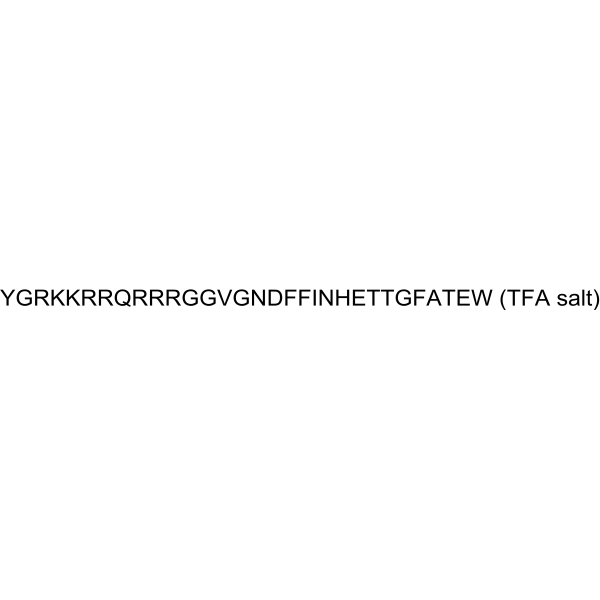
Tat-beclin 1 scrambled is the scrambled part and a scrambled control of Tat-beclin 1 (HY-P2260), which is derived from a region of the autophagy protein, beclin 1. beclin 1 induces autophagy via binding human immunodeficiency virus, HIV-1 Nef and interacting with negative regulator GAPR-1 (GLIPR2). Tat-beclin 1 decreases the accumulation of polyglutamine expansion protein aggregates and the replication of several pathogens, such as HIV-1. Tat-beclin 1 also reduces mortality in mice infected with chikungunya or West Nile virus .
loading...
    loading...
Cat. No.: HY-P2260C
Target:  

HIV

Research Areas:  

Infection

Tat-beclin 1 scrambled TFA is the scrambled part and a scrambled control of Tat-beclin 1 (HY-P2260), which is derived from a region of the autophagy protein, beclin 1. beclin 1 induces autophagy via binding human immunodeficiency virus, HIV-1 Nef and interacting with negative regulator GAPR-1 (GLIPR2). Tat-beclin 1 decreases the accumulation of polyglutamine expansion protein aggregates and the replication of several pathogens, such as HIV-1. Tat-beclin 1 also reduces mortality in mice infected with chikungunya or West Nile virus .
loading...
    loading...
Cat. No.: HY-117710A
CAS No.: 1531586-58-9
AD-35 free base is an orally active, blood-brain barrier-permeable acetylcholinesterase inhibitor with an IC50 of 793 nM. AD-35 free base inhibits metal-induced amyloid-β aggregation and disassembles preformed amyloid-β aggregates. In rat models of cognitive impairment, AD-35 free base attenuates Aβ25-35-induced astrocyte activation, TNF-α and IL-1β release, inhibits ERK phosphorylation, and alleviates learning and memory deficits. AD-35 free base can be used for research on Alzheimer's disease .
loading...
    loading...
Cat. No.: HY-125172
CAS No.: 300670-16-0
Synonyms: Polyglutamine Aggregation inhibitor III
Target:  

Huntingtin

Research Areas:  

Others

C2-8 is an inhibitor of polyglutamine (polyQ) aggregation (IC50s=25 and 0.05 μM for recombinant HDQ51 and in PC12 cells, respectively). It also inhibits polyQ aggregation in organotypic hippocampal slice cultures isolated from R6/2 transgenic mice and reduces neurodegeneration in a dose-dependent manner in a Drosophila model of Huntington's disease. C2-8 (100 and 200 mg/kg) reduces huntingtin aggregate size, reduces neuronal atrophy, and improves motor performance in a rotarod test in the R6/2 transgenic mouse model of Huntington's disease.
loading...
    loading...

