33 Results for "

electrical activity

" in MedChemExpress (MCE) Product Catalog:
Products (33)

33 Results for "electrical activity" in MCE Product Catalog:

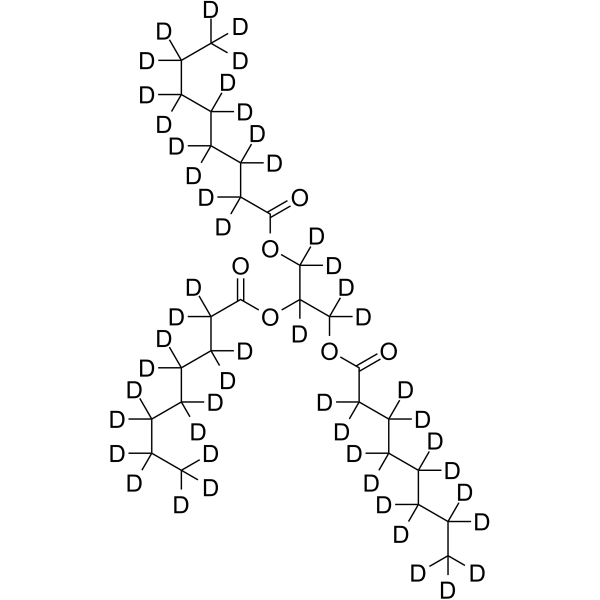
Cat. No.: HY-B1804S1
Synonyms: Trioctanoin-d50; Glyceryl trioctanoate-d50
Tricaprilin-d50 (Trioctanoin-d50) is the deuterium labeled Tricaprilin (HY-B1804). Tricaprilin is an orally active and well tolerated ketogenic agent that safely induces ketosis. Tricaprilin restores brain electrical activity and metabolism to help counteract neuroinflammation in migraine. Tricaprilin is promising for research of migraine prevention and Alzheimer’s disease (AD). Tricaprilin is a pure C8 medium chain triglyceride (MCT) .
loading...
    loading...
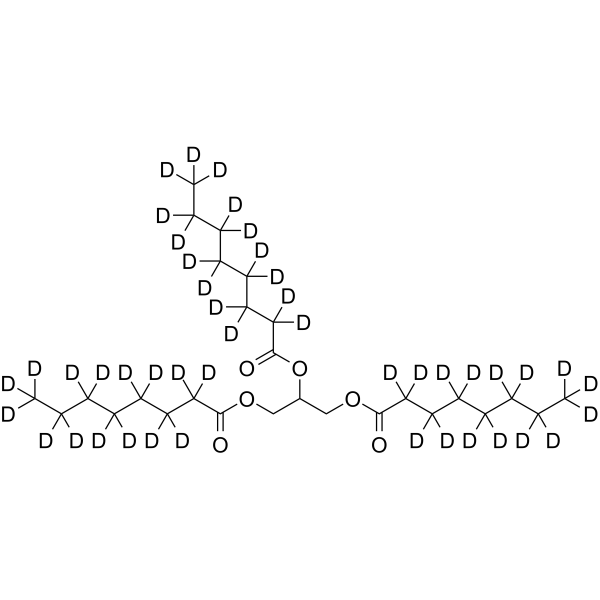
Cat. No.: HY-B1804S2
CAS No.: 352431-24-4
Synonyms: Trioctanoin-d15; Glyceryl trioctanoate-d15
Tricaprilin-d15 (Trioctanoin-d15) is the deuterium labeled Tricaprilin (HY-B1804). Tricaprilin is an orally active and well tolerated ketogenic agent that safely induces ketosis. Tricaprilin restores brain electrical activity and metabolism to help counteract neuroinflammation in migraine. Tricaprilin is promising for research of migraine prevention and Alzheimer’s disease (AD). Tricaprilin is a pure C8 medium chain triglyceride (MCT) .
loading...
    loading...
Cat. No.: HY-115375
CAS No.: 104860-61-9
Target:  

5-HT Receptor

Research Areas:  

Neurological Disease

50595 hydrochloride is a selective noncompetitive cisapride antagonist that interferes with the activity of cisapride and BRL 24924. R 50595 hydrochloride has no effect on the response to electrical stimulation at concentrations up to 3 X 10(-7) M. R 50595 hydrochloride antagonizes the effects of cisapride and BRL 24924 in a noncompetitive manner. R 50595 hydrochloride completely abolishes the effects of 5-HT at a concentration of 3 X 10(-7) M and also antagonizes the effects of 5-HT in a noncompetitive manner .
loading...
    loading...
Cat. No.: HY-183420
CAS No.: 151656-58-5
EXP631 is a centrally acting non-opioid analgesic that targets serotonin and norepinephrine transporters. EXP631 exhibits activity against acute pain induced by chemical stimuli, stress, and electrical stimulation. EXP631 blocks the reuptake of serotonin and norepinephrine. EXP631 can be used in research related to moderate to moderately severe acute and chronic pain .
loading...
    loading...
Cat. No.: HY-182831
CAS No.: 1432512-70-3
Target:  

Sodium Channel

Research Areas:  

Neurological Disease

Nav1.7-IN-22 (P58 13-2) is a selective inhibitor of voltage-gated sodium channel Nav1.7. Nav1.7-IN-22 inhibits abnormal electrical signal generation and conduction in sensory neurons by blocking Nav1.7 channel activity. Nav1.7-IN-22 can be used for the study of pain .
loading...
    loading...
Cat. No.: HY-184751
CAS No.: 58409-59-9
Research Areas:  

Cardiovascular Disease

Bucumolol is an orally active β-adrenergic receptor blocker. Bucumolol inhibits Renin release. Bucumolol exhibits activities including local anesthesia, antiarrhythmia, antihypertension, heart rate reduction, negative inotropy, cardiac action potential inhibition, and action potential duration shortening. Bucumolol does not increase cardiac electrical threshold, prolong atrial refractory period, or affect body weight in rodents. Bucumolol can be used in research related to arrhythmia and hypertension .
loading...
    loading...
Cat. No.: HY-L186
54 compounds

Neurotransmitters are chemical messengers that allows a neuron's electrical signal to pass to a postsynaptic neuron or effect target. Neurotransmitters include amino acids, monoamines, and peptides, while other neurotransmitters are composed of metabolites such as nitric oxide and carbon monoxide. The function of neurotransmitters is closely related to the disease of life, helping to regulate the body's heartbeat, blood pressure, breathing, sleep, aging and muscle activity. Therefore, research based on neurotransmitters can help to increase human understanding of diseases.

MCE collects and organizes 54 neurotransmitters and is a tool library for drug screening and mechanism research.

Cat. No.: HY-W714853
CAS No.: 65732-07-2
(+)-Theta-cypermethrin is a stereoisomer of Cypermethrin (HY-B0829) that possesses blood-brain barrier penetration ability and binds to AKT1, SRC, STAT3 and EGFR with high affinity. (+)-Theta-cypermethrin reduces the amplitude of delayed rectifier potassium channel currents, shifts the steady-state activation curve to negative potentials, and shifts the steady-state inactivation curve to negative potentials at higher concentrations. (+)-Theta-cypermethrin induces abnormal electrical activity in rat hippocampal neurons. (+)-Theta-cypermethrin causes chronic respiratory system damage and exhibits neurotoxicity .
loading...
    loading...
Cat. No.: HY-133240
CAS No.: 1109241-72-6
trans-AzoTAB is a photoresponsive potassium/sodium/calcium channel modulator and DNA-binding agent. trans-AzoTAB undergoes trans-cis isomerization driven by light, with variable polarity and DNA affinity. trans-AzoTAB also enhances voltage-gated potassium currents and inhibits sodium and calcium currents in cardiomyocytes, thereby reducing spontaneous electrical activity and excitation conduction velocity. In addition, trans-AzoTAB induces compaction and frozen conformation of λ-phage DNA, and non-sequence-dependently inhibits transcription and translation processes in the dark; its activity can be reversed and restored by visible light after activation with ultraviolet irradiation. trans-AzoTAB can serve as a probe for two-photon optical regulation of myocardial excitability, and is used to construct photoresponsive interfacial polymer structures .
loading...
    loading...
Cat. No.: HY-182563
CAS No.: 72732-17-3
Target:  

Opioid Receptor

Research Areas:  

Endocrinology

Tyr-Ala-N-(1,3-dimethylbutyl)glycinamide is a μ/δ opioid receptor ligand with high μ opioid receptor selectivity and agonist activity. Tyr-Ala-N-(1,3-dimethylbutyl)glycinamide has an IC50 of 237 nM for μ receptors and 1050 nM for δ receptors. Tyr-Ala-N-(1,3-dimethylbutyl)glycinamide shows Ki values of 17 nM for μ receptors and 480 nM for δ receptors. Tyr-Ala-N-(1,3-dimethylbutyl)glycinamide inhibits electrically evoked contractions of guinea pig ileum and mouse vas deferens. Tyr-Ala-N-(1,3-dimethylbutyl)glycinamide serves as a starting compound for structure-activity relationship investigations of μ receptor recognition .
loading...
    loading...
Cat. No.: HY-A0236AR
CAS No.: 33237-74-0
Aprindine hydrochloride (Standard) is the analytical reference standard of Aprindine hydrochloride (HY-A0236A). This product is used for research and analytical applications. Aprindine hydrochloride is an Ib-class anti-arrhythmic agent. Aprindine hydrochloride mainly exerts its effect by blocking sodium channels (INa), thereby reducing the excitability and conduction velocity of cardiac muscle cells. Aprindine hydrochloride significantly inhibits delayed potassium currents, which helps to prolong the atrial effective refractory period (AERP) and inhibit the occurrence of atrial fibrillation. Aprindine hydrochloride can also regulate intracellular calcium ion concentration by inhibiting Na +/Ca 2+ exchange current (INCX), thereby further stabilizing cardiac electrical activity. Aprindine hydrochloride can be used for the study of atrial fibrillation (AF) and ventricular arrhythmias.
loading...
    loading...
Cat. No.: HY-D3146
CAS No.: 1418017-91-0
Target:  

Fluorescent Dye

Research Areas:  

Others

Di-4-AN (F) EPPTEA is a voltage-sensitive dye used for membrane potential imaging and optical recording of electrical activity in excitable cells and tissues. Its detection mechanism is based on electrochromism (also known as the molecular Stark effect). The single-photon excitation/emission wavelengths measured in ethanol solution are Ex/Em = 444/610 nm, and it can be excited via 1064 nm two-photon excitation in optical recording applications. Di-4-AN (F) EPPTEA can be used to record backpropagating action potentials in individual dendritic spines of brain cortical slices, map subcellular action potential characteristics of single cardiomyocytes, and perform real-time recording of multicellular action potentials in cerebellar slices .
loading...
    loading...
Cat. No.: HY-108511R
CAS No.: 172907-03-8
PB28 dihydrochloride (Standard) is the analytical standard of PB28 (dihydrochloride) (HY-108511). This product is intended for research and analytical applications. PB28 dihydrochloride, a cyclohexylpiperazine derivative, is a high affinity and selective sigma 2 (σ2) receptor agonist with a Ki of 0.68 nM. PB28 dihydrochloride is also a σ1 antagonist with a Ki of 0.38 nM. PB28 dihydrochloride is less affinity for other receptors. PB28 dihydrochloride inhibits electrically evoked twitch in guinea pig bladder and ileum with EC50 values of 2.62 μM and 3.96 μM, respectively. PB28 dihydrochloride can modulate SARS-CoV-2-human protein-protein interaction. PB28 dihydrochloride induces caspase-independent apoptosis and has antitumor activity .
loading...
    loading...

