40 Results for "

MRI

" in MedChemExpress (MCE) Product Catalog:
Products (40)

40 Results for "MRI" in MCE Product Catalog:

Cat. No.: HY-141411B
Synonyms: (R)-MRI-1867
Research Areas:  

Others

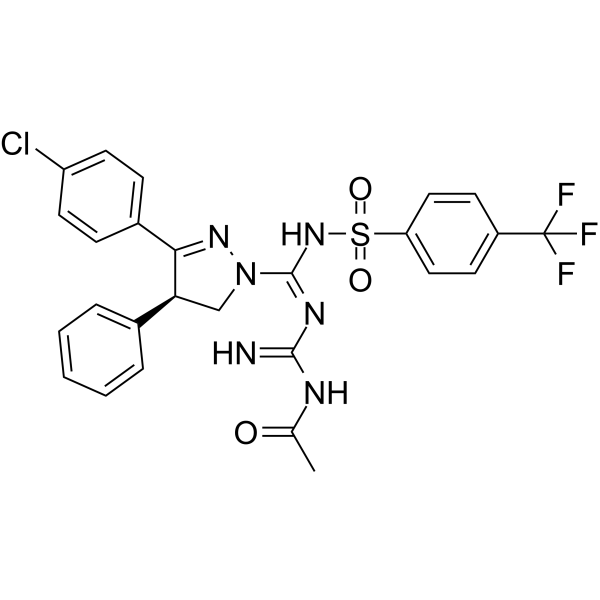
(R)-Zevaquenabant ((R)-MRI-1867) is the enantiomer of Zevaquenabant (HY-141411A). Zevaquenabant ((S)-MRI-1867) is a peripherally restricted, orally bioavailable dual cannabinoid CB1 receptor and inducible NOS antagonist. Zevaquenabant ameliorates obesity-induced chronic kidney disease (CKD) .
loading...
    loading...
Cat. No.: HY-RS08653
Research Areas:  

Others

MRI1 Human Pre-designed siRNA Set A contains three designed siRNAs for MRI1 gene (Human), as well as a negative control, a positive control, and a FAM-labeled negative control.

loading...
    loading...
Cat. No.: HY-153800A
CAS No.: 2765579-76-6
Synonyms: (R)-MRI-1891; (R)-INV-202
Target:  

Cannabinoid Receptor

Research Areas:  

Metabolic Disease

(R)-Monlunabant ((R)-MRI-1891) is a CB1 receptor mediators for research of obesity and metabolic disease
loading...
    loading...
Cat. No.: HY-RS28987
Research Areas:  

Others

Cyren Rat Pre-designed siRNA Set A contains three designed siRNAs for Cyren gene (Rat), as well as a negative control, a positive control, and a FAM-labeled negative control.
loading...
    loading...
Cat. No.: HY-RS22464
Research Areas:  

Others

Cyren Mouse Pre-designed siRNA Set A contains three designed siRNAs for Cyren gene (Mouse), as well as a negative control, a positive control, and a FAM-labeled negative control.

loading...
    loading...
Cat. No.: HY-RS03490
Research Areas:  

Others

CYREN Human Pre-designed siRNA Set A contains three designed siRNAs for CYREN gene (Human), as well as a negative control, a positive control, and a FAM-labeled negative control.

loading...
    loading...
Cat. No.: HY-115853A
Research Areas:  

Others

Pyclen dihydrochloride forms kinetically and thermodynamically stable nine-coordinate Ln (III) complexes, as well as Mn (II)-based MRI contrast agents. Pyclen-Based Mn(II) Complexes can be used for liver-specific MRI .
loading...
    loading...
Cat. No.: HY-173383
Synonyms: 1,2-dioleoyl-sn-glycero-3-phosphoethanolamine-N- tetraazacyclododecane-N-tetraacetic acid, sodium salt
DOPE-DOTA sodium is a chelated lipid that serves as a key contrast agent in magnetic resonance imaging (MRI). DOPE-DOTA sodium can be used for cancer, blood-brain barrier disruption, abnormalities such as aneurysms or plaque buildup, inflammation in arthritis, and liver function and lesions study
loading...
    loading...
Cat. No.: HY-173384
Synonyms: 1,2-distearoyl-sn-glycero-3-phosphoethanolamine-N- tetraazacyclododecane-N-tetraacetic acid, sodium salt
DSPE-DOTA sodium (1,2-distearoyl-sn-glycero-3-phosphoethanolamine-N- tetraazacyclododecane-N-tetraacetic acid, sodium salt) is a chelating lipid used as a key contrast agent in magnetic resonance imaging (MRI). DSPE-DOTA sodium can be used for imaging detection of tumors, neurological and inflammatory diseases .
loading...
    loading...
Cat. No.: HY-164981
CAS No.: 1703752-99-1
Target:  

Drug Intermediate

Research Areas:  

Cancer

p-SCN-Bn-DOTA(tBu)4 is the derivative of DOTA (HY-W053583). p-SCN-Bn-DOTA(tBu)4 is the component of the Gd(III)-DOTA-IAC, which is a targeted magnetic resonance imaging (MRI) contrast agent for αvβ3 integrin receptor .
loading...
    loading...
Cat. No.: HY-129242S1
CAS No.: 36763-53-8
Synonyms: 4-Oxo-Tempo-d16
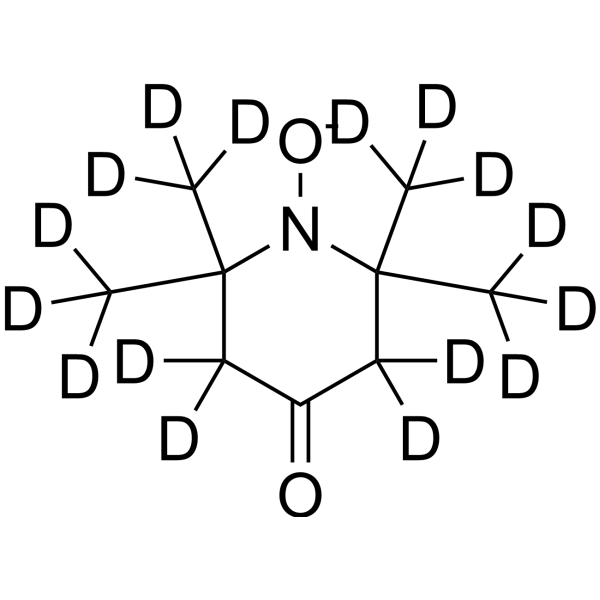
Tempone-d16 (4-Oxo-Tempo-d16) is the deuterated-labeled Tempone (HY-129242). Tempone (4-Oxo-Tempo) is a nitroxide radical spin label and ROS scavenger. Tempone induces cytotoxicity in lymphoma cells. Tempone serves as a substrate for intracellular reduction to hydroxylamine, rapidly equilibrates between intracellular and extracellular compartments, reduces nitroxide radical spin labels at the ubiquinol site of the respiratory chain, and acts as an alternative terminal electron acceptor when electron flow to oxygen is blocked. Tempone serves as a superoxide sensor, a T2-weighted MRI contrast agent, and a dynamic nuclear polarization polarizing agent for 13C. Tempone inhibits superoxide and peroxynitrite, hydroxyl radical generation, nitrotyrosine formation, and poly (ADP-ribose) formation, and alleviates renal dysfunction and injury in ischemia/reperfusion and hydrogen peroxide-induced injury. Tempone can be used for research on ischemia-reperfusion injury, acute renal failure, and lymphoma .
loading...
    loading...
Cat. No.: HY-115853B
CAS No.: 129135-03-1
Research Areas:  

Others

Pyclen sulfate forms kinetically and thermodynamically stable nine-coordinate Ln (III) complexes, as well as Mn (II)-based MRI contrast agents. Pyclen-Based Mn(II) Complexes can be used for liver-specific MRI .
loading...
    loading...
Cat. No.: HY-P88451
Synonyms: MRDI; MTNA; Ypr118w

Host:  

Mouse

Application:  

WB, IHC-P, ICC/IF, FC

Reactivity:  

Human, Mouse, Rat

loading...
    loading...
Cat. No.: HY-P88451A
Synonyms: MRDI; MTNA; Ypr118w

Host:  

Mouse

Application:  

WB, IHC-P, ICC/IF, FC

Reactivity:  

Human, Mouse, Rat

loading...
    loading...
Cat. No.: HY-184647
Target:  

Metal Nanoparticles

Research Areas:  

Others

Citrate-modified ferric oxide nanoparticles are functionalized nanoparticles formed by attaching citric acid to the surface of Fe3O4 nanoparticles. Due to their excellent biocompatibility and stability, Citrate-modified ferric oxide nanoparticles can be used as drug carriers for drug delivery and contrast enhancement in magnetic resonance imaging (MRI).
loading...
    loading...
Cat. No.: HY-106594BR
CAS No.: 12240-15-2
Synonyms: Pigment blue 27 (Standard)
Prussian blue soluble (Standard) is the analytical standard of Prussian blue soluble (HY-106594B). This product is intended for research and analytical applications. Prussian blue soluble is a good adsorbent to be used as antidotes for poisoning with cesium or thallium ions. Prussian blue soluble has anticancerous and antibacterial properties. Prussian blue soluble can be used as a contrast agent in photoacoustic and magnetic resonance imaging (MRI) .
loading...
    loading...
Cat. No.: HY-P11850
CAS No.: 1192023-11-2
Research Areas:  

Cancer

PTP peptide is a specific Plectin-1 binder. PTP peptide can serve as a component of imaging agents; when conjugated with magnetofluorescent nanoparticles, it enables the detection of small pancreatic ductal adenocarcinomas and precancerous lesions via in vivo confocal microscopy and MRI. When conjugated with imaging agents, PTP peptide specifically targets pancreatic ductal adenocarcinoma cells, and can be used for tumor visualization and compound delivery. PTP peptide is applicable to research related to pancreatic ductal adenocarcinoma .
loading...
    loading...
Cat. No.: HY-W007656R
CAS No.: 294-90-6
Cyclen (Standard) is the analytical standard substance of Cyclen. This product is used for research and analytical applications. Cyclen is a macrocyclic tetrathiolate chelating agent. Cyclen is a nitrogen-containing analogue of crown ethers and can be used as a precursor for MRI contrast agents, as well as an intermediate for preparing highly efficient macrocyclic chelates. As a structural regulator, Cyclen can be prepared into polyamide nanofiltration membranes with efficient Li +/Mg 2+ separation performance through the interfacial polymerization of polyethyleneimine (PEI) and meta-benzotriazole chloride (TMC). Cyclen has a unique cavity structure and exhibits selective coordination properties for Li + ions .
loading...
    loading...
Cat. No.: HY-D3429
CAS No.: 2700202-84-0
Shiga-Y51 is a molecular probe that can cross the blood-brain barrier and selectively bind Aβ oligomers. Shiga-Y51 can be imaged based on fluorine-19 nuclear magnetic resonance imaging ( 19F-MRI) technology. Shiga-Y51 exhibits extremely strong binding affinity for early to intermediate Aβ oligomers, while having almost no affinity for mature Aβ fibrils. Shiga-Y51 is a derivative of Curcumin (HY-N0005) and can inhibit the binding of Curcumin to Aβ oligomers with an IC50 of 34.61 µM. Shiga-Y51 can be used in research related to Alzheimer's disease .
loading...
    loading...
Cat. No.: HY-184620
Ferric oxide (Fe3O4) is widely used in magnetic resonance imaging (MRI), magnetic separation, targeted drug delivery, tumor hyperthermia, cell labeling and separation, and as a contrast agent and enhancement agent in retinal detachment repair surgery due to its stable material properties, good biocompatibility, high strength, and lack of toxic side effects. It is also used as a catalyst carrier, microwave absorbing material, and magnetic recording material. Xianfeng has developed numerous derivatives of ferric oxide, including oleic acid-modified ferric oxide, PEG-terminated ferric oxide, DMSA-modified ferric oxide, polylysine-modified ferric oxide, carboxylated dextran-modified ferric oxide nanoparticles, streptavidin-modified ferric oxide particles, thiol-modified ferric oxide magnetic nanoparticles, and polyethyleneimine (PEI)-modified magnetic ferric oxide nanoparticles, among others. This wide range of modifications provides numerous options for subsequent experiments.
loading...
    loading...

