31 Results for "

TRPV3

" in MedChemExpress (MCE) Product Catalog:
Products (31)

31 Results for "TRPV3" in MCE Product Catalog:

  • Categories Recommended:
    More
Cat. No.: HY-B0364AR
CAS No.: 536-43-6
Synonyms: Dyclocaine hydrochloride (Standard)
Dyclonine hydrochloride (Standard) (Dyclocaine hydrochloride (Standard)) is the analytical standard of Dyclonine hydrochloride (HY-B0364A). This product is intended for research and analytical applications. Dyclonine hydrochloride (Dyclocaine hydrochloride) is an orally active, blood-brain barrier-permeable piperidine phenylacetone small molecule commonly used as a local anesthetic. Dyclonine hydrochloride acts as a highly selective allosteric antagonist of TRPV3; it also reversibly inhibits G9a, ALDH2 and ALDH3A1, non-competitively blocks AChE. Dyclonine hydrochloride activates the Nrf2/ARE pathway, relieves the epigenetic silencing of FXN, blocks Aβ42 aggregation, and promotes remyelination and reparative polarization of microglia. Dyclonine hydrochloride alleviates pruritus via TRPV3 inhibition; it is used in studies of neurodegenerative disease models based on its AChE inhibitory, antioxidant and remyelinating effects; it sensitizes drug-resistant tumors through ALDH inhibition, and combined use with protease inhibitors induces more tumor cell apoptosis; it inhibits Candida albicans in vitro. Dyclonine hydrochloride can be used for research on multiple diseases including neurodegenerative diseases, cancer and pruritic dermatitis [3] .
loading...
    loading...
Cat. No.: HY-B0364AS
Synonyms: Dyclocaine-d9 hydrochloride
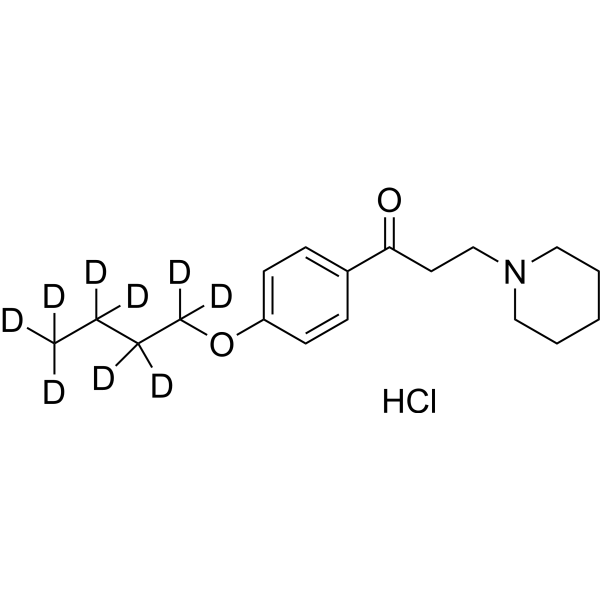
Dyclonine-d9 hydrochloride (Dyclocaine-d9 hydrochloride) is the deuterated-labeled Dyclonine hydrochloride (HY-B0364A). Dyclonine hydrochloride (Dyclocaine hydrochloride) is an orally active, blood-brain barrier-permeable piperidine phenylacetone small molecule commonly used as a local anesthetic. Dyclonine hydrochloride acts as a highly selective allosteric antagonist of TRPV3; it also reversibly inhibits G9a, ALDH2 and ALDH3A1, non-competitively blocks AChE. Dyclonine hydrochloride activates the Nrf2/ARE pathway, relieves the epigenetic silencing of FXN, blocks Aβ42 aggregation, and promotes remyelination and reparative polarization of microglia. Dyclonine hydrochloride alleviates pruritus via TRPV3 inhibition; it is used in studies of neurodegenerative disease models based on its AChE inhibitory, antioxidant and remyelinating effects; it sensitizes drug-resistant tumors through ALDH inhibition, and combined use with protease inhibitors induces more tumor cell apoptosis; it inhibits Candida albicans in vitro. Dyclonine hydrochloride can be used for research on multiple diseases including neurodegenerative diseases, cancer and pruritic dermatitis [3] .
loading...
    loading...
Cat. No.: HY-125527AS
Synonyms: 17(R)-RvD1-d5; AT-RvD1-d5
17(R)-Resolvin D1-d5 (17(R)-RvD1-d5) is deuterium labeled 17(R)-Resolvin D1. 17R-Resolvin D1 (17R-RvD1; AT-RvD1) is an aspirin-triggered epimer of Resolvin D1, which exhibits anti-inflammatory activity in mice and human PMNs cells . 17R-Resolvin D1 specificially inhibits TRPV3 with an IC50 of 398 nM and exhibits peripheral anti-nociceptive efficacy .
loading...
    loading...
Cat. No.: HY-B1239A
CAS No.: 1679-76-1
Synonyms: Cycloadiphene; Hexahydroadiphenine
Drofenine (Cycloadiphene; Hexahydroadiphenine) is an brain-penetrant antispasmodic agent. Drofenine is a Kv2.1 channel inhibitor with human IC50 of 9.53 μM. Drofenine is a butyrylcholinesterase (BChE) inhibitor with Ki of 0.003 mM, and is a TRPV3 activator. Drofenine blocks Kv2.1-dependent potassium efflux, inhibits Kv2.1/JNK/NF-κB and IkBa/NF-kB signaling, suppresses Kv2.1 mRNA/protein expression. Drofenine suppresses oligomeric Aβ-induced microglial NLRP3 inflammasome activation and neuronal Tau hyperphosphorylation, improves cognitive impairment, promotes neurite outgrowth. Drofenine induces calcium influx in keratinocytes and exert cytotoxicity against keratinocytes. Drofenine ameliorates diabetic peripheral neuropathy -like pathology. Drofenine can be used for the researches of Alzheimer's disease, diabetic peripheral neuropathy and smooth muscle spasm [3] .
loading...
    loading...
Cat. No.: HY-P702477
Purity:  ≥ 90%, as determined by reducing SDS-PAGE.
Synonyms: TRPV3; Transient receptor potential cation channel subfamily V member 3; TRPV3; Vanilloid receptor-like 3; VRL-3; OLMS; OLMS1; Transient Receptor Potential Cation Channel, Subfamily V, Member 3; FNEPPK2; Vanilloid Receptor-Related Osmotically Activated Ch
Species:  
Human
Source:  
E. coli Cell-free
loading...
    loading...
Cat. No.: HY-153275A
CAS No.: 2682864-43-1
Synonyms: (S)-KM-001
Target:  

Drug Isomer

Research Areas:  

Others

(S)-KM-001 ((S)-KM-001) is the enantiomer of KM-001 (HY-153275). KM-001 is a TRPV3 channel antagonist and can be used for studying skin itching and keratinosis diseases .
loading...
    loading...
Cat. No.: HY-186172
CAS No.: 1689577-22-7
Research Areas:  

Metabolic Disease

KS0365 is a selective TRPV3 agonist with an EC50 of 5.08 μM. KS0365 does not activate TRPV2 or TRPV4 channels. KS0365 triggers an increase in [Ca 2+]i and accelerates keratinocyte migration. KS0365 can be used in studies related to impaired skin wound healing .
loading...
    loading...
Cat. No.: HY-184776
CAS No.: 586-60-7
Synonyms: Dyclocaine
Dyclonine (Dyclocaine) is an orally active, blood-brain barrier-permeable piperidine phenylacetone small molecule commonly used as a local anesthetic. Dyclonine acts as a highly selective allosteric antagonist of TRPV3; it also reversibly inhibits G9a, ALDH2 and ALDH3A1, non-competitively blocks AChE. Dyclonine activates the Nrf2/ARE pathway, relieves the epigenetic silencing of FXN, blocks Aβ42 aggregation, and promotes remyelination and reparative polarization of microglia. Dyclonine alleviates pruritus via TRPV3 inhibition; it is used in studies of neurodegenerative disease models based on its AChE inhibitory, antioxidant and remyelinating effects; it sensitizes drug-resistant tumors through ALDH inhibition, and combined use with protease inhibitors induces more tumor cell apoptosis; it inhibits Candida albicans in vitro. Dyclonine can be used for research on multiple diseases including neurodegenerative diseases, cancer and pruritic dermatitis [3] .
loading...
    loading...
Cat. No.: HY-184973
CAS No.: 887-15-0
Synonyms: DPTHF
2,2-Diphenyltetrahydrofuran (DPTHF) acts as a TRPV3 channel antagonist and is a structural analog of 2-Aminoethyl diphenylborinate (HY-W009724). 2,2-Diphenyltetrahydrofuran shows weak inhibitory activity against TRPV1 and TRPV2. It reduces hedonic feeding in mice exposed to Olanzapine (HY-14541). 2,2-Diphenyltetrahydrofuran can be used in the research of nervous system-related diseases .
loading...
    loading...
Cat. No.: HY-N22000
CAS No.: 14379-32-9
N-Stearoyl valine is an N-acyl derivative of valine. N-Stearoyl valine antagonizes intracellular calcium mobilization by binding to the TRPV3 channel as a bioactive endogenous ligand of transient receptor potential (TRP) channels. N-Stearoyl valine participates in physiological processes such as lipid metabolism and cell signal transduction as an endogenous metabolite. N-Stearoyl valine is also a flavor compound. N-Stearoyl valine can be used in research on biomarker detection, animal nutrition and amino acid metabolism, and the development of the food and beverage industry [3] .
loading...
    loading...
Cat. No.: HY-104059R
CAS No.: 1470018-52-0
AMG2850 (Standard) is the analytical standard of AMG2850 (HY-104059). This product is intended for research and analytical applications. AMG2850 is an orally active, blood-brain barrier-permeable selective TRPM8 competitive antagonist. AMG2850 abolishes the counterirritant effect of TRPM8 agonists, blocks TRPM8 activation induced by cold, (-)-Menthol (HY-75161) and Icilin (HY-11062), and exhibits selectivity over TRPA1, TRPV1, TRPV3 and TRPV4. AMG2850 is applicable for pain-related research [3] .
loading...
    loading...

