53 Results for "

bioanalysis platform

" in MedChemExpress (MCE) Product Catalog:
Products (53)

53 Results for "bioanalysis platform" in MCE Product Catalog:

Cat. No.: HY-D2846
m-PEG-PEI800-Cy5 is a fluorescent dye composed of CY5 (HY-D0821), methoxypolyethylene glycol (mPEG), and polyethyleneimine (PEI). m-PEG-PEI8800-Cy5 is used for gene delivery, nanodrug delivery, cell imaging and biosensing and bioanalysis (Ex/Em = 633/670 nm).
loading...
    loading...
Cat. No.: HY-E70419
CAS No.: 81669-60-5
Target:  

Others

Research Areas:  

Others

PQQ-Dependent glucose dehydrogenase, microorganismyes PQQnovel nanostructure platform for fluorescence analysis of glucose dehydrogenase-dependent glycogenase. Fluorescence signals were generated under ultraviolet excitation at a wavelength (365 nm).
loading...
    loading...
Cat. No.: HY-Y1366R
CAS No.: 116-09-6
Hydroxyacetone is a dehydration product of glycerol. Hydroxyacetone is a platform for the electrocatalytic synthesis of acetone, 1,2-propanediol and 2-propanol. Hydroxyacetone can also be used as a glycerol substitute for electrocatalytic hydrogenation and hydrodeoxygenation processes .
loading...
    loading...
Cat. No.: HY-D2846A
m-PEG2000-PEI2000-Cy5 is a fluorescent dye composed of CY5 (HY-D0821), methoxypolyethylene glycol (mPEG), and polyethyleneimine (PEI). m-PEG2000-PEI2000-Cy5 is used for gene delivery, nanodrug delivery, cell imaging and biosensing and bioanalysis (Ex/Em=633/670 nm).
loading...
    loading...
Cat. No.: HY-W342243
CAS No.: 526-91-0
Research Areas:  

Others

D-Xylonic acid is a bio-based platform chemical that acts as a water reducer and dispersant for cement, and also serves as a precursor for 1,4-butanediol, 1,2,4-butanetriol, copolyamides, and 3,4-dihydroxybutyrate .
loading...
    loading...
Cat. No.: HY-115692
CAS No.: 1887057-34-2
2-Coumaranone-1-L serves as a chemiluminescent probe. Under alkaline conditions and in the presence of oxygen, 2-Coumaranone-1-L is capable of undergoing chemiluminescence, which enables its application as a chemiluminescent substrate in biochemical assays. 2-Coumaranone-1-L exhibits its maximum emission wavelength at 442 nm. 2-Coumaranone-1-L is utilized in research within the realm of bioanalysis .
loading...
    loading...
Cat. No.: HY-148880
CAS No.: 2874203-49-1
Purity:  95.06%
Target:  

Ligands for E3 Ligase

Research Areas:  

Cancer

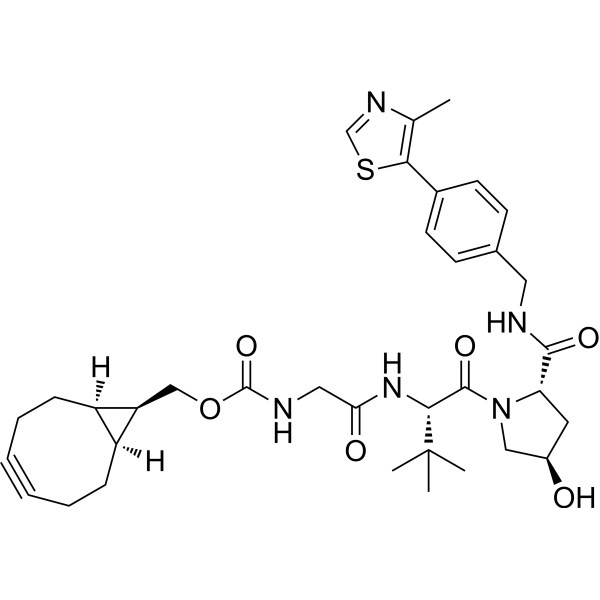
VHLL-BCN is a ligand targeting the VHL E3 ligase, which can be used for the synthesis of PROTAC molecules. As a key component of the copper-free SPAAC-based rapid synthesis platform for transcription factor PROTACs, VHLL-BCN is applicable to cancer-related research .
loading...
    loading...
Cat. No.: HY-145323
CAS No.: 2883123-79-1
Research Areas:  

Cancer

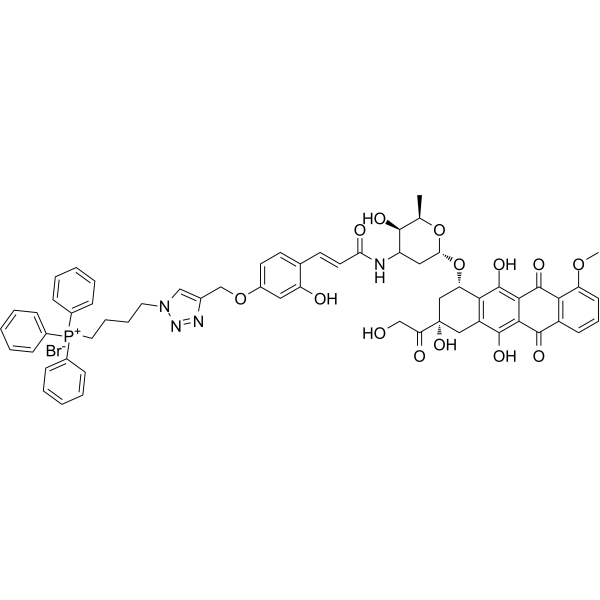
Mitochondria-Targeted Photoactivatable Proagent accumulates in the mitochondria and shows light-triggered temporally controlled cell death. Mitochondria-Targeted Photoactivatable Proagent can be used in a novel drug delivery platform that provides on-demand, real-time, organelle-specific agent release and monitoring upon photoactivation .
loading...
    loading...
Cat. No.: HY-130407
CAS No.: 1342764-64-0
Target:  

PROTAC Linkers

Research Areas:  

Cancer

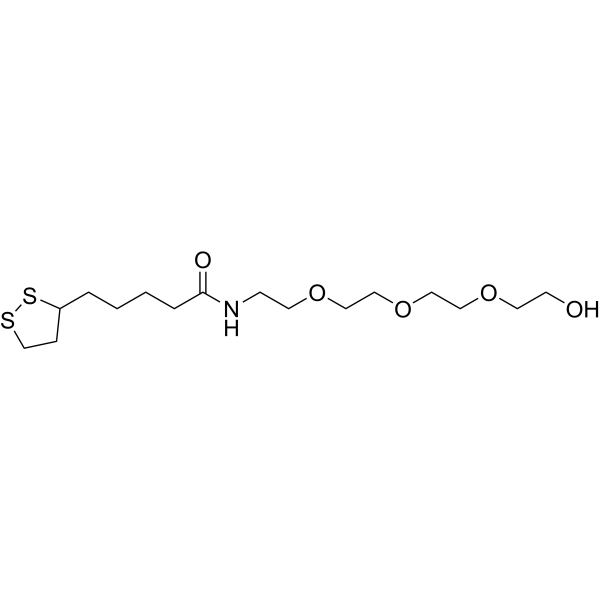
Lipoamido-PEG3-OH is a PEG-based PROTAC linker can be used in the synthesis of PROTACs. Lipoamido-PEG3-OH (compound TA-TEG-G2CN) can be used in the formation of a highly stable, dendronized gold nanoparticle (AuNP)-based drug delivery platform .
loading...
    loading...
Cat. No.: HY-142533
Research Areas:  

Cancer

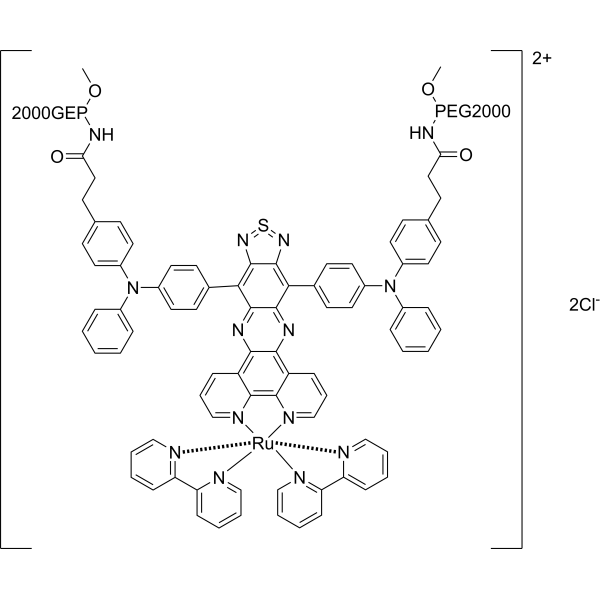
HL-PEG2k is a second near-infrared Ru(II) polypyridyl complex. HL-PEG2k exhibits a wavelength bathochromic shift, enhanced photothermal conversion efficiency (41.77%), and an antineoplastic effect against glioma. HL-PEG2k displays a superior biocompatibility and thus can be a potential theranostic platform to combat the growth and recurrence of tumors .
loading...
    loading...
Cat. No.: HY-175421
Research Areas:  

Cancer

ArMan is a co-activator of DC-SIGN (CD209) and TLR7. ArMan can selectively bind to DC-SIGN, promoting receptor-mediated endocytosis of the virus-like particle (VLP) platform, thereby enhancing co-binding with TLR7. ArMan can drive dendritic cell activation, shifting the immune response from humoral immunity to type 1 cellular immunity. ArMan can be used in melanoma research .
loading...
    loading...
Cat. No.: HY-W014410R
CAS No.: 526-99-8
Mucic acid (Standard) is the analytical standard of Mucic acid (HY-W014410). This product is intended for research and analytical applications. Mucic acid is an aldonic acid that can be prepared from pectin. Mucic acid increases the expression level of Runx2, promotes osteoblast differentiation, and upregulates osteogenic differentiation marker genes. Mucic acid can be used to prepare platform compounds, polymers, polymer materials and metal-organic frameworks. Mucic acid is applicable to the research of bone-related defects .
loading...
    loading...
Cat. No.: HY-W015410R
CAS No.: 150-90-3
Disodium succinate (Standard) is the analytical standard of Disodium succinate. This product is intended for research and analytical applications. Disodium succinate is an anti-anxiety agent with oral activity. Disodium succinate is the salt form of Succinic acid. Disodium succinate is an intermediate product of the tricarboxylic acid cycle. Disodium succinate is an important platform chemical. Disodium succinate can be used as surfactant, additive, ion chelating agent, flavoring agent and other applications in chemical, pharmaceutical and food fields .
loading...
    loading...
Cat. No.: HY-178962
Target:  

Drug Metabolite

Research Areas:  

Cancer

Antitumor agent-207 (compound 10K) is a Pt(IV)-NO prodrug with high lipid solubility, good stability, and excellent tumor targeted release ability. Antitumor agent-207 has significant anti proliferative activity in various cells such as TE-1 (IC50 = 1.79 μM), TE-10 (IC50 = 1.95 μM), KYSE-30 IC50 = 5.99 μM), KYSE-520 (IC50 = 5.53 μM) cells. Antitumor agent-207 can significantly enhance intracellular Pt accumulation and DNA platformization levels, and effectively release NO. Antitumor agent-207 can be used for research on cancers such as esophageal cancer .
loading...
    loading...
Cat. No.: HY-D2846B
m-PEG5000-PEI5000-Cy5 is a fluorescent dye composed of CY5 (HY-D0821), methoxypolyethylene glycol (mPEG), and polyethyleneimine (PEI). m-PEG5000-PEI5000-Cy5 is used for gene delivery, nanodrug delivery, cell imaging and biosensing and bioanalysis (Ex/Em=633/670 nm).
loading...
    loading...
Cat. No.: HY-W342243A
Research Areas:  

Others

D-Xylonic acid lithium is a bio-based platform chemical that acts as a water reducer and dispersant for cement, and also serves as a precursor for 1,4-butanediol, 1,2,4-butanetriol, copolyamides, and 3,4-dihydroxybutyrate .
loading...
    loading...
Cat. No.: HY-K6502

MCE Human iPSC-Derived Brain Organoid Long-term Culture Medium is a specialized culture system developed through systematic reformulation and concentration optimization based on neuronal cell culture platforms. It significantly enhances the adaptability and stability of long-term culture for brain organoids derived from human induced pluripotent stem cells (iPSCs).

loading...
    loading...
Cat. No.: HY-W142795
CAS No.: 99-71-8
Synonyms: 4-sec-BP
4-sec-Butylphenol (4-sec-BP) is an androgen receptor ligand that binds to the androgen receptor with a pIC50 of 4.07 . 4-sec-Butylphenol is an estrogen receptor agonist. 4-sec-Butylphenol can be found in industrial effluents, in production water of oil and gas platforms, as well as in river water samples .
loading...
    loading...
Cat. No.: HY-E0209
compounds

MCE 384-well storage plate can be used for the storage of compound, and the V-shaped bottom design can improve the sample recovery rate and reduce the dead volume. This plate is made of polypropylene material with high heat resistance and free of detectable DNase, RNase, human DNA. ANSI/SBS compliant and suitable for automated pipette workstations and high-throughput screening platforms.

Cat. No.: HY-184607
Nanoclusters are essentially ultrasmall nanomaterials, typically with diameters between 1 and 10 nm, composed of a specific number of metal atoms (approximately 10 to several hundred) and ligands. This structure places their size between that of small molecules and traditional nanoparticles, exhibiting quantum effects. When the size of the metal core approaches the Fermi wavelength of electrons, its band structure transitions from a continuous state to discrete energy levels, thus exhibiting molecular-like properties such as single-electron transitions, multiple absorption bands, and strong photoluminescence. Iron nanoclusters (FeNCs) are a class of ultrasmall fluorescent nanomaterials composed of several to tens of iron atoms. Synthesized using bovine serum albumin (BSA) as a template and protectant via a chemical reduction method, these materials possess excellent optical properties and biocompatibility. Furthermore, they can be functionalized through surface modification, leading to their wide application in fields such as bioanalysis, environmental monitoring, and disease diagnosis.
loading...
    loading...

