51 Results for "

BV2 cells

" in MedChemExpress (MCE) Product Catalog:
Products (51)

51 Results for "BV2 cells" in MCE Product Catalog:

Cat. No.: HY-161925
sTGFBR3 antagonist 1 (Compound p24) is an antagonist for soluble transforming growth factor beta receptor 3 (sTGFBR3), thus activates TGF-β signaling pathway, and inhibits IκBα/NF-κB signaling pathway. sTGFBR3 antagonist 1 inhibits NO-release in LPS (HY-D1056) -induced BV2 cells with an IC50 of 0.52 μM. sTGFBR3 antagonist 1 exhibits anti-inflammatory and neuroprotective activities with blood brain barrier (BBB) permeability. sTGFBR3 antagonist 1 can be used in Alzheimer’s Disease research .
loading...
    loading...
Cat. No.: HY-B1114R
CAS No.: 33342-05-1
Synonyms: AR-DF 26 (Standard)
Gliquidone (Standard) is the analytical standard of Gliquidone. This product is intended for research and analytical applications. Gliquidone can bind to the pancreatic β-cells and increases insulin release to regulate blood glucose levels. Gliquidone significantly decreases LPS (HY-D1056)-induced proinflammatory responses and inhibits ERK/STAT3/NF-κB phosphorylation in BV2 microglial cells. Gliquidone can suppress microgliosis, microglial hypertrophy mediated by LPS, and proinflammatory cytokine COX-2 and IL-6 levels in murine model. Gliquidone also exhibits good anticancer activity in lung carcinoma cells. Gliquidone has antioxidant property. Gliquidone can be studied in research for type 2 diabetes and cancers .
loading...
    loading...
Cat. No.: HY-B1114S
Synonyms: AR-DF 26-d6
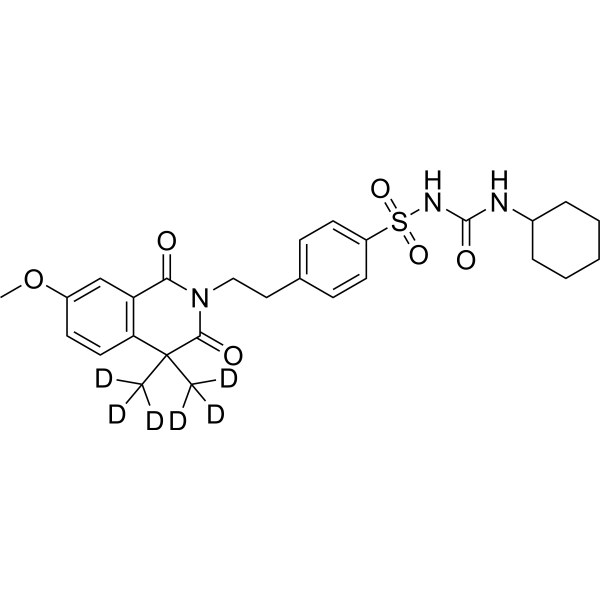
Gliquidone-d6 (AR-DF 26-d6) is the deuterated-labeled Gliquidone (HY-B1114). Gliquidone can bind to the pancreatic β-cells and increases insulin release to regulate blood glucose levels. Gliquidone significantly decreases LPS (HY-D1056)-induced proinflammatory responses and inhibits ERK/STAT3/NF-κB phosphorylation in BV2 microglial cells. Gliquidone can suppress microgliosis, microglial hypertrophy mediated by LPS, and proinflammatory cytokine COX-2 and IL-6 levels in murine model. Gliquidone also exhibits good anticancer activity in lung carcinoma cells. Gliquidone has antioxidant property. Gliquidone can be studied in research for type 2 diabetes and cancers .
loading...
    loading...
Cat. No.: HY-N13831
CAS No.: 2721-56-4
Swietenidine B is a quinoline alkaloid that can be isolated from the root bark of Dictamnus dasycarpus. Swietenidine B does not show significant activity in inhibiting NO production in LPS-induced BV-2 microglial cells .
loading...
    loading...
Cat. No.: HY-N21923
CAS No.: 126239-88-1
Euphoscopin H is a diterpenoid compound found in the fresh leaves and roots of Euphorbia helioscopia. Euphoscopin H shows weak inhibitory activity against LPS-induced NO production and no obvious cytotoxicity in the mouse microglial BV-2 cell model .
loading...
    loading...
Cat. No.: HY-167853
CAS No.: 174800-22-7
Synonyms: SK-1080
Target:  

Angiotensin Receptor

Research Areas:  

Metabolic Disease

KR-31080 is an derivative of imidazo [4,5-b] pyridine. KR-31080 inhibits angiotensin II receptor. KR-31080 inhibits the NO production in LPS-stimulated BV-2 cells at a concentration of 2 μm with inhibition of 8.3% .
loading...
    loading...
Cat. No.: HY-N10458
CAS No.: 3000508-28-8
Target:  

NF-κB

Asperbisabolane L, a sesquiterpenoid, exerts the anti-inflammatory activity by inhibiting the NF-κB-activated pathway. Asperbisabolane L inhibits the translocation of NF-κB from cytoplasm to the nucleus. Asperbisabolane L also inhibits NO production in LPS-activated BV-2 microglia cells .
loading...
    loading...
Cat. No.: HY-N19854
CAS No.: 2097442-40-3
Mariaterpenoside A is an inducible nitric oxide synthase (iNOS) inhibitor. Mariaterpenoside A interacts with the active cavity of iNOS protein via hydrogen bonds with specific residues of the binding site. Mariaterpenoside A suppresses NO release in LPS (HY-D1056)-induced murine microglial BV-2 cells. Mariaterpenoside A can be used for the research of neurodegenerative disease .
loading...
    loading...
Cat. No.: HY-N15564
CAS No.: 31554-34-4
Theleganbanin B is a p-terphenyl derivative found in the Thelephora ganbajun. Theleganbanin B inhibits TNF-α, IL-6, and IL-1β production in LPS-induced BV-2 microglial cells. Theleganbanin B inhibits the phosphorylation of JAK2/STAT3. Theleganbanin B is promising for research of neurodegenerative diseases .
loading...
    loading...
Cat. No.: HY-B1114A
CAS No.: 62783-47-5
Synonyms: AR-DF 26 sodium
Gliquidone sodium (AR-DF 26 sodium) can bind to the pancreatic β-cells and increases insulin release to regulate blood glucose levels. Gliquidone sodium significantly decreases LPS (HY-D1056)-induced proinflammatory responses and inhibits ERK/STAT3/NF-κB phosphorylation in BV2 microglial cells. Gliquidone sodium can suppress microgliosis, microglial hypertrophy mediated by LPS, and proinflammatory cytokine COX-2 and IL-6 levels in murine model. Gliquidone sodium also exhibits good anticancer activity in lung carcinoma cells. Gliquidone sodium has antioxidant property. Gliquidone sodium can be studied in research for type 2 diabetes and cancers .
loading...
    loading...
Cat. No.: HY-180889
CAS No.: 2257497-15-5
PROTAC BRD3 degrader-1 (compound D072) is a potent and selective PROTAC BRD3 degrader. PROTAC BRD3 degrader-1 selectively degrades BRD3 in mice, leading to the downregulation of H3K18ac without affecting BRD2 or BRD4. PROTAC BRD3 degrader-1 reduces intraocular inflammation in the experimental autoimmune uveitis (EAU) mouse mode and inhibits proinflammatory microglia in both uveitis retina and LPS (HY-D1056) treated mouse microglia cell line BV2. PROTAC BRD3 degrader-1 can be used for uveitis research .
loading...
    loading...

