62 Results for "

Enterococcus faecalis.

" in MedChemExpress (MCE) Product Catalog:
Products (62)

62 Results for "Enterococcus faecalis." in MCE Product Catalog:

Cat. No.: HY-172962
Research Areas:  

Infection

DNA Gyrase-IN-17 (Compound 5C) is a DNA Gyrase inhibitor. DNA Gyrase-IN-17 exhibits significant antibacterial activity against a variety of Gram-positive and Gram-negative strains (such as Enterococcus faecalis, Escherichia coli, Pseudomonas aeruginosa, etc.), with a MIC value of 62.5 μg/mL. DNA Gyrase-IN-17 interferes with DNA replication by inhibiting bacterial DNA gyrase. DNA Gyrase-IN-17 can be used in the development of antibacterial drugs, especially for the study of drug-resistant strains .
loading...
    loading...
Cat. No.: HY-173192
Target:  

Bacterial

Research Areas:  

Infection

Antibacterial agent 272 (Compound Z22) is a potential antimicrobial agent targeting DNA and the DNA-topoisomerase II (DNA-Topo II) complex, exhibiting MIC values of 1 μg/mL against Staphylococcus aureus 25923 and 29213, 2 μg/mL against Staphylococcus epidermidis 12228, 2-4 μg/mL against Enterococcus faecalis, and 4 μg/mL against Pseudomonas aeruginosa 9027 and 27853, demonstrating potent antibacterial activity. This compound functions by intercalating with DNA base pairs to disrupt normal bacterial DNA function, making it suitable for research on bacterial infectious diseases .
loading...
    loading...
Cat. No.: HY-124350S
CAS No.: 461426-41-5
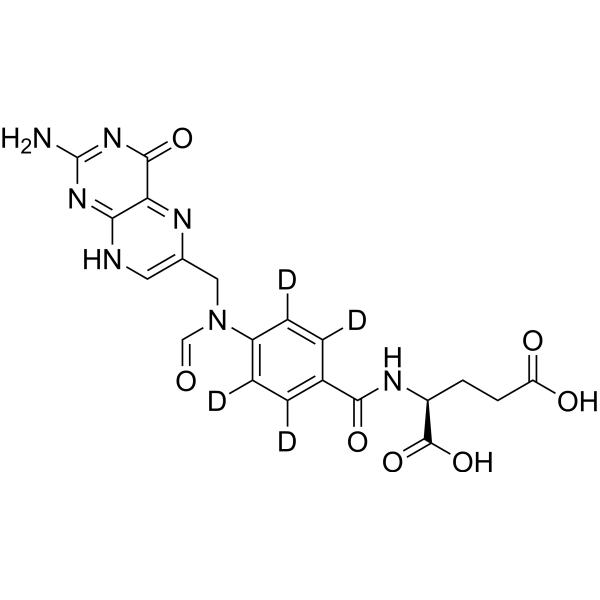
10-Formylfolic acid-d4 is the deuterated-labeled 10-Formylfolic acid (HY-124350). 10-Formylfolic acid is a potent inhibitor of dihydrofolate reductase, with an IC50 of 80 nM against the rat enzyme. 10-Formylfolic acid also acts as an orally active folate source and a growth factor for specific bacteria. 10-Formylfolic acid supports growth and increases plasma folate levels; its absorption and metabolism patterns are similar to those of folic acid, but its liver retention is slightly higher. It exhibits high folate activity in microbial assays, serves as a growth factor for Enterococcus faecalis and Lactobacillus casei, aids folate nutrient supply, and may exert cell regulatory functions .
loading...
    loading...
Cat. No.: HY-124350R
CAS No.: 134-05-4
10-Formylfolic acid (Standard) is the analytical standard of 10-Formylfolic acid (HY-124350). This product is intended for research and analytical applications. 10-Formylfolic acid is a potent inhibitor of dihydrofolate reductase, with an IC50 of 80 nM against the rat enzyme. 10-Formylfolic acid also acts as an orally active folate source and a growth factor for specific bacteria. 10-Formylfolic acid supports growth and increases plasma folate levels; its absorption and metabolism patterns are similar to those of folic acid, but its liver retention is slightly higher. It exhibits high folate activity in microbial assays, serves as a growth factor for Enterococcus faecalis and Lactobacillus casei, aids folate nutrient supply, and may exert cell regulatory functions .
loading...
    loading...
Cat. No.: HY-187666
CAS No.: 506429-34-1
Target:  

Bacterial

Research Areas:  

Infection

YycG-IN-1 is a selective YycG inhibitor, with an IC50 of 42.9 μM and a Kd of 86.4 μM against YycG from Enterococcus faecalis. YycG-IN-1 inhibits the kinase activity and autophosphorylation activity of YycG, suppresses biofilm formation of Enterococcus faecalis, inhibits the planktonic growth of Enterococcus faecalis, and exerts effects on multiple mutant strains of Enterococcus faecalis. YycG-IN-1 can be used in studies related to Enterococcus faecalis infection .
loading...
    loading...
Cat. No.: HY-N5196
CAS No.: 214044-52-7
Synonyms: Nocathiacine I
Nocathiacin I (Nocathiacine I) is highly resistant to Gram-positive bacteria, including methicillin-resistant Staphylococcus aureus (MRSA), penicillin-resistant Streptococcus pneumoniae (PRSP) and multidrug resistant Enterococcus faecalis (MREF) .
loading...
    loading...
Cat. No.: HY-112027
CAS No.: 105394-83-0
Synonyms: Ciprofloxacin impurity E
Target:  

Bacterial

Research Areas:  

Infection

Decarboxy ciprofloxacin (Decarboxylated ciprofloxacin) is an antibacterial agent. Decarboxy ciprofloxacin displays antibacterial activities against Staphylococcus aureus, Staphylococcus epidermidis, Enterococcus faecalis, Bacillus subtilis, Enterobacter cloacae, Serratia marcescens and especially potent activity against Escherichia coli .
loading...
    loading...
Cat. No.: HY-10391
CAS No.: 128311-86-4
Target:  

Bacterial

Research Areas:  

Infection

E3709 is an antibacterial agent. E3709 exhibits significant inhibitory activity against Gram-positive bacteria, including Staphylococcus aureus (MRSA), Enterococcus faecalis, streptococci, Clostridia, and diphtheroids. E3709 can be used for research related to Gram-positive bacterial infections .
loading...
    loading...
Cat. No.: HY-187641
CAS No.: 299419-24-2
Target:  

Bacterial

Research Areas:  

Infection

ST056083 is a small-molecule inhibitor of the c-di-AMP synthase DisA. The apparent KD of ST056083 binding to DisA is 21 μM. ST056083 reduces c-di-AMP production in Enterococcus faecalis ATCC 29212, and inhibits bacterial growth, biofilm formation, bacterial viability within biofilms, and the synthesis of water-insoluble extracellular polysaccharides. ST056083 is applicable to studies on bacterial c-di-AMP signaling and E. faecalis-associated infections .
loading...
    loading...
Cat. No.: HY-N12229
CAS No.: 1821668-16-9
Penipurdin A (Compound 1), an anthraquinone, is a microbial secondary metabolite. Penipurdin A can be isolated from the soil fungus Penicillium purpurogenum SC0070. Penipurdin A has no significant cytotoxicity against cancer cells, such as A549, HepG2 and Hela cells. Penipurdin A has antibacterial activity against Enterococcus faecalis and Staphylococcus aureus .
loading...
    loading...
Cat. No.: HY-W541015
CAS No.: 89-48-5
(±)-Menthyl acetate is a menthol acyl derivative (monoterpene ester) and antibacterial agent found in the essential oil of Mentha arvensis L.. (±)-Menthyl acetate inhibits growth of Gram-positive bacterial strains including Streptococcus mutans, Mycobacterium smegmatis, Enterococcus faecalis, Staphylococcus aureus, and Bacillus subtilis. (±)-Menthyl acetate is inactive against tested fungal strains. (±)-Menthyl acetate can be used in the research of Gram-positive bacterial infections .
loading...
    loading...
Cat. No.: HY-W039699
CAS No.: 938-94-3
Synonyms: 2-(4-Methylphenyl)propionic acid
Research Areas:  

Infection

2-(p-Tolyl) propanoic acid (2-(4-methylphenyl) propionic acid) acts as an Antimicrobial agent intermediate. 2-(p-Tolyl) propanoic acid inhibits COX-1 and COX-2 enzymes, with IC50 values of 38.23 μM and 64.30 μM, respectively. 2-(p-Tolyl) propanoic acid is applicable to research on E. coli, Enterococcus faecalis, Listeria monocytogenes, and Staphylococcus aureus .
loading...
    loading...
Cat. No.: HY-N19214
CAS No.: 3040055-91-9
Glenthmycin L is a potent antibiotic that can be found in Australian sheep pasture-derived Streptomyces sp. CMB-PB041. Glenthmycin L exhibits antibacterial activity against Gram-positive bacterial pathogens including Staphylococcus aureus, Enterococcus faecalis, Methicillin (HY-B0974)-resistant Staphylococcus aureus, and Vancomycin (HY-B0671)-resistant Enterococci. Glenthmycin L can be used for the research of bacterial infections caused by Gram-positive pathogens .
loading...
    loading...
Cat. No.: HY-181686
Research Areas:  

Infection

Antibacterial agent 326 is a bactericide that inhibits the growth of various bacterial strains. Antibacterial agent 326 inhibits biofilm formation in Escherichia coli, disrupts bacterial cell membranes, induces oxidative stress and lipid peroxidation in Escherichia coli, increases ROS levels, and reduces GSH activity. Antibacterial agent 326 can be used in studies of bacterial infections, including those caused by Escherichia coli, Staphylococcus aureus, Enterococcus faecalis, Listeria spp., Bacillus subtilis, Serratia marcescens, Salmonella enteritidis and Acinetobacter calcoaceticus .
loading...
    loading...
Cat. No.: HY-N19903
CAS No.: 2243140-21-6
Verticilatin is a prenylated diaryl ether derived from phytopathogenic fungi, acting as an antibacterial agent and biofilm inhibitor. Verticilatin exhibits no direct growth inhibitory activity against Gram-negative bacteria. Verticilatin effectively inhibits the growth of Gram-positive strains, including methicillin-sensitive/resistant Staphylococcus aureus and Enterococcus faecalis, and reduces the biofilm-forming ability of Gram-negative Stenotrophomonas maltophilia. Verticilatin can be used for infections caused by the aforementioned Gram-positive bacteria and biofilm infections caused by Stenotrophomonas maltophilia .
loading...
    loading...
Cat. No.: HY-183291
Antibacterial agent 343 (Compound 47) is an Antibacterial agent. Antibacterial agent 343 binds to the allosteric site of PBP2a to open its active site. Antibacterial agent 343 disrupts bacterial cell membranes, leading to protein leakage. Antibacterial agent 343 interacts with DNA and inhibits replication and transcription. Antibacterial agent 343 induces ROS accumulation. Antibacterial agent 343 exhibits antibacterial activity against MRSA, Staphylococcus aureus, and Enterococcus faecalis. Antibacterial agent 343 can be used for the research of methicillin-resistant Staphylococcus aureus infections .
loading...
    loading...
Cat. No.: HY-184387
CAS No.: 2552327-34-9
Target:  

Bacterial

Research Areas:  

Infection

Pleuromutilin conjugate T7 is a broad-spectrum antibacterial agent. Pleuromutilin conjugate T7 inhibits bacterial energy uptake, reverses drug efflux, interferes with carbohydrate metabolism, inhibits protein synthesis, disrupts biofilms, impairs cell membrane integrity, and attenuates the functions of virulence and adhesion factors. Pleuromutilin conjugate T7 can be used in studies related to Methicillin (HY-121544)-resistant Staphylococcus aureus (MRSA) infections, multidrug-resistant Enterococcus faecalis infections, and Gram-negative bacterial infections .
loading...
    loading...
Cat. No.: HY-111034
CAS No.: 94714-78-0
Target:  

Antibiotic Bacterial

Research Areas:  

Infection

CGP 31523A is a broad-spectrum aminothiazole cephalosporin. CGP 31523A exhibits potent inhibitory effects on Enterobacteriaceae, Neisseria, Haemophilus influenzae, and Streptococcus (except Enterococcus faecalis), among others. CGP 31523A can be hydrolyzed by the common Escherichia coli type Ic β-lactamase, but is stable against the Ia type enzyme. CGP 31523A is neither an effective β-lactamase inhibitor nor does it induce the production of β-lactamase. CGP 31523A can be used for studying infections caused by Gram-negative bacteria (including drug-resistant strains) .
loading...
    loading...
Cat. No.: HY-184287
Research Areas:  

Infection

Antibacterial agent 352 is an orally active Antibacterial agent. Antibacterial agent 352 binds to the active cavity of Staphylococcus aureus DNA gyrase via hydrogen bonding, π-π stacking and hydrophobic interactions, thereby blocking bacterial DNA synthesis. Antibacterial agent 352 exhibits antibacterial activity against Gram-positive bacteria including Staphylococcus aureus, Bacillus pumilus, Staphylococcus epidermidis and Enterococcus faecalis. Antibacterial agent 352 can disrupt established Staphylococcus aureus biofilms and inhibit the formation of Staphylococcus aureus biofilms. Antibacterial agent 352 can be used in the research of Staphylococcus aureus wound infections .
loading...
    loading...
Cat. No.: HY-182798
Research Areas:  

Infection

Antibacterial agent 337 is an antibacterial agent. Antibacterial agent 337 specifically interacts with PG in bacterial cell membranes, triggering membrane disruption, membrane depolarization, increased permeability, cytoplasmic leakage, ROS accumulation and rapid bacterial death. Antibacterial agent 337 inhibits biofilm formation and disrupts mature biofilms. Antibacterial agent 337 exhibits potent in vivo antibacterial efficacy in a mouse model of Staphylococcus aureus skin abscess. Antibacterial agent 337 can be used in studies of Gram-positive bacterial infections, including methicillin-resistant Staphylococcus aureus infections, vancomycin-resistant Enterococcus faecalis infections and bacterial biofilm infections .
loading...
    loading...

