113 Results for "

Polymer materials

" in MedChemExpress (MCE) Product Catalog:
Products (113)

113 Results for "Polymer materials" in MCE Product Catalog:

Cat. No.: HY-174929
Synonyms: DBCO-PEG3400-NH2
DBCO-PEG3400-Amine (DBCO-PEG3400-NH2) is a polyethylene glycol derivative containing dibenzocyclooctyne. DBCO-PEG-Amine is a universal, modular "bridge molecule": it forms stable covalent linkage with target materials (e.g., MSN or polymers) via the amino group at one end, while the DBCO group at the other end enables efficient, specific, and biocompatible click chemical conjugation with any azide-bearing biological entities (e.g., bacteria, cells) in subsequent steps .
loading...
    loading...
Cat. No.: HY-W090151
CAS No.: 2396521-63-2
Silyl-ether based ROMP monomer iPrSi is a biochemical reagent that can be used in the synthesis of advanced polymer materials for biomedical applications, including drug delivery vehicles and hydrogels .
loading...
    loading...
Cat. No.: HY-W014410R
CAS No.: 526-99-8
Mucic acid (Standard) is the analytical standard of Mucic acid (HY-W014410). This product is intended for research and analytical applications. Mucic acid is an aldonic acid that can be prepared from pectin. Mucic acid increases the expression level of Runx2, promotes osteoblast differentiation, and upregulates osteogenic differentiation marker genes. Mucic acid can be used to prepare platform compounds, polymers, polymer materials and metal-organic frameworks. Mucic acid is applicable to the research of bone-related defects .
loading...
    loading...
Cat. No.: HY-163977
CAS No.: 1621108-00-6
Synonyms: 2,2-Diphenyl-1,3-dioxa-2-silacyclooct-5-ene
Silyl-ether based ROMP Monomer (2,2-Diphenyl-1,3-dioxa-2-silacyclooct-5-ene) is a biochemical reagent that can be used in the synthesis of advanced polymer materials for biomedical applications, including drug delivery vehicles and hydrogels .
loading...
    loading...
Cat. No.: HY-149505
CAS No.: 34932-14-4
Synonyms: 12(Z),15(Z)-10-HODE; (±)-10-Hydroxy-12(Z),15(Z)-ODE
Research Areas:  

Others

(±)-10-Hydroxy-12(Z),15(Z)-octadecadienoic acid is a fatty acid derivative. (±)-10-Hydroxy-12(Z),15(Z)-octadecadienoic acid can be used in the food, cosmetic and pharmaceutical industries, such as starting materials for biodegradable polymers, lubricants, emulsifiers, drugs and fragrances .
loading...
    loading...
Cat. No.: HY-34596R
CAS No.: 2380-94-1
Research Areas:  

Others

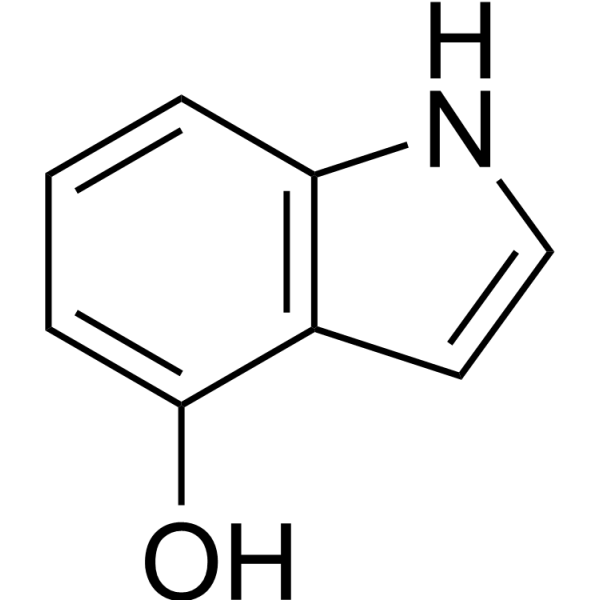
4-Hydroxyindole (Standard) is the analytical standard of 4-Hydroxyindole. This product is intended for research and analytical applications. 4-Hydroxyindole is a member of the class of hydroxyindoles that is 1H-indole substituted by a hydroxy group at position 4. 4-Hydroxyindole is an important raw material or intermediate in the synthesis of pharmaceutical products and industrial polymers .
loading...
    loading...
Cat. No.: HY-W099538R
CAS No.: 123-28-4
Synonyms: Dilauryl 3,3'-Thiodipropionate (Standard)
Research Areas:  

Others

Dilauryl thiodipropionate (Standard) is the analytical standard of Dilauryl thiodipropionate. This product is intended for research and analytical applications. Dilauryl thiodipropionate (DLTDP), which is a sulfur-containing antioxidant commonly used to stabilize polymers and plastics against degradation caused by heat, oxygen, and UV light, acts to scavenge free radicals and others that may cause polymer chain scission and cross-linked active substances, in addition, DLTDP has been used as an additive to lubricants, oils and other industrial fluids to improve their oxidation stability, the long hydrocarbon chain in DLTDP makes it low volatility and compatible with many materials and Good compatibility with substrates.
loading...
    loading...
Cat. No.: HY-W190743
CAS No.: 1527515-88-3
Br-PEG8-OH is a PEG derivative that consists of a bromine atom (Br), eight PEG units, and a hydroxyl group (-OH). The bromine group is a common functional group in chemical reactions and can be used for alkylation reactions, coupling reactions, or the introduction of other functional groups. Br-PEG8-OH can be used as a polymer-based material or as a modifier for biomolecules .
loading...
    loading...
Cat. No.: HY-W027592R
CAS No.: 61-82-5
1H-1,2,4-Triazol-3-amine (Standard) is the analytical standard of 1H-1,2,4-Triazol-3-amine. This product is intended for research and analytical applications. 1H-1,2,4-Triazol-3-amine consists of a triazole ring system and an amino group attached to carbon atom 3. The compound has potential applications in various fields such as medicinal chemistry, agrochemicals and material science. In medicinal chemistry, 1H-1,2,4-Triazol-3-amine is used as a starting material for the synthesis of pharmaceutical compounds such as antifungal agents, anticancer agents, and enzyme inhibitors associated with cardiovascular disease. In agrochemicals, it can be used as a raw material for the synthesis of herbicides, fungicides and insecticides. Furthermore, 1H-1,2,4-Triazol-3-amine is used as a ligand in coordination chemistry and as a precursor for the production of new functional materials such as polymers and metal-organic frameworks.
loading...
    loading...
Cat. No.: HY-W391671
CAS No.: 1333317-99-9
Research Areas:  

Others

Poly[bis(4-phenyl)(2,4,6-trimethylphenyl)amine] is a poly(triarylamine) that is an organic p-type semiconductor with hole mobilities ranging from 10 3 to 10 2 cm 2/V/s, which significantly improves carrier mobility. This stable, glassy polymer has an ionization potential suitable for thick film diodes. Committed to providing green alternatives that meet one or more of the 12 principles of green chemistry, this material falls into the enabling category of green alternatives, in line with the principle of "energy efficient design". In addition, while hole transport organic materials like these ensure optimal energy level alignment with the absorber layer for efficient charge collection, they can be susceptible to degradation under ambient conditions.
loading...
    loading...
Cat. No.: HY-117007
CAS No.: 106-91-2
Research Areas:  

Others

Glycidyl methacrylate is a bifunctional monomer containing both a polymerizable methacrylate double bond and a reactive epoxy group. Glycidyl methacrylate can be introduced into polymer backbones via free radical polymerization, and its epoxy group undergoes ring-opening reactions with nucleophilic groups such as amines, carboxylic acids and thiols, thus being used for the preparation of functional polymers, surface-grafted materials and crosslinkable biomaterials. Glycidyl methacrylate is applicable to research related to polymer chemistry, biomaterials, surface modification and drug delivery materials .
loading...
    loading...
Cat. No.: HY-184640
Carboxylated magnetic microspheres are magnetic microspheres with abundant carboxyl functional groups on their surface. They are usually composed of superparamagnetic materials (such as Fe3O4) and polymer materials, with polystyrene microspheres as the core.
loading...
    loading...
Cat. No.: HY-184613
Polydopamine nanoparticles (PDA NPs) are nanoscale materials formed by the self-polymerization of dopamine monomers under specific conditions. Their structural characteristics include a polyphenolic structure and a surface rich in functional groups such as amino and phenolic hydroxyl groups, which provide abundant chemical modification sites.
loading...
    loading...
Cat. No.: HY-W015891R
CAS No.: 502-44-3
ε-Caprolactone (Standard) is the analytical standard of ε-Caprolactone (HY-W015891). This product is intended for research and analytical applications. ε-Caprolactone is a 7-membered cyclic ester identified in Rubus arcticus L, and it is also a versatile monomer. ε-Caprolactone serves as an intermediate to derive various functional polymer materials. ε-Caprolactone is applicable to relevant research in fields such as biomedicine and material synthesis .
loading...
    loading...
Cat. No.: HY-159906
CAS No.: 17773-35-2
Research Areas:  

Others

14-Hydroxystearic acid is a hydroxy fatty acid and oleogelator that forms gels in mineral oil. 14-Hydroxystearic acid acts as a thickener component in high-temperature synthetic polymer greases. 14-Hydroxystearic acid is used in research on the preparation of smart supramolecular soft materials and greases .
loading...
    loading...
Cat. No.: HY-203862
CAS No.: 125275-25-4
Research Areas:  

Others

Polyquaternium-51 is a hydrophilic polymeric zwitterion with counter ions, and an artificial cell membrane-mimicking material with high biocompatibility. Polyquaternium-51 functions as a penetration inhibitor and exfoliation efficacy reducer. Polyquaternium-51 can be used as cosmetic moisturizing ingredient, and can be used as coating biological scaffolds .
loading...
    loading...
Cat. No.: HY-76217
CAS No.: 823-82-5
Synonyms: 2,5-Diformylfuran
Target:  

Drug Derivative

2,5-Furandicarboxaldehyde (2,5-Diformylfuran), a furan derivative, is a volatile organic compound. 2,5-Furandicarboxaldehyde the aerobic oxidation product of 5-Hydroxymethylfurfural (HY-Y0051), and can be used in organic synthesis and functional polymer manufacture, such as fluorescent material, surfactants, and vitrimer .
loading...
    loading...
Cat. No.: HY-W011875S
CAS No.: 1173019-24-3
2-Isopropylthioxanthone-d7 is the deuterium labeled 2-Isopropylthioxanthone (HY-W011875). 2-Isopropylthioxanthone is a photoinitiator that is widely used in printing ink of packaging materials. 2-Isopropylthioxanthone triggers the radical polymerization of the acrylic component of inks, thus causing the liquid ink film to dry .
loading...
    loading...
Cat. No.: HY-185567
CAS No.: 25067-34-9
Poly(vinyl alcohol-co-ethylene) ethylene 32 mol % is a non-toxic polymer with good hydrophilicity and biocompatibility. Poly(vinyl alcohol-co-ethylene) ethylene 32 mol % has high tensile strength and excellent film-forming property. Poly(vinyl alcohol-co-ethylene) ethylene 32 mol % can be used in research related to packaging materials .
loading...
    loading...
Cat. No.: HY-184779
CAS No.: 29435-48-1
Synonyms: PHB
Research Areas:  

Others

Poly[(R)-3-hydroxybutyrate] (PHB) is a polyhydroxyalkanoate polymer with biocompatibility and processability. Poly[(R)-3-hydroxybutyrate] can be used to prepare drug delivery nanoparticles and tissue engineering scaffolds. Poly[(R)-3-hydroxybutyrate] is applicable to research related to drug delivery, tissue engineering and wound dressing materials .
loading...
    loading...

