1125 Results for "

Transporter

" in MedChemExpress (MCE) Product Catalog:
Products (1125)

1125 Results for "Transporter" in MCE Product Catalog:

Cat. No.: HY-P703356
Purity:  ≥ 95%, as determined by reducing SDS-PAGE.
Synonyms: SLC28A3; Concentrative Na(+)-Nucleoside CoTransporter 3; Solute Carrier Family 28 Member 3; Concentrative Na+-Nucleoside CoTransporter; CNT3; HCNT3; Solute Carrier Family 28 (Sodium-Coupled Nucleoside Transporter), Member 3; CNT 3; Solute Carrier Family 2
Species:  
Human
Source:  
Sf9 insect cells
loading...
    loading...
Cat. No.: HY-P703724
Purity:  ≥ 95%, as determined by reducing SDS-PAGE.
Synonyms: SLC3A2; Solute Carrier Family 3 (Activators Of Dibasic And Neutral Amino Acid Transport), Member 2; Prev. MDU1; Solute Carrier Family 3 (Amino Acid Transporter Heavy Chain), Member 2; 4F2 Cell-Surface Antigen Heavy Chain; Monoclonal Antibody 44D7; Lymphoc
Species:  
Human
Source:  
HEK293
loading...
    loading...
Cat. No.: HY-P706177
Purity:  ≥ 90%, as determined by SDS-PAGE.
Synonyms: OCA2; Oculocutaneous Albinism II (Pink-Eye Dilution Homolog, Mouse); Prev. D15S12; Eye Color 2 (Central Brown); Prev. P; Eye Color 3 (Brown); Prev. EYCL2; P-Protein; Prev. EYCL3; P Protein; Melanocyte-Specific Transporter Protein; Total Brown Iris Pigment
Species:  
Virus
Source:  
E. coli
loading...
    loading...
Cat. No.: HY-103430B
CAS No.: 164265-49-0
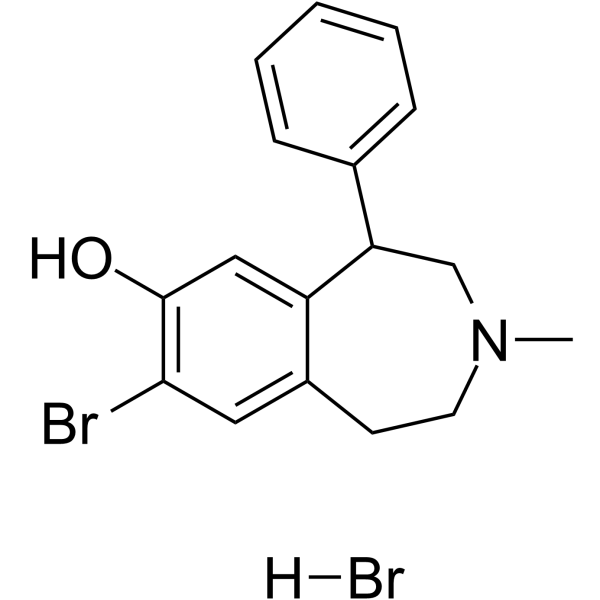
SKF-83566 hydrochloride is an orally active, blood-brain barrier-permeable D1/D5 dopamine receptor antagonist with a Ki value of approximately 0.4-0.56 nM. SKF-83566 hydrochloride modulates locomotor behavior and spatial memory by blocking D1 receptors and inhibits glioblastoma progression by targeting the DRD1/c-Myc/UHRF1 pathway. SKF-83566 hydrochloride acts as an inhibitor of the dopamine transporter (DAT) and adenylyl cyclase 2 (AC2). SKF-83566 hydrochloride competitively binds to DAT to inhibit dopamine reuptake and non-competitively inhibits AC2 activity, thereby reducing cAMP accumulation. SKF-83566 hydrochloride is used in research areas such as dopaminergic system mechanisms, learning and memory, targeted intervention for glioblastoma, AC2 pathophysiology, antiparasitic drug screening, and synaptic plasticity (the "gating effect") .
loading...
    loading...
Cat. No.: HY-113308AS1
CAS No.: 1265476-97-8
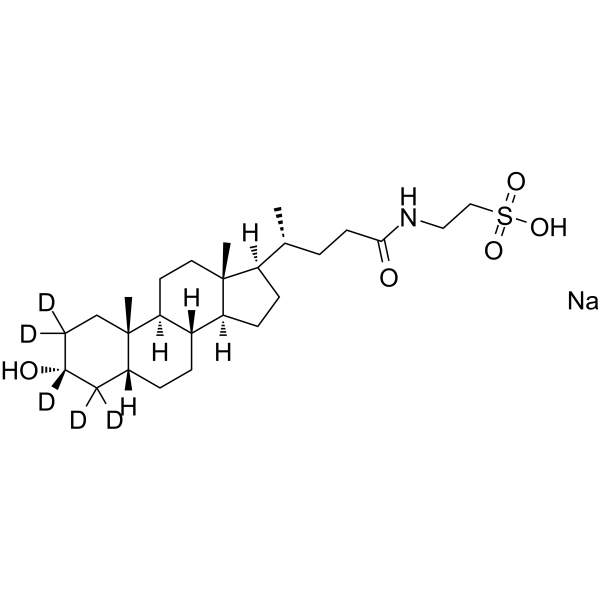
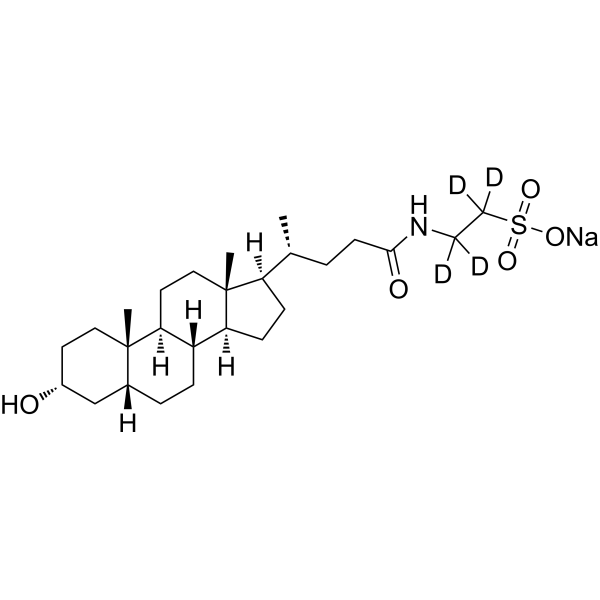
Taurolithocholic Acid-d5 (sodium) is the deuterium labeled Taurolithocholic acid sodium salt. Taurolithocholic Acid sodium salt is an orally active bile acid and antiviral agent. Taurolithocholic Acid sodium salt upregulates FADS2 by activating the TGR5-PI3K/AKT-SREBP2 signaling axis, inhibits SFTSV-induced ferroptosis, viral replication and viral entry of HBV/HDV, while reducing the release of IL-1β, lipid ROS and LDH. While exerting antiviral protective effects, Taurolithocholic Acid sodium salt also stimulates the recycling of hepatocellular membrane transporters, impairs canalicular bile acid secretion function, and induces hepatocyte cholestasis, apoptosis and acute hepatocellular injury. Taurolithocholic Acid sodium salt serves as an experimental model compound for hepatocellular cholestasis. At concentrations ≤200 μM, Taurolithocholic Acid sodium salt shows no cytotoxicity and does not activate the interferon pathway. Taurolithocholic Acid sodium salt not only protects mice from lethal SFTSV infection but also is suitable for studies related to severe fever with thrombocytopenia syndrome and cholestasis .
loading...
    loading...
Cat. No.: HY-113308AS2
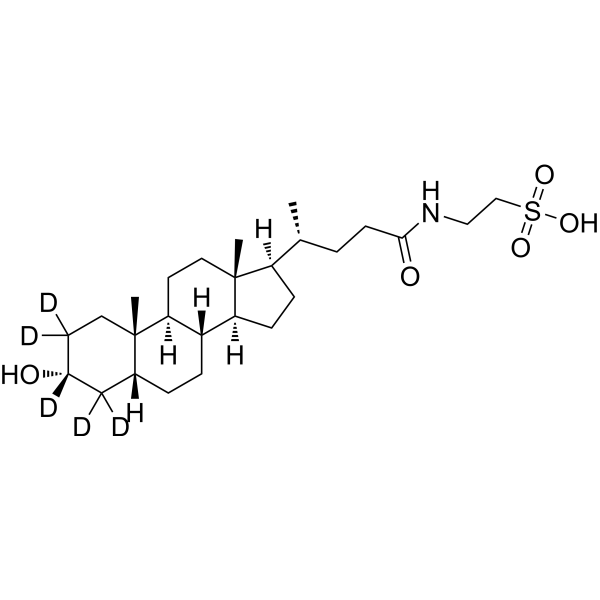
Taurolithocholic acid-d4-1 (sodium) is the deuterium labeled Taurolithocholic acid. Taurolithocholic acid sodium is an orally active bile acid and antiviral agent. Taurolithocholic acid sodium upregulates FADS2 by activating the TGR5-PI3K/AKT-SREBP2 signaling axis, inhibits SFTSV-induced ferroptosis, viral replication and viral entry of HBV/HDV, while reducing the release of IL-1β, lipid ROS and LDH. While exerting antiviral protective effects, Taurolithocholic acid sodium also stimulates the recycling of hepatocellular membrane transporters, impairs canalicular bile acid secretion function, and induces hepatocyte cholestasis, apoptosis and acute hepatocellular injury. Taurolithocholic acid sodium serves as an experimental model compound for hepatocellular cholestasis. At concentrations ≤200 μM, Taurolithocholic acid sodium shows no cytotoxicity and does not activate the interferon pathway. Taurolithocholic acid sodium not only protects mice from lethal SFTSV infection but also is suitable for studies related to severe fever with thrombocytopenia syndrome and cholestasis .
loading...
    loading...
Cat. No.: HY-113308S
CAS No.: 1265681-64-8
Taurolithocholic acid-d5 is deuterium labeled Taurolithocholic acid. Taurolithocholic acid is an orally active bile acid and antiviral agent. Taurolithocholic acid upregulates FADS2 by activating the TGR5-PI3K/AKT-SREBP2 signaling axis, inhibits SFTSV-induced ferroptosis, viral replication and viral entry of HBV/HDV, while reducing the release of IL-1β, lipid ROS and LDH. While exerting antiviral protective effects, Taurolithocholic acid also stimulates the recycling of hepatocellular membrane transporters, impairs canalicular bile acid secretion function, and induces hepatocyte cholestasis, apoptosis and acute hepatocellular injury. Taurolithocholic acid serves as an experimental model compound for hepatocellular cholestasis. At concentrations ≤200 μM, Taurolithocholic acid shows no cytotoxicity and does not activate the interferon pathway. Taurolithocholic acid not only protects mice from lethal SFTSV infection but also is suitable for studies related to severe fever with thrombocytopenia syndrome and cholestasis .
loading...
    loading...
Cat. No.: HY-P992159
Anti-ZnT8 Antibody (mAb43) is a monoclonal antibody targeting the zinc transporter ZnT8, with islet-specific biodistribution characteristics. Anti-ZnT8 Antibody (mAb43) binds to extracellular ZnT8 on the surface of pancreatic β-cells and masks its insulin-co-localizing sites to block autoimmune recognition. Anti-ZnT8 Antibody (mAb43) also promotes an increase in the proportion of regulatory T cells and inhibits B cell antigen presentation, thereby effectively blocking the T cell-mediated cascade of β-cell destruction. Anti-ZnT8 Antibody (mAb43) eliminates insulitis, preserves β-cell mass and induces seroconversion of autoantibodies, without directly altering the insulin secretion function or content of β-cells. Anti-ZnT8 Antibody (mAb43) can be used for research related to type 1 diabetes .
loading...
    loading...
Cat. No.: HY-P702027
Purity:  ≥ 90%, as determined by reducing SDS-PAGE.
Synonyms: SLC17A3; Sodium-Dependent Phosphate Transport Protein 4; Solute Carrier Family 17 Member 3; Sodium/Phosphate CoTransporter 4; NPT4; Na(+)/PI CoTransporter 4; Solute Carrier Family 17 (Organic Anion Transporter), Member 3; UAQTL4; Solute Carrier Family 17
Species:  
Human
Source:  
Sf9 insect cells
loading...
    loading...
Cat. No.: HY-P87138
Synonyms: AChR antibody; MGC12716 antibody; rVAT antibody; Slc18a3 antibody; Solute carrier family 18 (vesicular acetylcholine) member 3 antibody; Solute carrier family 18 (vesicular monoamine) member 3 antibody; Solute carrier family 18 member 3 antibody; VAChT antibody; VACHT_HUMAN antibody; Vesicular acetylcholine Transporter antibody;

Host:  

Rat

Application:  

IHC-F

Reactivity:  

Mouse

loading...
    loading...
Cat. No.: HY-P705631
Purity:  ≥ 85%, as determined by reducing SDS-PAGE.
Synonyms: SLC11A1; Solute Carrier Family 11 (Proton-Coupled Divalent Metal Ion Transporter), Member 1; Prev. NRAMP1; NRAMP 1; Prev. NRAMP; Solute Carrier Family 11 (Proton-Coupled Divalent Metal Ion Transporters), Member 1; Prev. LSH; Solute Carrier Family 11 (Sodi
Species:  
Human
Source:  
HEK293
loading...
    loading...
Cat. No.: HY-P81448A
Synonyms: SLC7A5; CD98LC, LAT1; MPE16; Large neutral amino acids Transporter small subunit 1; 4F2 light chain (4F2 LC; 4F2LC); CD98 light chain; Integral membrane protein E16; Solute carrier family 7 member 5

Host:  

Rabbit

Application:  

IHC-P

Reactivity:  

Human

loading...
    loading...
Cat. No.: HY-103430
CAS No.: 108179-91-5
SKF-83566 hydrobromide is an orally active, blood-brain barrier-permeable D1/D5 dopamine receptor antagonist with a Ki value of approximately 0.4-0.56 nM. SKF-83566 hydrobromide modulates locomotor behavior and spatial memory by blocking D1 receptors and inhibits glioblastoma progression by targeting the DRD1/c-Myc/UHRF1 pathway. SKF-83566 hydrobromide acts as an inhibitor of the dopamine transporter (DAT) and adenylyl cyclase 2 (AC2). SKF-83566 hydrobromide competitively binds to DAT to inhibit dopamine reuptake and non-competitively inhibits AC2 activity, thereby reducing cAMP accumulation. SKF-83566 hydrobromide is used in research areas such as dopaminergic system mechanisms, learning and memory, targeted intervention for glioblastoma, AC2 pathophysiology, antiparasitic drug screening, and synaptic plasticity (the "gating effect") .
loading...
    loading...
Cat. No.: HY-113308AR
CAS No.: 6042-32-6
Taurolithocholic acid (sodium salt) (Standard) is the analytical standard of Taurolithocholic acid (sodium salt). This product is intended for research and analytical applications. Taurolithocholic acid sodium salt is an orally active bile acid and antiviral agent. Taurolithocholic acid sodium salt upregulates FADS2 by activating the TGR5-PI3K/AKT-SREBP2 signaling axis, inhibits SFTSV-induced ferroptosis, viral replication and viral entry of HBV/HDV, while reducing the release of IL-1β, lipid ROS and LDH. While exerting antiviral protective effects, Taurolithocholic acid sodium salt also stimulates the recycling of hepatocellular membrane transporters, impairs canalicular bile acid secretion function, and induces hepatocyte cholestasis, apoptosis and acute hepatocellular injury. Taurolithocholic acid sodium salt serves as an experimental model compound for hepatocellular cholestasis. At concentrations ≤200 μM, Taurolithocholic acid sodium salt shows no cytotoxicity and does not activate the interferon pathway. Taurolithocholic acid sodium salt not only protects mice from lethal SFTSV infection but also is suitable for studies related to severe fever with thrombocytopenia syndrome and cholestasis .
loading...
    loading...
Cat. No.: HY-177797
CAS No.: 30439-19-1
Research Areas:  

Neurological Disease

5-Methoxytryptoline acts as a modulator of the Serotonin transporter complex, as well as a ligand for the 5-HT2A and 5-HT2C receptors, with Ki values of 130 nM and 140 nM for the 5-HT2A and 5-HT2C receptors, respectively. 5-Methoxytryptoline inhibits the active uptake of Serotonin (HY-B1473A) and Tryptamine (HY-B2132) in platelets. 5-Methoxytryptoline induces behavioral excitation, cortical electroencephalographic desynchronization, and dose-dependent elevation of plasma prolactin, followed by behavioral sedation and partial recovery of cortical electroencephalographic voltage. 5-Methoxytryptoline antagonizes Reserpine (HY-N0480)-induced sedation, reduced locomotor activity, and hypothermia. 5-Methoxytryptoline exerts dose-dependent effects on behavior and cortical electroencephalographic activity in freely moving rats. 5-Methoxytryptoline can be used in depression-related research .
loading...
    loading...
Cat. No.: HY-103430AR
CAS No.: 99295-33-7
SKF-83566 (Standard) is the analytical standard of SKF-83566 (HY-103430A). This product is intended for research and analytical applications. SKF-83566 is an orally active, blood-brain barrier-permeable D1/D5 dopamine receptor antagonist with a Ki value of approximately 0.4-0.56 nM. SKF-83566 modulates locomotor behavior and spatial memory by blocking D1 receptors and inhibits glioblastoma progression by targeting the DRD1/c-Myc/UHRF1 pathway. SKF-83566 acts as an inhibitor of the dopamine transporter (DAT) and adenylyl cyclase 2 (AC2). SKF-83566 competitively binds to DAT to inhibit dopamine reuptake and non-competitively inhibits AC2 activity, thereby reducing cAMP accumulation. SKF-83566 is used in research areas such as dopaminergic system mechanisms, learning and memory, targeted intervention for glioblastoma, AC2 pathophysiology, antiparasitic drug screening, and synaptic plasticity (the "gating effect") .
loading...
    loading...
Cat. No.: HY-179063
5-HT2A receptor agonist-13 (Compound 28c) is a partial agonist of the 5-HT2A receptor, with an EC50 value of 416.9 nM and a Ki value of 113.9 nM. 5-HT2A receptor agonist-13 exhibits very weak agonistic activity towards the 5-HT2B receptor (EC50 = 120.2 nM), D2 receptor (Ki = 1298 nM), and has no activity towards the 5-HT2C receptor. 5-HT2A receptor agonist-13 exhibits weak inhibitory activity on the serotonin transporter (SERT) (EC50 = 977.2 nM). 5-HT2A receptor agonist-13 has antidepressant activity in mouse models and does not induce hallucinogenic behavior. 5-HT2A receptor agonist-13 can be used for the study of major depressive disorder (MDD) and treatment-resistant depression (TRD) .
loading...
    loading...
Cat. No.: HY-W748758
Synonyms: NSC 108165-d8; Navan-d8; Navane-d8
(Z)-Thiothixene-d8 (NSC 108165-d8; Navan-d8; Navane-d8) is the deuterium labeled Thiothixene (HY-A0139). Thiothixene is a typical antipsychotic. It selectively binds to dopamine D2 over D1, D3, and D4 receptors (Kis=0.417, 338, 186.2, and 363.1 nM, respectively). Thiothixene also binds to various serotonin (5-HT), histamine H1, α1- and α2-adrenergic, muscarinic acetylcholine, and sigma receptors (Kis=15-5,754 nM) as well as the dopamine, norepinephrine, and serotonin transporters (Kis=3.16-30 μM). In vivo, thiothixene reduces spontaneous and amphetamine-induced locomotor activity in rats. It enhances latent inhibition, as measured by a decreased lick latency in response to light and foot shock stimuli, which is a measure of selective attention in rats.3 Thiothixene also increases competitive behavior in submissive mice, indicating antidepressant-like behavior.
loading...
    loading...
Cat. No.: HY-L208
62 compounds

Bile acids are a class of amphiphilic molecules derived from the metabolic breakdown of cholesterol, primarily synthesized in the liver, and play a crucial role in the intestines. Based on their structural characteristics, bile acids are mainly divided into two categories: free bile acids (including Cholic acid, Deoxycholic acid, Chenodeoxycholic acid) and conjugated bile acids (including Glycocholic acid, Glycochenodeoxycholic acid, Taurocholic acid, etc.). Bile acids play a significant role in the pathophysiological research of liver and gastrointestinal diseases and are closely associated with the occurrence of metabolic diseases such as obesity, type II diabetes, non-alcoholic fatty liver disease, and atherosclerosis. Bile acids maintain metabolic balance within the body by regulating sugar metabolism, lipid metabolism, and amino acid metabolism, and they influence the activity of metabolism-related enzymes and transporters. In addition, Bile acids can also be used to construct a bile acid metabolism research platform, which helps to delve into the metabolic pathways and dynamic changes of bile acids in living organisms and aids in identifying new biomarkers for certain diseases.

MCE included 62 bile acids, including Cholic acid, Deoxycholic acid, Glycocholic acid, etc., which are effective tools for the study of liver and gallbladder diseases.

Cat. No.: HY-P703353
Synonyms: SLC22A23; Chromosome 6 Open Reading Frame 85; Prev. C6orf85; CDNA: FLJ21380 Fis, Clone COL03329; FLJ22174; Ion Transporter Protein; Solute Carrier Family 22, Member 23; SLC22A23 Protein; Solute Carrier Family 22 Member 23; CDNA: FLJ22174 Fis, Clone HRC007
Species:  
Human
Source:  
HEK293
loading...
    loading...

