
149 Results for "

protease substrates

" in MedChemExpress (MCE) Product Catalog:
Products (149)

149 Results for "protease substrates" in MCE Product Catalog:

Cat. No.: HY-P11735
Target:  

Inhibitory Antibodies

Research Areas:  

Others

Suc-AAPP-pNA is a protease substrate. (Sequence: Suc-Ala-Ala-Pro-Pro-pNA) .
loading...
    loading...
Cat. No.: HY-E70933
Target:  

Endogenous Metabolite

Research Areas:  

Metabolic Disease

Protease, Streptomyces griseus, exhibits broad substrate specificity. Its active site consists of one aspartic acid residue, one histidine residue, and one serine residue. Protease tends to hydrolyze the peptide bond on the carboxyl side of glutamate or aspartate.
loading...
    loading...
Cat. No.: HY-P12182
Target:  

Fluorescent Dye

Research Areas:  

Others

Mca-KKVAPYPME-Dap(Dnp)-NH2 is a fluorescent peptide substrate. Mca-KKVAPYPME-Dap(Dnp)-NH2 can be used to report ATP-dependent protease activities, such as those of the 26S Proteasome or ClpP protease .
loading...
    loading...
Cat. No.: HY-P11427
CAS No.: 259176-74-4
Target:  

Fluorescent Dye MALT1

Research Areas:  

Inflammation/Immunology Cancer

Ac-LVSR-AMC is a tetrapeptide fluorescent substrate that can be used for in vitro quantitative detection of the specific activity of the Malt1 protease .
loading...
    loading...
Cat. No.: HY-P11367
CAS No.: 118850-78-5
Boc-Ala-Gly-Pro-Arg-AMC is a synthetic fluorescent substrate, widely used for the detection of protease activity. Boc-Ala-Gly-Pro-Arg-AMC can be used to detect the activity of serine proteases and the oligopeptide enzyme B of Trypanosoma brucei .
loading...
    loading...
Cat. No.: HY-168378A
Synonyms: S-2251 acetate
Target:  

Fluorescent Dye

Research Areas:  

Others

D-Val-Leu-Lys-pNA acetate (S-2251 acetate) is a chromogenic peptide substrate that serves as a characteristic substrate for plasmin and plasminogen. D-Val-Leu-Lys-pNA acetate acts as a sensitive substrate for the DFE27 serine protease derived from Bacillus subtilis DC27. Catalyzed by plasmin, D-Val-Leu-Lys-pNA acetate binds and hydrolyzes to release p-nitroaniline (pNA), which can be detected colorimetrically at 405 nm as a measure of fibrinolytic activity .
loading...
    loading...
Cat. No.: HY-184367
CAS No.: 41149-01-3
Research Areas:  

Others

Ac-L-Asp-pNA is a non-substrate peptidyl p-nitroaniline. Ac-L-Asp-pNA is not hydrolyzed by recombinant mature Paenibacillus protease I or its single-point mutants. Ac-L-Asp-pNA can be used in studies related to enzyme activity and kinetics .
loading...
    loading...
Cat. No.: HY-P4323
CAS No.: 109376-05-8
Target:  

Fluorescent Dye

Research Areas:  

Others

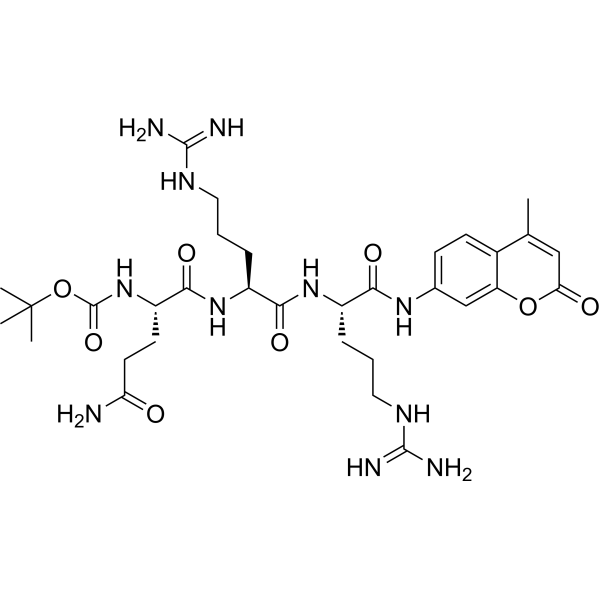
Boc-Gln-Arg-Arg-AMC is a fluorogenic substrate for the determination of protease activity. Boc-Gln-Arg-Arg-AMC undergoes hydrolysis and releases the fluorescent product 7-amino-4-methylcoumarin (AMC). AMC is fluorescent under UV light and can emit a fluorescent signal .
loading...
    loading...
Cat. No.: HY-P4323A
CAS No.: 2223665-74-3
Target:  

Fluorescent Dye

Research Areas:  

Others

Boc-Gln-Arg-Arg-AMC acetate is a fluorogenic substrate for the determination of protease activity. Boc-Gln-Arg-Arg-AMC undergoes hydrolysis and releases the fluorescent product 7-amino-4-methylcoumarin (AMC). AMC is fluorescent under UV light and can emit a fluorescent signal .
loading...
    loading...
Cat. No.: HY-P4406A
Target:  

Fluorescent Dye

Research Areas:  

Others

Abz-AGLA-Nba TFA is a fluorogenic substrate for the determination of protease activity. Abz-AGLA-Nba TFA is hydrolyzed to release aminoacyl benzimide (Abz-AGLA) and 2-naphthylaminoacyl (Nba). The product Abz-AGLA produced by this hydrolysis reaction is fluorescent under ultraviolet light and can emit a fluorescent signal .
loading...
    loading...
Cat. No.: HY-P4408
CAS No.: 660846-99-1
Target:  

Fluorescent Dye

Research Areas:  

Others

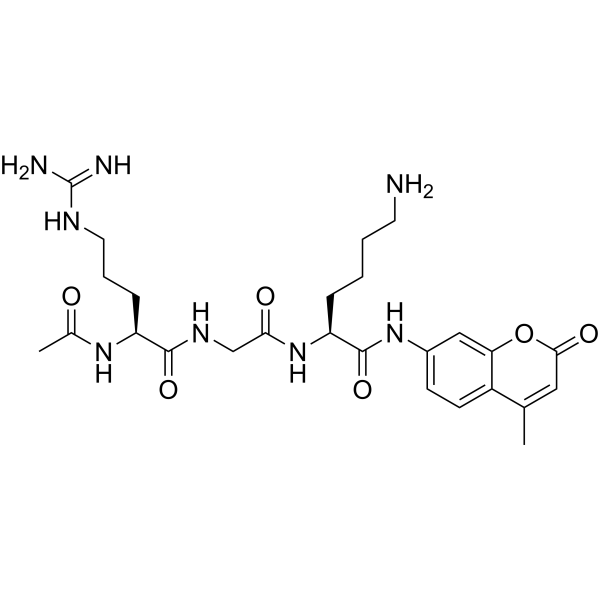
Ac-Arg-Gly-Lys-AMC is a fluorogenic substrate for the determination of protease activity. Ac-Arg-Gly-Lys-AMC undergoes hydrolysis and releases the fluorescent product 7-amino-4-methylcoumarin (AMC). AMC is fluorescent under UV light and can emit a fluorescent signal .
loading...
    loading...
Cat. No.: HY-153574
Synonyms: pArg-JQ1
Research Areas:  

Infection

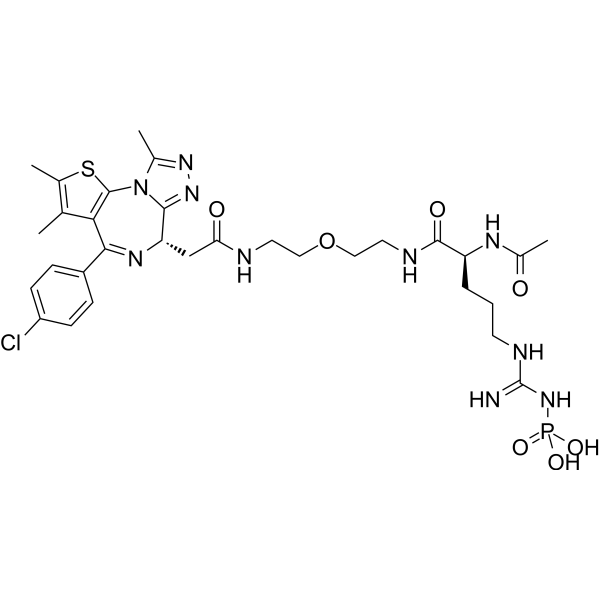
BI01826025 (pArg-JQ1) is a BacPROTAC-type bifunctional degrader that induces the degradation of BRDTBD1-containing substrates by recruiting the ClpC1P1P2 protease system. BI01826025 binds to the BRDTBD1 substrate via its JQ1 moiety and to ClpC1 via its pArg moiety; it delivers the substrate to ClpC1, where the substrate undergoes ClpC1-mediated unfolding followed by proteolysis by ClpP1P2. BI01826025 can be used to study ClpC1P1P2-mediated targeted protein degradation and ClpC2-regulated bacterial protein homeostasis .
loading...
    loading...
Cat. No.: HY-P4400
CAS No.: 219138-08-6
Target:  

Fluorescent Dye

Research Areas:  

Others

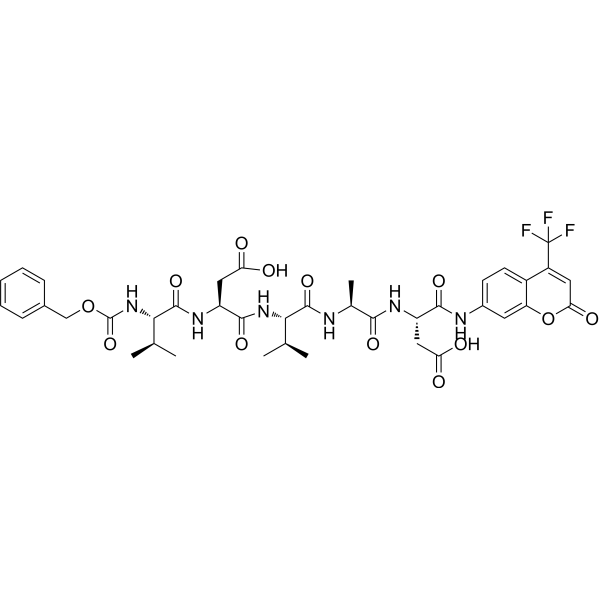
Z-VDVAD-AFC is a fluorogenic substrate. Z-VDVAD-AFC is used to measure the activity of cysteine protease 3 (Caspase-3). Z-VDVAD-AFC undergoes hydrolysis to release 7-amino-4-trifluoromethylcoumarin (AFC). AFC is fluorescent under ultraviolet light and can emit fluorescent signals .
loading...
    loading...
Cat. No.: HY-P4416
CAS No.: 577969-56-3
Target:  

Fluorescent Dye

Research Areas:  

Others

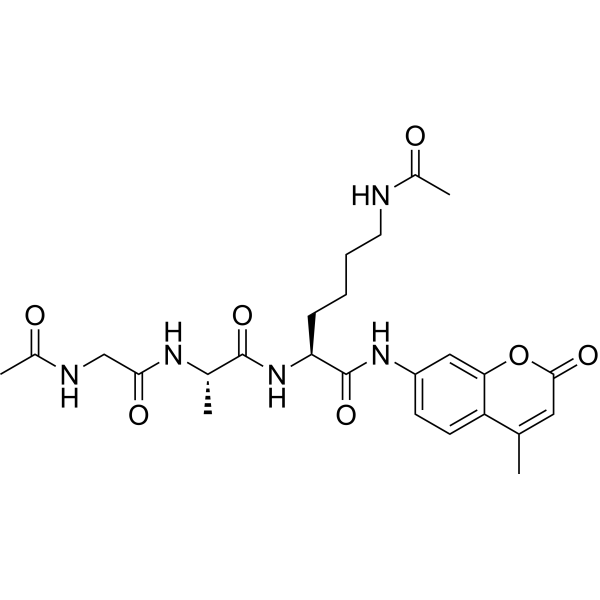
Ac-Gly-Ala-Lys(Ac)-AMC is a fluorogenic substrate for the determination of protease activity. Ac-Gly-Ala-Lys(Ac)-AMC undergoes hydrolysis and releases the fluorescent product 7-amino-4-methylcoumarin (AMC). AMC is fluorescent under UV light and can emit a fluorescent signal .
loading...
    loading...
Cat. No.: HY-P4419A
Target:  

Fluorescent Dye

Research Areas:  

Others

Boc-Asp(OBzl)-Pro-Arg-AMC acetate is a fluorogenic substrate for the determination of protease activity. Boc-Asp(OBzl)-Pro-Arg-AMC acetate undergoes hydrolysis and releases the fluorescent product 7-amino-4-methylcoumarin (AMC). AMC is fluorescent under UV light and can emit a fluorescent signal .
loading...
    loading...
Cat. No.: HY-W344383
CAS No.: 73554-90-2
Research Areas:  

Others

Boc-Phe-Ser-Arg-AMC is a fluorescence peptide substrate with specificity. Boc-Phe-Ser-Arg-AMC can be cleaved by tryptase-like serine proteases (TLSPs) to generate fluorescent products, thereby enabling the detection of TLSPs activity. Boc-Phe-Ser-Arg-AMC can be used in studies related to rosacea .
loading...
    loading...
Cat. No.: HY-N15079
CAS No.: 88465-81-0
Arphamenine B is a Zn 2+-dependent exopeptidase that selectively removes arginine and/or lysine residues from the NH2-terminus of several peptide substrates. Arphamenine B is an inhibitor of aminopeptidase B that can be isolated from bacteria. Arphamenine B enhances the immune response and is used to characterize novel proteases .
loading...
    loading...
Cat. No.: HY-P2895
CAS No.: 9028-00-6
Synonyms: Clostridiopeptidase B
Target:  

Endogenous Metabolite

Research Areas:  

Others

Clostripain (Clostridiopeptidase B) is a thiol protease isolated from Clostridium histolyticum. Clostripain exhibits proteolytic activity as well as amidase-esterase activity. The specificity of Clostripain is primarily restricted to arginine residues, but it also shows minor hydrolytic activity toward most lysine-containing substrates. Clostripain catalyzes the ammonolysis of Carbobenzoxyarginyl methyl ester to generate various dipeptides .
loading...
    loading...
Cat. No.: HY-P4404
CAS No.: 827044-38-2
Target:  

Cathepsin

Research Areas:  

Others

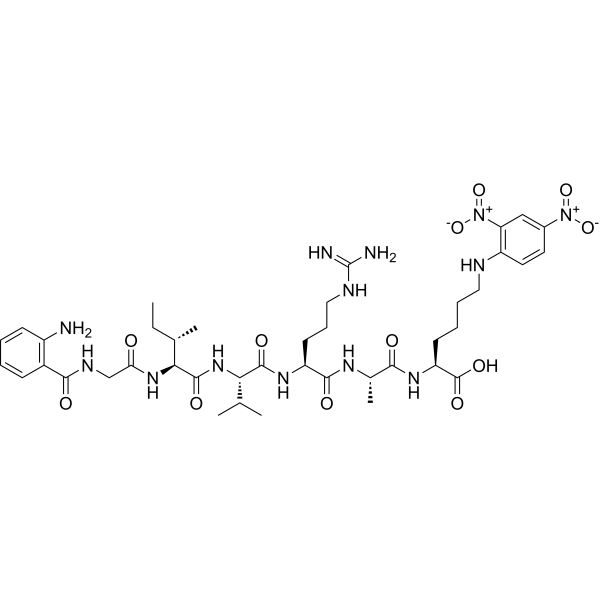
Abz-GIVRAK(Dnp) is the most efficient substrate for cathepsin B and is highly selective for this enzyme among lysosomal cysteine proteases. After Abz-GIVRAK(Dnp) is hydrolyzed, aminoacylbenziminosulfosuccinic acid (Abz-SAS) is released, and dinitrobenzoyl (Dnp) is also released. The product of this hydrolysis reaction, Abz-SAS, is fluorescent under ultraviolet light and can emit a fluorescent signal .
loading...
    loading...
Cat. No.: HY-W344383A
Research Areas:  

Others

Boc-Phe-Ser-Arg-AMC TFA is a fluorescence peptide substrate with specificity. Boc-Phe-Ser-Arg-AMC TFA can be cleaved by tryptase-like serine proteases (TLSPs) to generate fluorescent products, thereby enabling the detection of TLSPs activity. Boc-Phe-Ser-Arg-AMC TFA can be used in studies related to rosacea .
loading...
    loading...

