129 Results for "

soil

" in MedChemExpress (MCE) Product Catalog:
Products (129)

129 Results for "soil" in MCE Product Catalog:

Cat. No.: HY-117204
CAS No.: 68026-87-9
Target:  

Antibiotic

AA-57 is an acidic lipophilic antibiotic isolated from the fermentation broth of Actinomycetes strain AA-57. The AA-57 strain can be isolated from a soil sample collected in Koriyama City, Fukushima Prefecture, Japan. AA-57 has antibacterial properties against Gram-positive bacteria, Gram-negative bacteria, and acid-fast bacteria. AA-57 was discovered by screening actinomycete cultures for antibacterial properties. AA-57 exhibits significant antibacterial activity and has inhibitory effects against a variety of bacteria.
loading...
    loading...
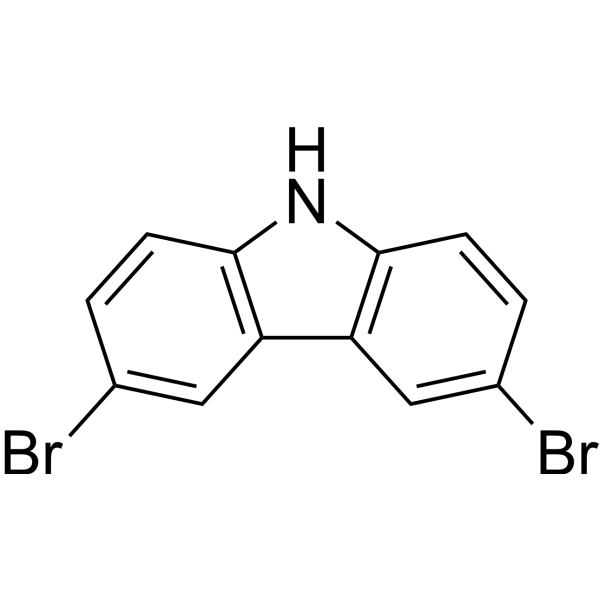
Cat. No.: HY-W009154
CAS No.: 6825-20-3
3,6-Dibromocarbazole is a glucocorticoid receptor (GR) inhibitor and Environmental pollutant. 3,6-Dibromocarbazole induces abnormal development of zebrafish embryos and disrupts the neurohormonal function of the hypothalamic-pituitary-adrenal axis in zebrafish larvae. 3,6-Dibromocarbazole increases the α-diversity of soil bacteria, alters community structure, enhances interspecific competition, regulates metabolic functions, and changes the abundance of genes related to nitrogen fixation, nitrification and carbon cycling. 3,6-Dibromocarbazole exerts endocrine-disrupting potential by interfering with the gluconeogenesis pathway .
loading...
    loading...
Cat. No.: HY-167959
CAS No.: 26544-20-7
Target:  

Herbicide

Research Areas:  

Infection

MCPA-isooctyl is a selective conductive phenoxycarboxylate herbicide and an alternative to 2,4-D Butyl ester (HY-B0867). MCPA-isooctyl effectively controls broadleaf weeds in various crop fields via post-emergence foliar or soil treatment. MCPA-isooctyl is absorbed by the roots, stems and leaves of plants; it is easily metabolized and detoxified in gramineous crops, but difficult to metabolize in dicotyledonous weeds, causing stem and leaf distortion, root deformation, and eventually weed death. When formulated into chitosan nanoparticles, MCPA-isooctyl still significantly inhibits the growth of weeds in wheat fields, and reduces their chlorophyll content and biomass at low doses .
loading...
    loading...
Cat. No.: HY-W133968
CAS No.: 9003-04-7
Research Areas:  

Others

Polyacrylate sodium is a sodium polyacrylate salt with extremely strong hygroscopicity. Polyacrylate sodium serves as a gel excipient and can be used as a pharmaceutical excipient. Polyacrylate sodium can reduce permeability by modifying bentonite to form a cavity-containing microstructure, while improving the chemical resistance, cation exchange capacity, and free swelling index of bentonite. Polyacrylate sodium can enhance the water retention capacity, available water content, and top-layer water content of sandy soil, while reducing the saturated hydraulic conductivity, wetting front advance rate, and infiltration rate. Polyacrylate sodium can chelate Cu 2+ ions in aqueous solutions and has renewable adsorption capacity. Polyacrylate sodium is widely used in researches related to various fields such as consumer products, agriculture, and industry .
loading...
    loading...
Cat. No.: HY-L247
296 compounds

Environmental pollution refers to the process where human activities release harmful chemicals or energy (such as industrial waste, pesticides, and plastic particles) into the natural environment at a rate that exceeds the ecosystem's capacity for self-purification, leading to deterioration in the composition or state of the atmosphere, water bodies, and soil. Environmental pollution is not only a direct threat to biodiversity but also ultimately impacts human health through the bioaccumulation effect of the food chain. Therefore, the accurate identification and dynamic monitoring of pollutants constitute the scientific cornerstone for formulating environmental policies, assessing ecological risks, and promoting green chemistry transformation.

MCE features a collection of 296 environmental pollutants, covering categories such as air pollutants, water pollutants, and pesticides, for research in the field of environmental chemistry.

Cat. No.: HY-121139
CAS No.: 756-09-2
Synonyms: 2,2,3,3-Tetrafluoropropionic acid; 3H-Tetrafluoropropionic acid
Target:  

Herbicide

Research Areas:  

Others

Flupropanate (2,2,3,3-Tetrafluoropropionic acid; 3H-Tetrafluoropropionic acid) is a soil-active selective herbicide and plant growth inhibitor that acts by inhibiting radicle growth and lipid biosynthesis in sensitive plants. Flupropanate exhibits high-efficiency control of Stipa weeds (such as Nassella neesiana and N. trichotoma) in pastures, and reduces the coverage of the invasive species Eragrostis curvula. Meanwhile, Flupropanate is sensitive to gramineous plants like ryegrass, but shows good selective tolerance to plantain, chicory and some leguminous plants. Studies show that in the protected area with Mediterranean climate in southwestern Australia, Flupropanate produces no significant non-target effects on native plant communities, functional groups or the endangered species Grevillea curviloba, indicating high ecological safety .
loading...
    loading...
Cat. No.: HY-N16377
CAS No.: 1644075-01-3
1-Butyl-3,5,8-trihydroxy-9,10-anthracenedione (Compound 2) is an anthraquinone analog. 1-Butyl-3,5,8-trihydroxy-9,10-anthracenedione can be isolated from soil Actinomycete Streptomyces. 1-Butyl-3,5,8-trihydroxy-9,10-anthracenedione has potent cytotoxicity against HepG2, A875, BGC-823 and MCF-7 cells with IC50s of 2.29, 4.90, 0.99 and 1.66 μg/mL, respectively. 1-Butyl-3,5,8-trihydroxy-9,10-anthracenedione has an antitumor activity .
loading...
    loading...
Cat. No.: HY-W115721
CAS No.: 523-21-7
Synonyms: Sodium rhodizonate dibasic
Rhodizonic acid disodium (Sodium rhodizonate dibasic) is a transition metal-dependent pro-oxidant and lead detection agent that induces reactive oxygen species generation, DNA damage, and inhibits Aconitase activity. Rhodizonic acid disodium generates superoxide anion radicals in an iron (II)-dependent manner, leading to aconitase inactivation. Rhodizonic acid disodium also triggers hydroxyl radical-mediated DNA strand breaks and 8-OHdG formation via copper ion reduction. Rhodizonic acid disodium reacts with lead to form a scarlet precipitate, with the color intensity proportional to lead content, enabling qualitative or quantitative analysis of lead. Rhodizonic acid disodium can also be used for real-time visualization of the dynamic process of lead sequestration in the plant rhizosphere and evaluation of the effects of environmental factors such as soil type on the stability of lead-sequestering structures .
loading...
    loading...
Cat. No.: HY-N1970R
CAS No.: 31721-94-5
5,7-Dihydroxychromone (Standard) is the analytical standard of 5,7-Dihydroxychromone (HY-N1970). This product is intended for research and analytical applications. 5,7-Dihydroxychromone is a flavonoid compound with antioxidant properties. 5,7-Dihydroxychromone induces Nrf2 nuclear translocation, increases Nrf2/ARE binding activity, and up-regulates Nrf2-dependent antioxidant genes HO-1, NQO1, GCLc. 5,7-Dihydroxychromone attenuates excessive ROS generation, inhibits activated caspase-3, caspase-9, cleaved PARP expression, and prevents neuronal apoptosis and cell death. 5,7-Dihydroxychromone increases LXRα and PPARγ mRNA expression, induces preadipocyte differentiation, and regulates blood glucose levels. 5,7-Dihydroxychromone inhibits radial growth of soil pathogenic fungi, radicle elongation of select seedlings, and transiently inhibits Bradyrhizobium sp. growth in high mannitol medium. 5,7-Dihydroxychromone can be used for the research of Parkinson’s disease, type 2 diabetes mellitus and pathogenic fungal infection .
loading...
    loading...

