
1557 Results for "

ADC Linker

" in MedChemExpress (MCE) Product Catalog:
Products (1557)

1557 Results for "ADC Linker" in MCE Product Catalog:

Cat. No.: HY-W800617
CAS No.: 2055024-63-8
Target:  

ADC Linkers

Research Areas:  

Cancer

NH2-PEG1-Val-Cit-PAB-OH is a cleavable ADC linker intermediate featuring a primary amine, a hydrophilic PEG spacer, a Val-Cit dipeptide, and a PAB group. The benzylic alcohol on the PAB can be used to attach with reactive groups such as PNP for conjugation with drug payloads. The primary amine is free to perform a wide variety of reactions such as coupling with carboxylic acids, reductive aminations with ketones or aldehydes, or other more specialized uses such as in SNAr reactions or heterocyclic chemistry. The Val-Cit dipeptide is cleaved by cellular proteases within the cell to allow for efficient payload delivery via an elimination mechanism within the PAB structure.
loading...
    loading...
Cat. No.: HY-W800618
CAS No.: 2055024-62-7
Target:  

ADC Linkers

Research Areas:  

Others

NH2-PEG3-Val-Cit-PAB-OH is a cleavable ADC linker featuring a primary amine, a hydrophilic PEG spacer, a Val-Cit dipeptide, and a PAB group. The benzylic alcohol on the PAB can be used to attach with reactive groups such as PNP for conjugation with drug payloads. The primary amine is free to perform a wide variety of reactions such as coupling with carboxylic acids, reductive aminations with ketones or aldehydes, or other more specialized uses such as in SNAr reactions or heterocyclic chemistry. The Val-Cit dipeptide is cleaved by cellular proteases within the cell to allow for efficient payload delivery via an elimination mechanism within the PAB structure.
loading...
    loading...
Cat. No.: HY-W800619
CAS No.: 2055024-61-6
Target:  

ADC Linkers

Research Areas:  

Others

NH2-PEG4-Val-Cit-PAB-OH is a cleavable ADC linker featuring a primary amine, a hydrophilic PEG spacer, a Val-Cit dipeptide, and a PAB group. The benzylic alcohol on the PAB can be used to attach with reactive groups such as PNP for conjugation with drug payloads. The primary amine is free to perform a wide variety of reactions such as coupling with carboxylic acids, reductive aminations with ketones or aldehydes, or other more specialized uses such as in SNAr reactions or heterocyclic chemistry. The Val-Cit dipeptide is cleaved by cellular proteases within the cell to allow for efficient payload delivery via an elimination mechanism within the PAB structure.
loading...
    loading...
Cat. No.: HY-W800620
CAS No.: 2055024-60-5
Target:  

ADC Linkers

Research Areas:  

Others

NH2-PEG6-Val-Cit-PAB-OH is a cleavable ADC linker featuring a primary amine, a hydrophilic PEG spacer, a Val-Cit dipeptide, and a PAB group. The benzylic alcohol on the PAB can be used to attach with reactive groups such as PNP for conjugation with drug payloads. The primary amine is free to perform a wide variety of reactions such as coupling with carboxylic acids, reductive aminations with ketones or aldehydes, or other more specialized uses such as in SNAr reactions or heterocyclic chemistry. The Val-Cit dipeptide is cleaved by cellular proteases within the cell to allow for efficient payload delivery via an elimination mechanism within the PAB structure.
loading...
    loading...
Cat. No.: HY-157763
Research Areas:  

Cancer

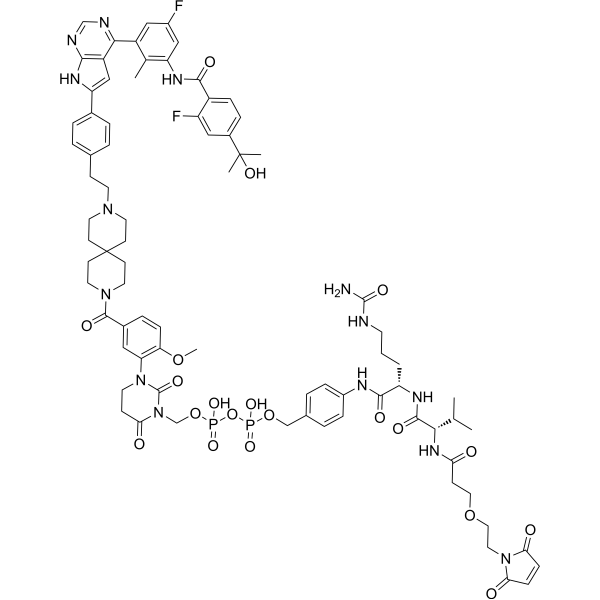
Mal-PEG1-Val-Cit-PABC-diphosphate-BTK degrader-1 is a cleavable linker-payload conjugate and cereblon-binding BTK bifunctional degrader. Mal-PEG1-Val-Cit-PABC-diphosphate-BTK degrader-1 induces BTK degradation and exerts cytotoxic effects when delivered via CD79b monoclonal antibody. Mal-PEG1-Val-Cit-PABC-diphosphate-BTK degrader-1, when formulated as a CD79b antibody-drug conjugate, achieves sustained in vivo BTK degradation in tumor-bearing mice with reduced systemic payload exposure. Mal-PEG1-Val-Cit-PABC-diphosphate-BTK degrader-1 can be used for the research of activated b-cell-like diffuse large b-cell lymphoma (ADC linker: (HY-130944); PROTAC: (HY-163295)) .
loading...
    loading...
Cat. No.: HY-P99682
CAS No.: 1629760-28-6
Synonyms: hLIV22
Target:  

ADC Antibodies

Research Areas:  

Cancer

Ladiratuzumab (hLIV22) is a humanized monoclonal antibody against zinc transporter LIV-1/ZIP6. Ladiratuzumab is conjugated to MMAE (HY-15162) via a cleavable dipeptide linker to synthesize an antibody-drug conjugate (ADC) Ladiratuzumab vedotin (HY-P99683). Ladiratuzumab vedotin selectively targets LIV-1 protein overexpressed on the surface of tumor cells, enters cells through antibody-mediated receptor endocytosis, releases MMAE to inhibit microtubule polymerization, and kills adjacent tumor cells with a bystander effect. Ladiratuzumab can be used in the study of solid tumors such as metastatic triple-negative breast cancer (mTNBC) .
loading...
    loading...
Cat. No.: HY-L951
505 compounds

Macrocyclic scaffolds are increasingly valued in modern drug discovery for their exceptional activity against undruggable targets (proteases, kinases, PPIs). 2026 marks a key commercial breakthrough for oral macrocyclic peptides: enlicitide, the world’s first oral PCSK9 macrocyclic peptide, has received FDA approval. Macrocyclic candidates targeting KRAS and other classic undruggable targets have also entered clinical development, validating macrocyclization as an effective strategy to overcome druggability barriers.

Two core R&D directions lead current macrocyclic drug design: AI-driven de novo generation and structural optimization of small-molecule macrocycles, and macrocyclic peptides based on sequence design and conformational engineering. Macrocycle druggability hinges on embedded linkers, which determine cyclization efficiency, final conformation and drug-like properties. Bifunctional reaction orthogonality is the core linker selection criterion. Our linker library enables stepwise intramolecular cyclization with suppressed side reactions, accommodates varied ring sizes, and covers three key reaction systems: amide condensation, nucleophilic substitution and CuAAC click chemistry.

Built on classical macrocyclization systems, the library is processed through reaction classification, bifunctional orthogonality evaluation, novelty clustering and redundancy removal, with PROTAC long-chain and ADC cleavable linkers explicitly excluded. Featuring rigid, semi-rigid and flexible scaffolds, it is widely applicable to small-molecule macrocycle synthesis and linear peptide cyclization.

Cat. No.: HY-171124
Synonyms: AZD9592
Tilatamig samrotecan (AZD9592) is an anti-EGFR/c-MET antibody-drug conjugate (ADC). Tilatamig samrotecan consists of an anti-EGFR/c-MET antibody with the drug-linker conjugate being AZ14170133 (HY-145399) (a topoisomerase I (TOP1i) inhibitor payload). Tilatamig samrotecan induces multiple DNA damage response pathway markers (like ATM, ATR, γH2AX). Tilatamig samrotecan selectively binds to EGFR and c-MET, delivering the cytotoxic payload. Tilatamig samrotecan exerts anti-tumor activity in vivo. Tilatamig samrotecan can be used for non-small cell lung cancer (NSCLC) and head and neck squamous cell carcinoma (HNSCC) research .
loading...
    loading...
Cat. No.: HY-177542
CAS No.: 2855974-40-0
Synonyms: Emi-Le; XMT-1660
Research Areas:  

Cancer

Emiltatug ledadotin (Emi-Le; XMT-1660) is a B7-H4-targeted antibody-drug conjugate (ADC). Emiltatug ledadotin consists of the tumor-specific anti-B7-H4 monoclonal antibody Emiltatug (HY-P990918) and the linker-payload system Ledadotin (HY-177541), with site-specific conjugation achieved via GlycoConnect click chemistry. Emiltatug ledadotin inhibits the growth of B7-H4-positive cancer cells. Emiltatug ledadotin can be used to study advanced solid tumors with B7-H4 overexpression, particularly breast cancer, ovarian cancer, and endometrial cancer .
loading...
    loading...
Cat. No.: HY-P3371
CAS No.: 2484870-92-8
Synonyms: DS-7300a; MABX-9001a; I-DXd
Ifinatamab deruxtecan (DS-7300a) is a B7-H3-targeting Antibody-drug conjugate (ADC), which is composed of a humanized anti-B7-H3 monoclonal antibody, an enzymatically cleavable peptide-based linker, and Exatecan derivative (DXd) (HY-13631D). Ifinatamab deruxtecan is a DNA Topoisomerase I inhibitor. Ifinatamab deruxtecan induces Apoptosis. DS-7300a exerts potent antitumor activities against B7-H3-expressing tumors. against rhabdomyosarcoma, endometrial adenocarcinoma and lung adenocarcinoma. Ifinatamab deruxtecan does not exert direct immunomodulatory effects
loading...
    loading...
Cat. No.: HY-180467
CAS No.: 2823367-76-4
Target:  

ADC Linkers

Research Areas:  

Cancer

Neu5Ac-2Galβ1-3Glc-oxazoline-(2)Me (Compound G12) is a disaccharide linker. Neu5Ac-2Galβ1-3Glc-oxazoline-(2)Me can be efficiently recognized by the endo-glycosidase Endo-S2 and can be directedly transferred to the conserved N-glycosylation site (Asn297 position) of the antibody's Fc domain through enzymatic catalytic reactions, thereby achieving site-specific modification of the antibody. Neu5Ac-2Galβ1-3Glc-oxazoline-(2)Me can be used for for the synthesis of antibody-conjugated drugs (ADCs) .
loading...
    loading...
Cat. No.: HY-180467A
Target:  

ADC Linkers

Research Areas:  

Cancer

Neu5Ac-2Galβ1-3Glc-oxazoline-(2)Me (Compound G12) sodium is a disaccharide linker. Neu5Ac-2Galβ1-3Glc-oxazoline-(2)Me sodium can be efficiently recognized by the endo-glycosidase Endo-S2 and can be directedly transferred to the conserved N-glycosylation site (Asn297 position) of the antibody's Fc domain through enzymatic catalytic reactions, thereby achieving site-specific modification of the antibody. Neu5Ac-2Galβ1-3Glc-oxazoline-(2)Me sodium can be used for for the synthesis of antibody-conjugated drugs (ADCs) .
loading...
    loading...
Cat. No.: HY-164702
Synonyms: Izalontamab Brengitecan
Research Areas:  

Cancer

BL-B01D1 (Izalontamab Brengitecan) is a bispecific antibody-drug conjugate (ADC) targeting EGFR and HER3, formed by conjugating the EGFR/HER3 bispecific antibody Izalontamab (HY-P99676) to a novel TOP-I inhibitor payload Deruxtecan 2-hydroxypropanamide (HY-153891) via a cleavable linker (Mc-Gly-Gly-Phe-Gly). BL-B01D1 binds to EGFR and HER3 on the surface of tumor cells, mediates endocytosis and releases the payload, inhibits topoisomerase I, blocks DNA replication and RNA synthesis, and disrupts DNA structure. BL-B01D1 induces cell cycle S-phase arrest, apoptosis, antibody-dependent cell-mediated cytotoxicity, and tumor cell death. BL-B01D1 can be used for cancer research .
loading...
    loading...
Cat. No.: HY-185743
ZW-191 is an antibody-drug conjugate (ADC) targeting folate receptor α (FRα). ZW-191 consists of ZW-191 Antibody (HY-P992515) as the antibody component and MC-GGFG-AM-(10Me-11F-Camptothecin) (HY-153360) as the linker-payload component. ZW-191 possesses excellent tumor sphere penetration, cellular internalization and payload delivery capabilities, and can release a topoisomerase 1 inhibitor inside tumor cells to inhibit tumor cell activity. ZW-191 exerts a potent bystander effect on both antigen-positive and antigen-negative cells. ZW-191 exhibits prominent activity in xenograft models of cell lines with different FRα expression levels. ZW-191 can be used in studies related to ovarian cancer, non-small cell lung cancer, endometrial cancer and triple-negative breast cancer .
loading...
    loading...
Cat. No.: HY-164919
CAS No.: 2847102-44-5
Synonyms: XMT-2056
Calotatug ginistinag (XMT-2056) is an antibody-drug conjugate (ADC) targeting HER2, linked to a payload composed of XMT-1519 conjugate-1 (HY-148067) and STING agonist-20 (HY-148068). Calotatug ginistinag activates the STING signaling pathway in tumor cells and tumor-resident immune cells, induces the production of type I interferons and cytokines (CXCL10, IFN-β, IL-6, TNF-α, triggers innate anti-tumor immune responses, and exerts a bystander effect. Calotatug ginistinag exhibits efficacy against HER2-expressing cancer cells in co-culture with PBMCs. Calotatug ginistinag induces tumor regression and reduces systemic inflammation in various tumor models. Combination treatment with Calotatug ginistinag, Trastuzumab (HY-P9907) and T-DXd (HY-138298) yields benefits. Calotatug ginistinag can be used in studies related to HER2-expressing solid tumors such as breast cancer, gastric cancer and ovarian cancer .
loading...
    loading...
Cat. No.: HY-L258
437 compounds

In modern medicinal chemistry and chemical biology research, alkyne (-C≡C-) structures play an important role in click chemistry, bioorthogonal labeling, and the construction of functional molecules due to their unique linear geometry and high reactivity. In particular, driven by the development of copper-catalyzed azide-alkyne cycloaddition (CuAAC) and copper-free click reactions (SPAAC), terminal alkyne groups have become important “chemical handles” for building complex biomolecular systems.

The MCE Alkyne Compound Library contains 437 compounds designed for the construction of click chemistry reaction systems and the development of diverse functional molecules. In drug discovery, these structures serve as key reactive sites that can efficiently undergo click reactions with azide groups, enabling modular assembly of PROTAC molecules, construction of ADC linkers, and rapid synthesis of bioorthogonal labeling probes. In addition, alkyne groups exhibit high stability, mild reaction conditions, and excellent biocompatibility, allowing them to maintain reactivity in complex biological environments. This contributes to improved efficiency and controllability in drug development, making them indispensable chemical building blocks in modern drug design and functional molecular engineering.

Cat. No.: HY-164729
FZ-AD005 is a DLL3-targeting antibody-drug conjugate (ADC) with high selectivity, composed of the anti-DLL3 antibody FZ-A038 (HY-P990896), a dipeptide linker (Val-Ala), and DXd (HY-13631D). The Kd value of FZ-AD005 for human DLL3 ranges from 13.29 to 58.3 pmol/L. After binding to DLL3 on the cell surface, FZ-AD005 mediates endocytosis, and the payload DXd is released via cleavage by lysosomal cathepsins. DXd inhibits topoisomerase TopI to induce double-strand DNA breaks, cell cycle arrest and apoptosis, and FZ-AD005 exhibits bystander killing activity against adjacent DLL3-negative cells. FZ-AD005 shows stable circulation in vivo, has good tolerance and acceptable pharmacokinetic profiles in rats and cynomolgus monkeys, and effectively inhibits the growth of DLL3-expressing tumor cells. FZ-AD005 serves as a promising candidate molecule for research on small cell lung cancer and human neuroendocrine prostate cancer .
loading...
    loading...

