1775 Results for "

protonatable backbone amines

" in MedChemExpress (MCE) Product Catalog:
Products (1775)

1775 Results for "protonatable backbone amines" in MCE Product Catalog:

Cat. No.: HY-B1018AS
CAS No.: 1219798-40-9
Phenelzine-d5 sulfate is the deuterium labeled Phenelzine sulfate (HY-B1018A). Phenelzine sulfate, an antidepressant agent, is an irreversible and orally active monoamine oxidase (MAO-A and MAO-B) inhibitor. Phenelzine sulfate inhibits GABA transaminase and primary amine oxidase (PrAO), and sequester reactive aldehydes. Phenelzine sulfate also inhibits LSD1 (Ki: 5.6 μM) and suppresses oxidative stress and lipogenesis. Phenelzine sulfate elevates neurotransmitters (serotonin, norepinephrine, dopamine). Phenelzine sulfate is studied in neurological, metabolic and cancer diseases for depression and anxiety disorders, stroke, spinal cord injury, traumatic brain injury, multiple sclerosis, Parkinson’s disease, Alzheimer’s disease, inflammatory pain, obesity and prostate cancer .
loading...
    loading...
Cat. No.: HY-W016288R
CAS No.: 7149-49-7
Synonyms: 2,3-Naphthalenedicarboxaldehyde (Standard); Naphthalene-2,3-dialdehyde (Standard)
Research Areas:  

Infection

Naphthalene-2,3-dicarboxaldehyde (Standard) is the analytical standard for Naphthalene-2,3-dicarboxaldehyde (HY-W016288). This product is for research and analytical applications. Naphthalene-2,3-dicarboxaldehyde (NDA) is an effective inhibitor of Candida albicans aspartate semialdehyde dehydrogenase (ASADH), with a Ki value of 45 μM. Naphthalene-2,3-dicarboxaldehyde targets ASADH in the aspartate biosynthetic pathway of Candida albicans. Naphthalene-2,3-dicarboxaldehyde reacts with primary amines to generate highly fluorescent and stable derivatives. Naphthalene-2,3-dicarboxaldehyde serves as a fungistatic agent and a fluorogenic derivatization reagent. Naphthalene-2,3-Dicarboxaldehyde can be used for the research of candidiasis .
loading...
    loading...
Cat. No.: HY-W391671
CAS No.: 1333317-99-9
Research Areas:  

Others

Poly[bis(4-phenyl)(2,4,6-trimethylphenyl)amine] is a poly(triarylamine) that is an organic p-type semiconductor with hole mobilities ranging from 10 3 to 10 2 cm 2/V/s, which significantly improves carrier mobility. This stable, glassy polymer has an ionization potential suitable for thick film diodes. Committed to providing green alternatives that meet one or more of the 12 principles of green chemistry, this material falls into the enabling category of green alternatives, in line with the principle of "energy efficient design". In addition, while hole transport organic materials like these ensure optimal energy level alignment with the absorber layer for efficient charge collection, they can be susceptible to degradation under ambient conditions.
loading...
    loading...
Cat. No.: HY-10587R
CAS No.: 935693-62-2
BIX-01294 (Standard) is the analytical standard of BIX-01294 (HY-10587). This product is intended for research and analytical applications. BIX-01294 is a reversible and highly selective G9a and GLP Histone Methyltransferase inhibitor, with IC50s of of 1.7 μM and 0.9 μM, respectively. BIX-01294 inhibits G9a/GLP by competing for binding with the amino acids N-terminal of the substrate lysine residue. BIX-01294, a (1H-1,4-diazepin-1-yl)-quinazolin-4-yl amine derivative, induces necroptosis and autophagy. BIX-01294 has antitumor activity in recurrent tumor cells .
loading...
    loading...
Cat. No.: HY-108239R
CAS No.: 1392399-03-9
BIX-01294 trihydrochloride (Standard) is the analytical standard of BIX-01294 (trihydrochloride) (HY-108239). This product is intended for research and analytical applications. BIX-01294 trihydrochloride is a reversible and highly selective G9a and GLP Histone Methyltransferase inhibitor, with IC50s of of 1.7 μM and 0.9 μM, respectively. BIX-01294 trihydrochloride inhibits G9a/GLP by competing for binding with the amino acids N-terminal of the substrate lysine residue. BIX-01294 trihydrochloride, a (1H-1,4-diazepin-1-yl)-quinazolin-4-yl amine derivative, induces necroptosis and autophagy. BIX-01294 trihydrochloride has antitumor activity in recurrent tumor cells .
loading...
    loading...
Cat. No.: HY-D2772
CAS No.: 383912-87-6
5-TAMRA cadaverine can used to modify carboxylic acid group in the presence of activators (e.g. EDC, or DCC) or activated esters (e.g. NHS esters) through a stable amide bond. It also can be reversibly coupled to aldehydes and ketones to form a Schiff base – which can be reduced to a generate stable amine derivative by sodium borohydride (NaBH4) or sodium cyanoborohydride (NaCNH3). Although the mixed isomers of 5(6)-TAMRA cadaverine is a preferred, routinely used orange-fluorescent dye for staining proteins, it is rearly used for labeling peptides and nucleotides. Purification of 5(6)-TAMRA labeled peptide and nucleotides might be troublesome due to significant signal broadening in HPLC purification. Peptides and nucleotides labeled with a single isomer TAMRA usually give better resolution in HPLC purification that is often required in the conjugation processes.
loading...
    loading...
Cat. No.: HY-D2773
CAS No.: 219729-26-7
5-Carboxyrhodamine 110 NHS Ester is the nonsulfonated analog of the BP Fluor 488 dye. The amine-reactive 5(6)-Carboxyrhodamine 110 NHS Ester can be used to create bright and photostable green-fluorescent bioconjugates with excitation/emission maxima ~502/527 nm. For many applications, the dye is preferred over 5-(6)-carboxyfluorescein NHS ester or FITC because of its exceptional photostability and fluorescence insensitivity to pH (4-9). Although the mixed isomers of Carboxyrhodamine 110 NHS Ester preferred, routinely used fluorescent dye for labeling proteins, peptides and nucleotides, purification of peptide and nucleotides labeled with 5(6) isomers might be troublesome due to significant signal broadening in HPLC purification. Peptides and nucleotides labeled with a single isomer usually give better resolution in HPLC purification that is often required in the conjugation processes.
loading...
    loading...
Cat. No.: HY-W391506
CAS No.: 9011-14-7
Synonyms: Poly(methyl methacrylate), beads; PMMA
Research Areas:  

Others

Poly (methyl methacrylate) (Poly(methyl methacrylate), beads; PMMA) is an amorphous glassy acrylic thermoplastic polymer belonging to the acrylate family, synthesized from methyl methacrylate monomers. Poly (methyl methacrylate) drives biochemical processes including free volume expansion induced by inelastic deformation, yield stress and strain softening regulated by physical aging, acid hydrolysis to polymethacrylic acid, multi-stage combustion, oxygen-dependent thermal decomposition, primary amine-mediated polypentanimide formation, and grafting/crosslinking-based copolymer and composite formation. Poly (methyl methacrylate) exhibits histocompatibility, low toxicity, low inflammatory potential, and fracture resistance; it can form functional blends and composites for biomedical and dental applications; it also allows performance-enhancing chemical and mechanical modifications. Poly (methyl methacrylate) is applicable to studies related to cranial repair .
loading...
    loading...
Cat. No.: HY-L123
6,767 compounds

Human metabolism is an integral part of cellular function that reflects individual differences in health, disease, diet, and lifestyle. Many health conditions such as obesity, diabetes, hypertension, heart disease, and cancer are associated with abnormal metabolic states. In the pathological state of the human body, metabolic pathways are significantly altered, resulting in aberrant levels of intermediates or end-products that can be viewed as potential diagnostic biomarkers or even therapeutic targets. Therefore, detection, identification and quantification of human metabolites are very important for drug metabolism research in drug development.

MCE offers a unique collection of 6,767 human metabolites, including endogenous metabolites and exogenous metabolites, covering multiple structure types, such as lipids, amino acids, nucleic acids, carbohydrates, organic acids, biogenic amines, vitamins,. MCE Human Metabolites Library is a helpful tool for studying the relationship between diseases and metabolism.

Cat. No.: HY-151824
CAS No.: 2576508-03-5
Target:  

ADC Linkers

Research Areas:  

Others

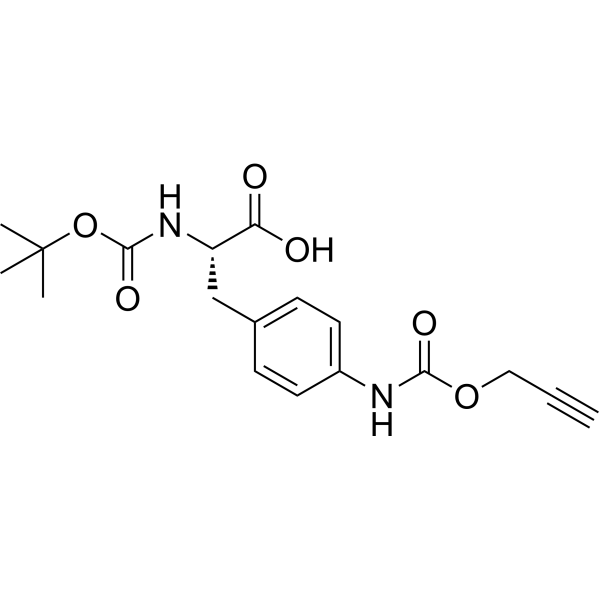
Boc-L-Phe(4-NH-Poc)-OH is a click chemistry reagent containing an azide group. Used as an orthogonally protected building block in peptide synthesis. Propargyloxycarbonyl, commonly abbreviated as Poc or Pryoc, can either be used as alkyne component for standard Click conjugation or in combination with tetrazine linkers in copper-free Diels-Alder type Click reactions. It also has applications as unusual protecting group for amines, hydroxy functions and as esters. All 3 are stable to neat TFA, but can be cleaved at ambient temperature with Co2(CO)8 in TFA:DCM. Deprotection with other transition metals like palladium have also been reported . Boc-L-Phe(4-NH-Poc)-OH is a click chemistry reagent, it contains an Alkyne group and can undergo copper-catalyzed azide-alkyne cycloaddition (CuAAc) with molecules containing Azide groups.
loading...
    loading...
Cat. No.: HY-151837
CAS No.: 2737202-66-1
Target:  

ADC Linkers

Research Areas:  

Others

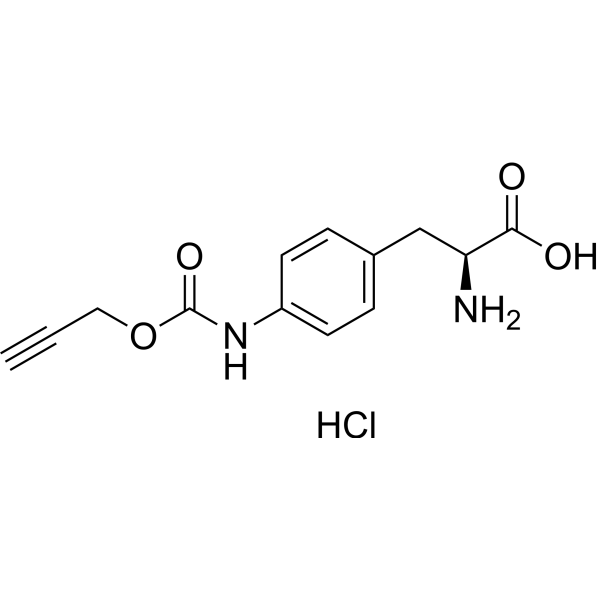
H-L-Phe(4-NH-Poc)-OH (hydrochloride) is a click chemistry reagent containing an azide group. Used as a modified Phe or Tyr analogue in protein and peptide biosynthesis. Propargyloxycarbonyl, commonly abbreviated as Poc or Pryoc, can either be used as alkyne component for standard Click conjugation or in combination with tetrazine linkers in copper-free Diels-Alder type Click reactions. It also has applications as unusual protecting group for amines, hydroxy functions and as esters. All 3 are stable to neat TFA, but can be cleaved at ambient temperature with Co2(CO)8 in TFA:DCM. Deprotection with other transition metals like palladium have also been reported . H-L-Phe(4-NH-Poc)-OH (hydrochloride) is a click chemistry reagent, it contains an Alkyne group and can undergo copper-catalyzed azide-alkyne cycloaddition (CuAAc) with molecules containing Azide groups.
loading...
    loading...
Cat. No.: HY-D3080
Target:  

Fluorescent Dye

Research Areas:  

Others

CR-1 is a ratiometric photoacoustic (PA) probe for in-situ real-time imaging of Zn 2+ in deep living tissues. CR-1 is formed by coupling the near-infrared cyanine dye IR825 with the Zn 2+ ligand tris (2-pyridylmethyl) amine (TMPA). Upon binding to Zn 2+, the five N atoms on TMPA coordinate with Zn 2+, leading to double bond rearrangement of IR825 and attenuation of its π-electron conjugated system. The absorption peak of CR-1 blue-shifts from 710 nm to 532 nm, enabling quantitative detection of Zn 2+ via the PA532/PA710 ratio. Free CR-1 generates a strong PA signal at 710 nm, while CR-1 bound to Zn 2+ produces a strong PA signal at 532 nm .
loading...
    loading...
Cat. No.: HY-151833
CAS No.: 2639395-39-2
Target:  

ADC Linkers

Research Areas:  

Others

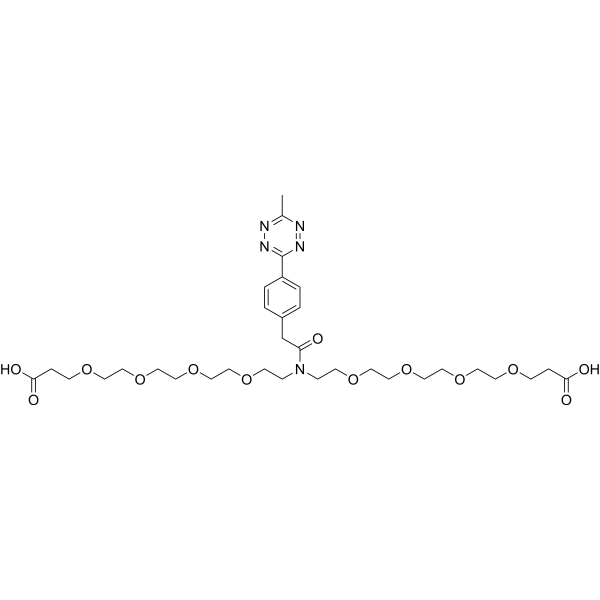
Methyltetrazine-amido-N-bis(PEG4-acid) is a click chemistry reagent containing an azide group. Methyltetrazine-amido-N-bis(PEG4-acid) is a PEG derivative that contains a methyltetrazine group and two acid groups. This reagent can react with TCO-containing compounds to form a stable covalent bond without the catalysis of Cu or elevated temperatures. The inverse-electron demand Diels-Alder cycloaddition reaction of TCO with tetrazines is the fastest bioorthogonal reaction with exceptional selectivity. The terminal carboxylic acid can react with primary amine groups in the presence of activators (e.g. EDC, or HATU) to form a stable amide bond. PEG linker increases the water solubility of the compound. Reagent grade, for research use only . Methyltetrazine-amido-N-bis(PEG4-acid) is a click chemistry reagent, it contains a Tetrazine group that can undergo an inverse electron demand Diels-Alder reaction (iEDDA) with molecules containing TCO groups.
loading...
    loading...
Cat. No.: HY-W043748
CAS No.: 38862-24-7
Synonyms: N-Succinimidyl acrylate
Research Areas:  

Others

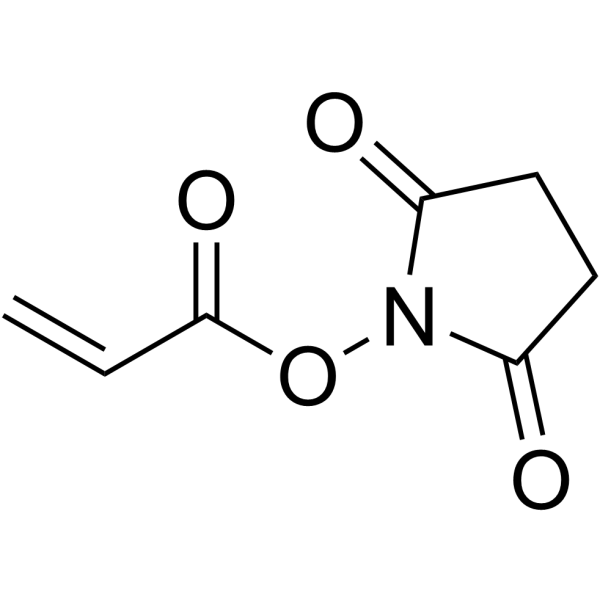
2,5-Dioxopyrrolidin-1-yl acrylate (N-Succinimidyl acrylate) is a lysine residue modifier and coupling monomer. 2,5-Dioxopyrrolidin-1-yl acrylate covalently modifies the primary amines of lysine residues on monoclonal anti-horseradish peroxidase IgG antibodies, neutralizes positive charges and replaces them with low-affinity acrylate groups. 2,5-Dioxopyrrolidin-1-yl acrylate inhibits the formation of rapid hard coronas on citrate-coated gold nanoparticles, induces antibody unfolding and loss of antigen-binding function, but does not affect the antigen-binding function of antibodies in free solution. 2,5-Dioxopyrrolidin-1-yl acrylate reacts with the ε-amino groups on lysine residues of L-asparaginase, introduces vinyl groups and generates N-hydroxysuccinimide. 2,5-Dioxopyrrolidin-1-yl acrylate regulates the activity of L-asparaginase .
loading...
    loading...
Cat. No.: HY-N20747
CAS No.: 28363-70-4
Synonyms: 4-Hydroxy-N-methyltryptamine; 4-HO-NMT
Norpsilocin (4-hydroxy-N-methyltrypt amine; 4-HO-NMT) is a natural tryptamine alkaloid isolated from the hallucinogenic mushroom Psilocybe cubensis. Norpsilocin activates human 5-HT2 receptors (5-HT2A: EC50 = 8.4 nM; 5-HT2B = 12.8 nM; 5-HT2C = 39.6 nM) and displays binding affinity toward 5-HT1 receptors (5-HT1B: Ki = 212 nM; 5-HT1D = 48.9 nM; 5-HT1E = 81.7 nM). Norpsilocin induces β-arrestin recruitment at the 5-HT1B receptor. Norpsilocin fails to produce psychedelic-like effects in mice, whereas high doses can induce hypothermia in vivo. Norpsilocin acts as an important research tool for exploring the structure–activity relationship of tryptamine hallucinogens and the pharmacology of serotonin receptors .
loading...
    loading...