181 Results for "

BODIPY

" in MedChemExpress (MCE) Product Catalog:
Products (181)

181 Results for "BODIPY" in MCE Product Catalog:

Cat. No.: HY-D1549
CAS No.: 1181844-41-6
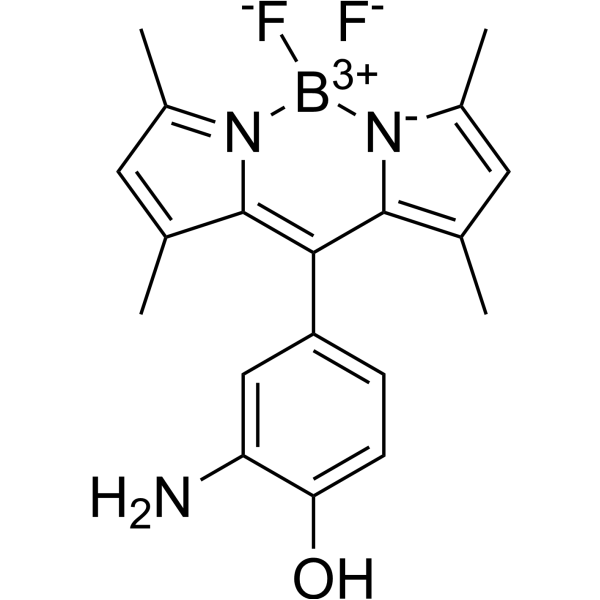
o-Pah is a BODIPY derivative with an -NH2 and -OH substituted meso-Ph group. o-Pah exhibits metal-induced J-aggregation in the presence of Cu 2+ and a specific fluorescence enhancement for Hg 2+ (Ex/Em=483/(495-600) nM) .
loading...
    loading...
Cat. No.: HY-P11911
Cyclo(Val-Val-Ile-d-Ala-Trp(7-Br)-Gly) is a cyclic peptide containing 7-bromotryptophan, designed as a precursor for Sonogashira cross-coupling to generate a BODIPY-conjugated probe selective for prefibrillar Aβ1−42 oligomers .
loading...
    loading...
Cat. No.: HY-155383
CAS No.: 2301931-35-9
TNIR7-1A is a fused cycloheptatriene–BODIPY derivative that displays properties favorable for near-infrared (NIR) imaging (Ex/Em = 600/774 nm in PBS) with high affinity and specificity to Neurofibrillary tangles (NFTs) in vitro. TNIR7-1A effectively penetrated the blood–brain barrier .
loading...
    loading...
Cat. No.: HY-D3432
WazaGaY-1 is an aza-BODIPY derivative, functions as a NIR-I/NIR-II fluorescent contrast agent. WazaGaY-1 undergoes internalization into tumor cells predominantly via clathrin-coated pits. WazaGaY-1 can be used for the research of glioblastoma, ovarian carcinoma and melanoma (Ex/Em = 685/820 nm) .
loading...
    loading...
Cat. No.: HY-D2620
CAS No.: 3030055-40-1
CAR-2 is a BODIPY-based photosensitizer that induces ferroptosis in photodynamic therapy (PDT) by targeting the endoplasmic reticulum (ER) and lipid droplets (LDs). CAR-2 exhibits phototoxicity in breast cancer cells with IC50 of 0.01-0.02 μM. CAR-2 exhibits antitumor efficacy in 4T1 xenograft mouse models .
loading...
    loading...
Cat. No.: HY-D3230
FLCS1 is a BODIPY-based Fluorescent probe and selective copper (I) ion binder (λex = 630 nm, λemis = 660 nm). Binding of FLCS1 to copper (I) ions induces fluorescence turn-on. Addition of copper (I) to a methanolic solution of FLCS1 causes a slight red shift (4 nm) in the maximum absorption wavelength (λmax) in the UV-Vis spectrum .
loading...
    loading...
Cat. No.: HY-D1671
Target:  

Fluorescent Dye

Research Areas:  

Others

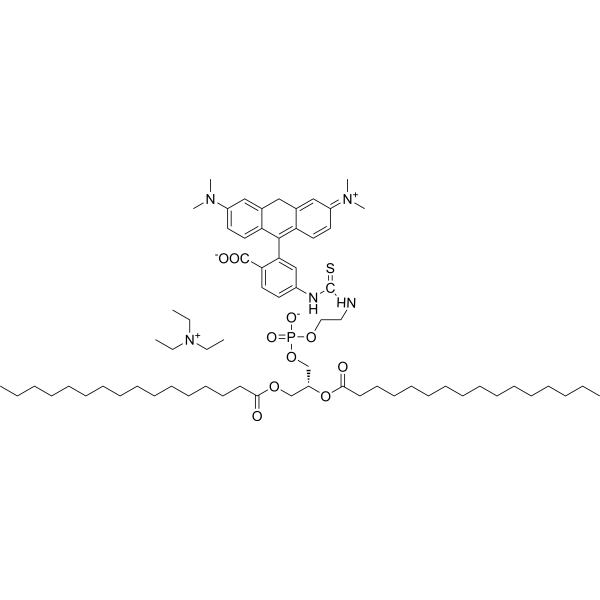
TRITC-DHPE is a rhodamine-labeled glycerophosphate ethanolamine lipid, with head groups marked with bright red fluorescent TRITC dye (λEx/λEm=514/580 nm). TRITC-DHPE can be used for membrane fusion assay to trace lipid processing in intracellular phagocytosis. TRITC-DHPE can serves as an energy transfer receptor for NBD, BODIPY and fluorescein lipid probes .
loading...
    loading...
Cat. No.: HY-D1726
CAS No.: 2705841-53-6
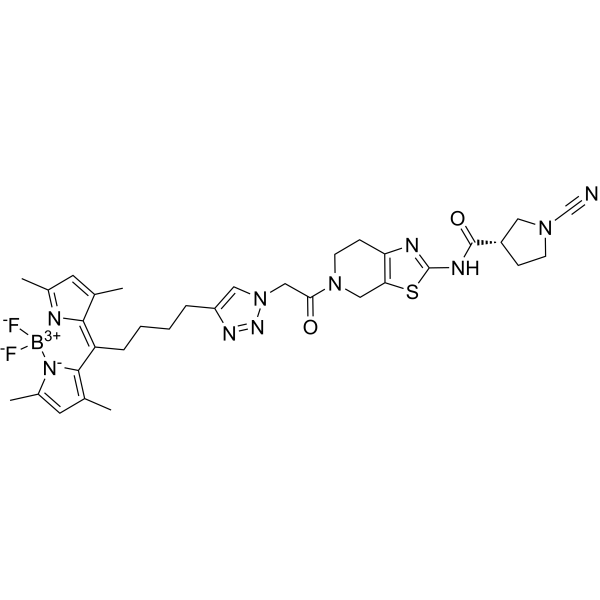
8RK59, a Bodipy probe, is a potent UCHL1 (ubiquitin C-terminal hydrolase L1) inhibitor, with an IC50 close to 1 μM. 8RK59 could penetrate and label living cells. BodipyFL-alkyne is coupled to the azide of 8RK64 (HY-148254) using copper(I)-mediated click chemistry, resulting in compound 8RK59 .
loading...
    loading...
Cat. No.: HY-D3243
CAS No.: 1646537-60-1
Mn1 (M1) is a BODIPY-based Mn 2+-selective "turn-on" Fluorescent sensor and fluorescence modulator. In the absence of Mn 2+, Mn1 undergoes fluorescence quenching via photoinduced electron transfer; binding to Mn 2+ inhibits this mechanism, thereby generating a fluorescence "turn-on" response. Mn1 exhibits Mn 2+-specific cellular fluorescence response .
loading...
    loading...
Cat. No.: HY-D3106
CAS No.: 2659241-66-2
Target:  

Fluorescent Dye

Research Areas:  

Others

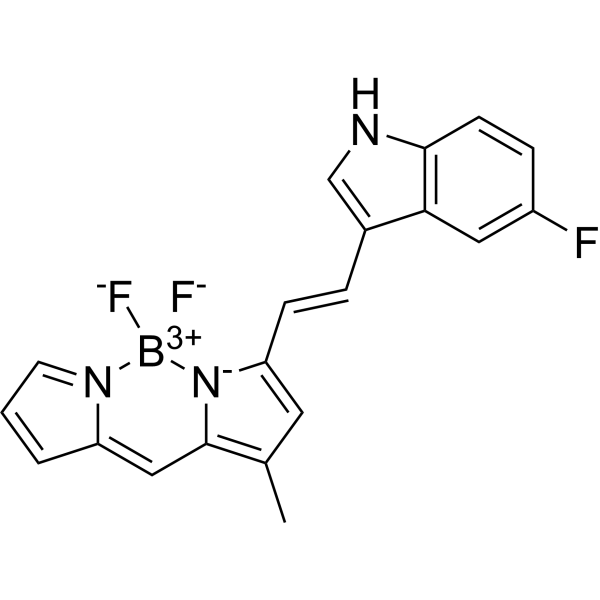
Lys-VBOD is a Fluorescent probe for lysosomal viscosity monitoring and live cell imaging. Its detection mechanism depends on viscosity: increased viscosity restricts the twisting of the double bond between the indole and BODIPY fluorophore, as well as the rotation of the single bond between quinoline and BODIPY, which reduces non-radiative decay and leads to enhanced fluorescence intensity in high viscosity environments; it also features a morpholine group that provides lysosome-targeting properties, allowing it to localize to lysosomes for viscosity detection. The probe has excitation/emission wavelengths of Ex/Em = 602/637 nm, and its fluorescence intensity shows a good linear relationship with log-transformed viscosity values. Lys-VBOD is stable across a wide pH range of 5.35 to 10.74, is not affected by macromolecules and proteins like BSA, has a fluorescence lifetime that increases with viscosity, and can visualize real-time lysosomal viscosity changes in live cells under Dexamethasone (HY-14648) stimulation[1].
loading...
    loading...
Cat. No.: HY-D2264
CAS No.: 1632296-13-9
Target:  

Fluorescent Dye

Research Areas:  

Others

Caffeine Orange (Compound 1) is a fluorescent probe for caffeine detection. Caffeine Orange is a BODIPY backbone-based probe that exhibits a turn-on fluorescence response upon binding to caffeine. The detection mechanism of Caffeine Orange relies on its binding with caffeine in aqueous media, which triggers an increase in fluorescence intensity; under irradiation with a 532 nm light source, the presence of caffeine produces orange fluorescence, with an excitation wavelength of 530 nm and an emission wavelength centered at approximately 620 nm .
loading...
    loading...
Cat. No.: HY-W248115
CAS No.: 137829-79-9
Research Areas:  

Others

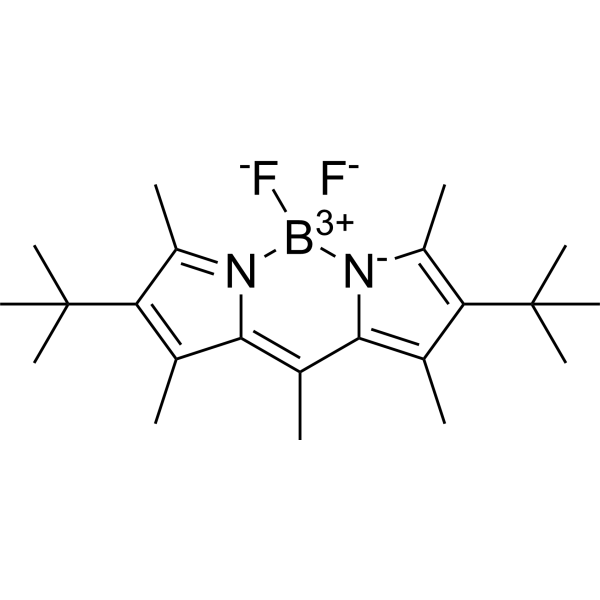
Pyrromethene 597 is a temperature-sensitive BODIPY-class laser fluorescent dye whose fluorescence anisotropy decreases with increasing temperature, Ex/Em =527/557 nm. Pyrromethene 597 can serve as a temperature probe in solution and as a whispering gallery mode (WGM) microlaser gain medium. Pyrromethene 597 can be doped into photoresists for in situ fabrication of microlaser devices within living cells. Pyrromethene 597 can be used in fluorescence imaging and microlaser-related research .
loading...
    loading...
Cat. No.: HY-D1551
CAS No.: 886212-86-8
Target:  

Fluorescent Dye

Research Areas:  

Others

10-(4-(Bis(2-hydroxyethyl)amino)phenyl)-5,5-difluoro-1,3,7,9-tetramethyl-5H-dipyrrolo[1,2-c:2',1'-f][1,3,2]diazaborinin-4-ium-5-uide, a BODIPY derivative, is a fluorescent indicator for detecting Pb 2+ (Ex=504 nM, Em=510 nM) .
loading...
    loading...
Cat. No.: HY-D3163
Target:  

Fluorescent Dye

Research Areas:  

Others

Endo-pH is a cell-permeable, pH-responsive fluorescent probe based on BODIPY, with a pKa of 5.08. When pH decreases from 7.32 to 4.97, Endo-pH undergoes protonation under acidic conditions, resulting in a 79-fold increase in fluorescence intensity at 786 nm. The detection wavelengths of its protonated form are Ex/Em=688/786 nm, while the absorption wavelength of its non-protonated form is 745 nm. Endo-pH can be used for staining late endosomes in live cells and determining the fusion time of late endosomes and lysosomes .
loading...
    loading...
Cat. No.: HY-DY1043
CAS No.: 730931-46-1
ER-Tracker dye is a derivative of BODIPY series dyes coupled with Glibenclamide (HY-15206) , highly selective binding to the endoplasmic reticulum, non-toxic to cells at low concentrations, this type of dye is an environmentally sensitive probe, and formaldehyde treatment can still retain part of the fluorescence, with high fluorescence life, good extinction coefficient and other characteristics. Glibenclamide is an atp-dependent K + channel blocker (Kir6, KATP) and CFTR Cl-channel blocker that binds in the endoplasmic reticulum. ER-Tracker is not suitable for staining cells after fixation .
Solvent and concentration: DMSO: 1 mM
loading...
    loading...
Cat. No.: HY-100335R
CAS No.: 1022899-36-0
Research Areas:  

Cancer

PCI-33380 (Standard) is the analytical standard of PCI-33380 (HY-100335). This product is intended for research and analytical applications. PCI-33380 is a fluorescent probe ( (Ex=532 nm, Em=555 nm). PCI-33380 consists of a (BTK) inhibitor PCI-32765 (HY-10997) attaching with a Bodipy-FL fluorophore via a piperazine linker. PCI-33380 binds predominantly to Btk in B cell lysates with cell permeable activity. PCI-33380 can be used for imaging live cancer cells such as non-Hodgkin lymphoma research
loading...
    loading...
Cat. No.: HY-DY1026
ER-Tracker dye is a derivative of BODIPY series dyes coupled with Glibenclamide (HY-15206) , highly selective binding to the endoplasmic reticulum, non-toxic to cells at low concentrations, this type of dye is an environmentally sensitive probe, and formaldehyde treatment can still retain part of the fluorescence, with high fluorescence life, good extinction coefficient and other characteristics. Glibenclamide is an atp-dependent K + channel blocker (Kir6, KATP) and CFTR Cl-channel blocker that binds in the endoplasmic reticulum. ER-Tracker is not suitable for staining cells after fixation. Ex/Em=587/615 nm .
Solvent and concentration: DMSO: 1 mM
loading...
    loading...
Cat. No.: HY-D1429
CAS No.: 287715-95-1
Target:  

Fluorescent Dye

Research Areas:  

Others

ER-Tracker dye is a derivative of BODIPY series dyes coupled with Glibenclamide (HY-15206), highly selective binding to the endoplasmic reticulum, non-toxic to cells at low concentrations, this type of dye is an environmentally sensitive probe, and formaldehyde treatment can still retain part of the fluorescence, with high fluorescence life, good extinction coefficient and other characteristics. Glibenclamide is an atp-dependent K + channel blocker (Kir6, KATP) and CFTR Cl-channel blocker that binds in the endoplasmic reticulum. ER-Tracker is not suitable for staining fixed cells. Staining followed by fixation is possible, but cells fixed with aldehydes will only retain partial fluorescence (Ex/Em = 374/ 430-640 nm) .
loading...
    loading...
Cat. No.: HY-D3520
CAS No.: 2484683-99-8
HPsensor 2 is a fluorescent probe used to detect the surface hydrophobicity of proteins. The detection mechanism of HPsensor 2 relies on its amphipathic properties. The 2-methoxyethylamine substituents at positions 3 and 5 of its BODIPY core enhance water solubility, enabling it to interact with solvent-exposed hydrophobic regions on proteins. When it binds to these hydrophobic surfaces, the free rotation of the meso-aryl substituent is restricted, increasing molecular rigidity and reducing non-radiative deactivation, which results in a significant enhancement of fluorescence. HPsensor 2 exhibits weak but detectable fluorescence in aqueous environments, and its fluorescence is highly sensitive to changes in protein surface hydrophobicity (Ex/Em = 528/579 nm) .
loading...
    loading...
Cat. No.: HY-DY1074
CAS No.: 287715-95-1
Target:  

Fluorescent Dye

Research Areas:  

Others

ER-Tracker dye is a derivative of BODIPY series dyes coupled with Glibenclamide (HY-15206) , highly selective binding to the endoplasmic reticulum, non-toxic to cells at low concentrations, this type of dye is an environmentally sensitive probe, and formaldehyde treatment can still retain part of the fluorescence, with high fluorescence life, good extinction coefficient and other characteristics. Glibenclamide is an atp-dependent K + channel blocker (Kir6, KATP) and CFTR Cl-channel blocker that binds in the endoplasmic reticulum. ER-Tracker is not suitable for staining fixed cells. Staining followed by fixation is possible, but cells fixed with aldehydes will only retain partial fluorescence .
Solvent and concentration: DMSO: 1 mM
loading...
    loading...