








1948 Results for "

Met

" in MedChemExpress (MCE) Product Catalog:
Products (1948)

1948 Results for "Met" in MCE Product Catalog:

Cat. No.: HY-P1304A
Research Areas:  

Neurological Disease

CART(55-102)(human) TFA is a human satiety factor with potent appetite-suppressing activity. CART(55-102)(human) TFA is closely associated with leptin and neuropeptide Y .
loading...
    loading...
Cat. No.: HY-P1305
CAS No.: 209615-79-2
Research Areas:  

Neurological Disease

CART(55-102)(rat) is a rat satiety factor with potent appetite-suppressing activity. CART(55-102)(rat) is closely associated with leptin and neuropeptide Y. CART(55-102)(rat) can induces anxiety and stress-related behavior .
loading...
    loading...
Cat. No.: HY-P1305A
Research Areas:  

Neurological Disease

CART(55-102)(rat) TFA is a rat satiety factor with potent appetite-suppressing activity. CART(55-102)(rat) TFA is closely associated with leptin and neuropeptide Y. CART(55-102)(rat) TFA can induces anxiety and stress-related behavior .
loading...
    loading...
Cat. No.: HY-P10327
Target:  

GLP Receptor

Research Areas:  

Metabolic Disease

PP18 is a novel OXM-based dual GLP-1 and glucagon receptor agonist with EC50 values of 0.487 nM target hGLP-1R and 0.188 nM target hGcgR .
loading...
    loading...
Cat. No.: HY-P10720
CAS No.: 129405-72-7
Target:  

Endogenous Metabolite

Research Areas:  

Cardiovascular Disease

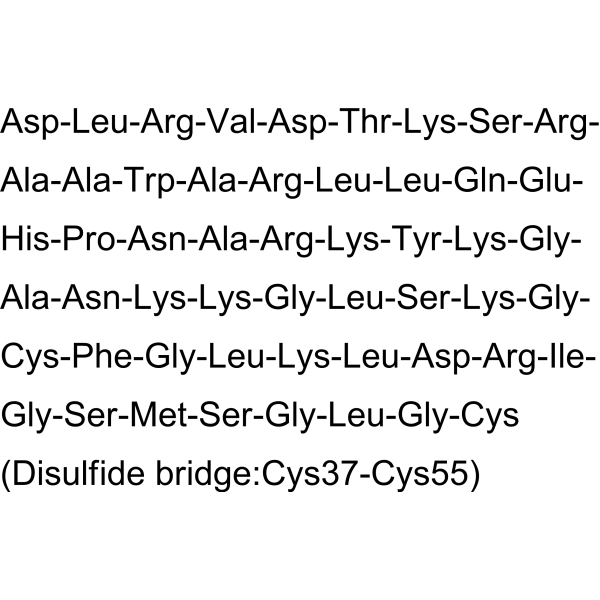
C-Type Natriuretic Peptide (1-53), Porcine, Rat, mouse is an activator of particulate guanylate cyclase B (pGC-B), which is highly expressed in endothelial cells, kidneys, and the heart. C-Type Natriuretic Peptide (1-53), Porcine, Rat, mouse can mediate a potent anti-fibrotic effect in human cardiac and renal fibroblasts by generating the second messenger cGMP .
loading...
    loading...
Cat. No.: HY-P11675
CAS No.: 3067191-26-5
Rolzavosoritide is a C-type natriuretic peptide .
loading...
    loading...
Cat. No.: HY-P1189
CAS No.: 154303-05-6
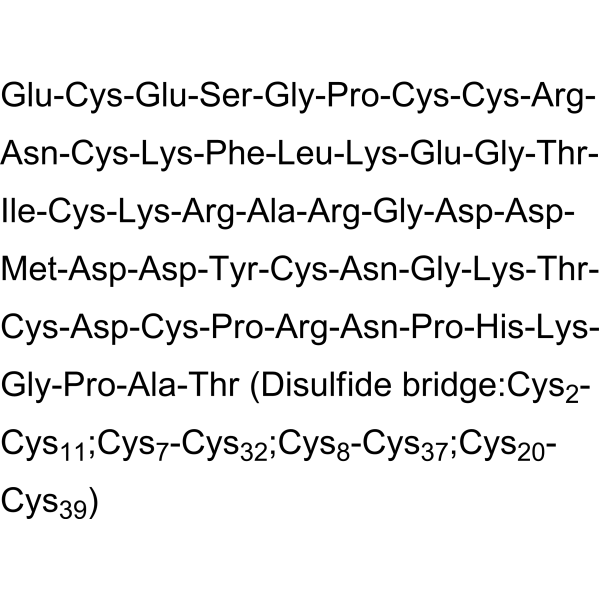
Echistatin is a naturally derived RGD-containing snake venom peptide. Echistatin exhibits an IC50 of 0.6 nM against mouse αvβ3 integrin, and acts as an antagonist against αvβ3, αIIbβ3, α5β1 integrins, pp125 FAK and paxillin. Echistatin reduces the phosphorylation of pp125 FAK and paxillin, inhibits the autophosphorylation and kinase activity of pp125 FAK, and weakens its binding to pp60src and paxillin. Echistatin disrupts the actin cytoskeleton and focal adhesions, induces melanoma cell detachment from fibronectin, and regulates cell adhesion and motility. Echistatin inhibits osteoclast maturation and migration, bone resorption, platelet aggregation, bone loss, as well as adhesion and metastasis of Lewis lung cancer cells; it also increases the number of osteoclasts and bone coverage area in mice with secondary hyperparathyroidism. Echistatin can be used in research related to melanoma, lung cancer and secondary hyperparathyroidism .
loading...
    loading...
Cat. No.: HY-P1189A
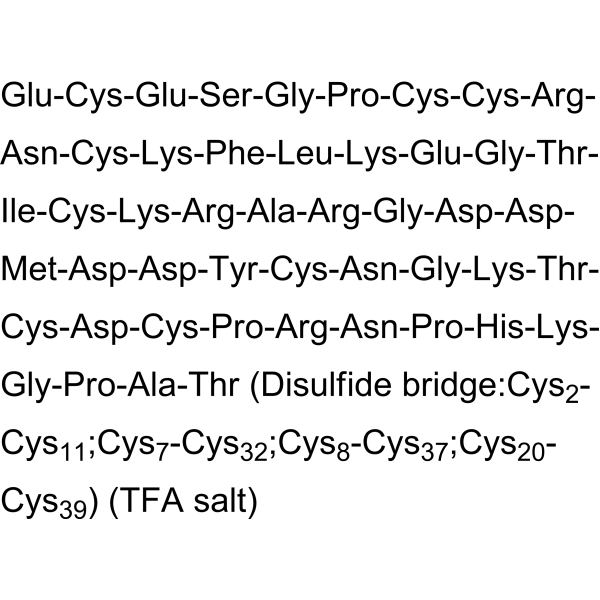
Echistatin TFA is a naturally derived RGD-containing snake venom peptide. Echistatin TFA exhibits an IC50 of 0.6 nM against mouse αvβ3 integrin, and acts as an antagonist against αvβ3, αIIbβ3, α5β1 integrins, pp125 FAK and paxillin. Echistatin TFA reduces the phosphorylation of pp125 FAK and paxillin, inhibits the autophosphorylation and kinase activity of pp125 FAK, and weakens its binding to pp60src and paxillin. Echistatin TFA disrupts the actin cytoskeleton and focal adhesions, induces melanoma cell detachment from fibronectin, and regulates cell adhesion and motility. Echistatin TFA inhibits osteoclast maturation and migration, bone resorption, platelet aggregation, bone loss, as well as adhesion and metastasis of Lewis lung cancer cells; it also increases the number of osteoclasts and bone coverage area in mice with secondary hyperparathyroidism. Echistatin TFA can be used in research related to melanoma, lung cancer and secondary hyperparathyroidism .
loading...
    loading...
Cat. No.: HY-178489
Target:  

Nectin-4

Research Areas:  

Cancer

BGC1614 is a Nectin-4-targeting bicyclic toxin conjugate (BTC) belonging to the category of peptide-drug conjugates (PDCs). BGC1614 exhibits strong targeted binding ability to Nectin-4, with an KD of 3.859 × 10 -7 M. BGC1614 exhibits superior antitumor efficacy in nude mice bearing PC-3 and N87 tumor xenografts. BGC1614 can be used for research related to Nectin-4-overexpressing tumors (such as prostate cancer, gastric cancer) .
loading...
    loading...
Cat. No.: HY-P11289
Target:  

Apoptosis

Research Areas:  

Cardiovascular Disease

Intermedin1-53 (Human) is a 53-aa human calcitonin family peptide that reduces the vulnerability of atherosclerotic plaques by inhibiting CHOP-mediated macrophage apoptosis and inflammasome .
loading...
    loading...
Cat. No.: HY-P1815
CAS No.: 141294-77-1
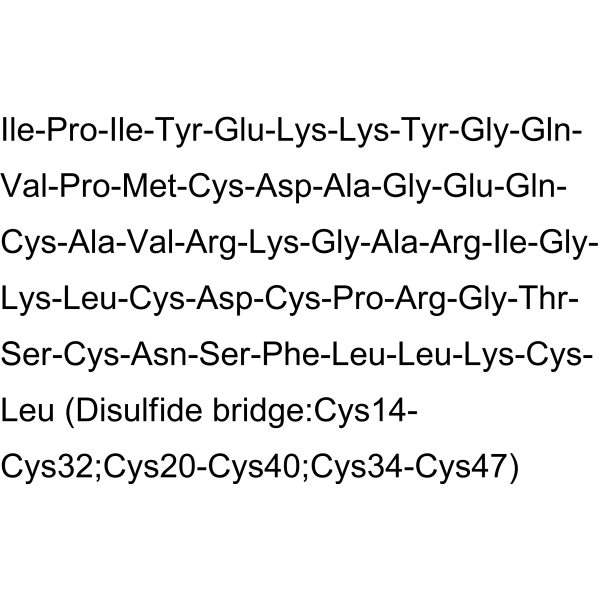
C-Type Natriuretic Peptide (1-53), human is the 1-53 fragment of C-Type Natriuretic Peptide. C-Type Natriuretic Peptide is natriuretic peptide family peptide that is involved in the maintenance of electrolyte-fluid balance and vascular tone .
loading...
    loading...
Cat. No.: HY-P1815A
C-Type Natriuretic Peptide (1-53), human TFA is the 1-53 fragment of C-Type Natriuretic Peptide. C-Type Natriuretic Peptide TFA is natriuretic peptide family peptide that is involved in the maintenance of electrolyte-fluid balance and vascular tone .
loading...
    loading...
Cat. No.: HY-P4766
CAS No.: 912862-96-5
Target:  

CGRP Receptor

Research Areas:  

Cardiovascular Disease

Adrenomedullin (porcine) is a peptide that regulates vasodilation. Adrenomedullin (porcine) induces endothelium-dependent relaxation in rat aorta with IC50 value of 2.4 nM. Adrenomedullin (porcine) induces endothelium-independent relaxation of porcine coronary arteries with an IC50 of 27.6 nM .
loading...
    loading...
Cat. No.: HY-P3561
Target:  

Melanocortin Receptor

Research Areas:  

Neurological Disease

Agouti-related Protein (AGRP) (83-132) Amide (human) is a fragment of agouti-related protein (AGRP) which is a protein found in abundance in the arcuate nucleus of the hypothalamus. AgRP primarily acts as an inverse agonist for the melanocortin-4 receptor (MC4R) to increase food intake .
loading...
    loading...
Cat. No.: HY-P3561A
Target:  

Melanocortin Receptor

Research Areas:  

Neurological Disease

Agouti-related Protein (AGRP) (83-132) Amide (human) TFA is a fragment of agouti-related protein (AGRP) which is a protein found in abundance in the arcuate nucleus of the hypothalamus. AgRP primarily acts as an inverse agonist for the melanocortin-4 receptor (MC4R) to increase food intake .
loading...
    loading...
Cat. No.: HY-P5063
CAS No.: 245114-99-2
Research Areas:  

Metabolic Disease

Galanin-Like Peptide (human) is a 60 amino acid neuropeptide. Galanin-Like Peptide (human) plays an important role in the regulation of feeding, body weight and energy metabolism .
loading...
    loading...
Cat. No.: HY-P5065
CAS No.: 245114-97-0
Research Areas:  

Metabolic Disease

Galanin-Like Peptide (rat) is a 60 amino acid neuropeptide. Galanin-Like Peptide (rat) plays an important role in the regulation of feeding, body weight and energy metabolism .
loading...
    loading...
Cat. No.: HY-P5151
Target:  

Inhibitory Antibodies

Research Areas:  

Others

LiTx3 is a lethal and cysteine-rich peptide. LiTx3 can be isolated from L. intermedia crude venom. LiTx3 induces flaccid paralysis in Spodoptera frugiperda larvae .
loading...
    loading...
Cat. No.: HY-P5172
Target:  

Sodium Channel

Research Areas:  

Neurological Disease

MitTx-alpha is a subunit of MitTx. MitTx is a potent, persistent, and selective agonist for acid-sensing ion channels (ASICs). MitTx is highly selective for the ASIC1 subtype at neutral pH; under more acidic conditions (pH<6.5), MitTx massively potentiates (>100-fold) proton-evoked activation of ASIC2a channels .
loading...
    loading...
Cat. No.: HY-108905
CAS No.: 68562-41-4
Synonyms: Human IGF-I; FK 780
Target:  

IGF-1R

Research Areas:  

Metabolic Disease

Mecasermin (Human IGF-I; FK 780) is a recombinant human insulin-like growth factor I (IGF-I). Mecasermin has the potential for the study of the growth failure of growth hormone (GH) insensitivity caused by GH receptor defects or GH-inhibiting antibodies .
loading...
    loading...

