1. Search Result
Search Result
Pathways Recommended: GPCR/G Protein
Results for "

Gly-Gly-Gly-Gly-Gly

" in MedChemExpress (MCE) Product Catalog:

11

Inhibitors & Agonists

9

Peptides

1

Click Chemistry

Cat. No. Product Name Target Research Areas Chemical Structure
  • HY-P10736

    GCGR Metabolic Disease
    AMG133 peptide payload is a GLP-1 analog agonist peptide. AMG133 peptide potently activates GLP-1R, and exhibits weight loss and metabolic improvement activities. AMG133 peptide payload can be used for the synthesis of AMG 133 (HY-164535) .
    AMG133 peptide payload
  • HY-P10736A

    GCGR Metabolic Disease
    AMG133 peptide payload TFA is a GLP-1 analog agonist peptide. AMG133 peptide payload TFA potently activates GLP-1R and exhibits weight loss and metabolic improvement activities. AMG133 peptide payload TFA can be used for the synthesis of AMG 133 (HY-164535) .
    AMG133 peptide payload TFA
  • HY-W141916

    TetraGlycylGlycine; Gly-Gly-Gly-Gly-Gly; NSC 96353

    Amino Acid Derivatives Bacterial Infection
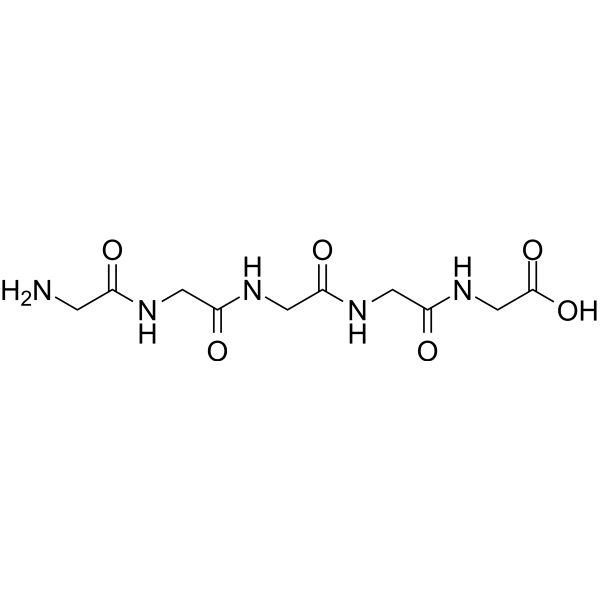
    Pentaglycine (Tetraglycylglycine; NSC 96353) is a bridging structure composed of five glycine residues. Pentaglycine serves as a characteristic peptidoglycan cross-bridge component of staphylococci and a specific substrate for lysostaphin. Pentaglycine maintains the integrity of the peptidoglycan cell wall of Staphylococcus aureus via peptide chain cross-linking and regulates bacterial growth. Pentaglycine expression is downregulated in high-glucose environments, inhibiting bacterial proliferation. Pentaglycine can be applied to studies related to Staphylococcus aureus infection .
    Pentaglycine
  • HY-P10810

    Wnt β-catenin Cancer
    QPH-FR is a LGR5 inhibitor. QPH-FR competitively binds to LGR5 and prevents the formation of the LGR5/RSPO1 complex. QPH-FR promotes RNF43/ZNRF3-mediated ubiquitination of FZD receptors, inhibits the Wnt β-catenin signaling pathway, and reduces the stemness of colorectal cancer cells. QPH-FR is applicable to relevant research on colorectal cancer .
    QPH-FR
  • HY-151777

    ADC Linker Others
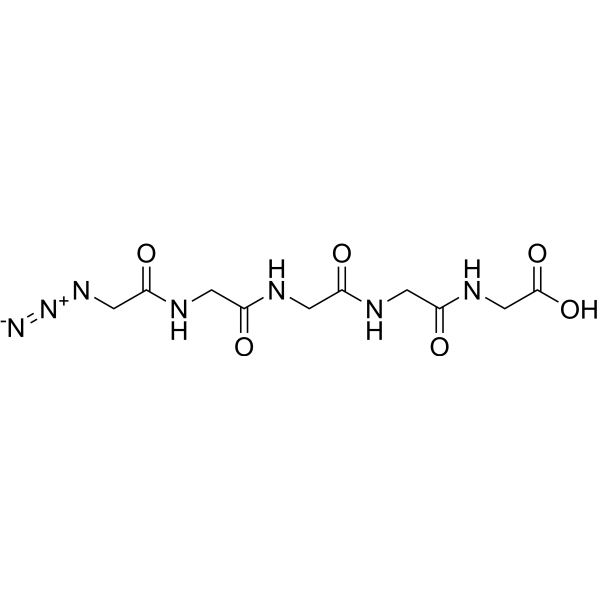
    N3-Gly-Gly-Gly-Gly-Gly-OH is a click chemistry reagent containing an azide group. It contains an azide group and can undergo copper-catalyzed azide-alkyne cycloaddition (CuAAc) with molecules containing alkyne groups. It can also undergo ring strain-promoted alkyne-azide cycloaddition (SPAAC) with molecules containing DBCO or BCN groups.
    N3-Gly-Gly-Gly-Gly-Gly-OH
  • HY-44370

    ADC Linker Cancer
    (tert-Butoxycarbonyl)glycyl-glycyl-glycyl-glycyl-glycine is an ADC linker with a Boc group on the N terminus, and it is used for the development of antibody-drug conjugates (ADCs). The Boc group can be deprotected under mild acidic conditions to form the free amine.
    Boc-Gly-Gly-Gly-Gly-Gly
  • HY-P0148

    HexaGlycine

    Bacterial Others
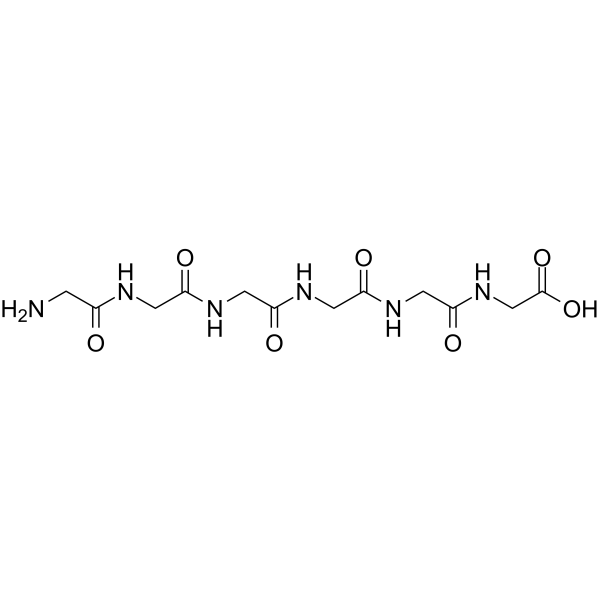
    Gly6 (Hexaglycine) is a linear glycine oligopeptide with six glycines .
    Gly6
  • HY-P2269A

    Drug Derivative Cancer
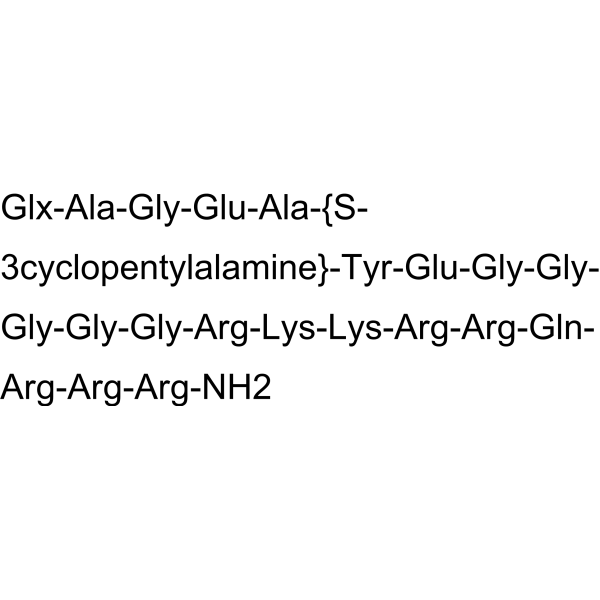
    MAIT-203 acetate is a cyclopentyalanin-derived peptidomimetic, potently inhibits the interaction of adenomatous polyposis coli (APC) and Asef (RhoGEF4), but not APC-Sam68 or APC-striatin interactions. MAIT-203 acetate binds APC-ARM with a Ki value of 0.015 μM and aKd value of 0.036 μM. MAIT-203 acetate significantly represses the migration and invasion of colorectal cancer cells .
    MAIT-203 acetate
  • HY-P2269

    Drug Derivative Cancer
    MAIT-203, a cyclopentyalanin-derived peptidomimetic, potently inhibits the interaction of adenomatous polyposis coli (APC) and Asef (RhoGEF4), but not APC-Sam68 or APC-striatin interactions. MAIT-203 binds APC-ARM with a Ki of 0.015 μM and a Kd of 0.036 μM. MAIT-203 significantly represses the migration and invasion of colorectal cancer cells.
    MAIT-203
  • HY-P10804

    SARS-CoV Infection
    PIH is an antiviral peptide that effectively inhibits the HR1/HR2-mediated membrane fusion between MERS-CoV and host cells, with an IC50 of 1.171 μM. By forming a complex with gold nanorods (AuNRs), the antiviral efficacy of PIH can be further enhanced by 10-fold .
    PIH
  • HY-P11168

    Bacterial Infection
    Diptericin is an antibacterial peptide, originally isolated from Phormia terranovae. Diptericin exhibits potent and selective activity against specific Gram-negative bacteria, such as Escherichia coli and Salmonella typhimurium. Diptericin kills bacteria within 1 hour. Diptericin can be used for antibacterial research .
    Diptericin

Inquiry Online

Your information is safe with us. * Required Fields.

Salutation


Country or Region *

Applicant Name *


Organization Name *

Department *


Email Address *


Product Name *

Cat. No.


Requested quantity *

Phone Number *


Remarks

Inquiry Online

Inquiry Information

Product Name:
Cat. No.:
Quantity:
MCE Japan Authorized Agent:

