



Pentaglycine

Based on 1 Customer Validation
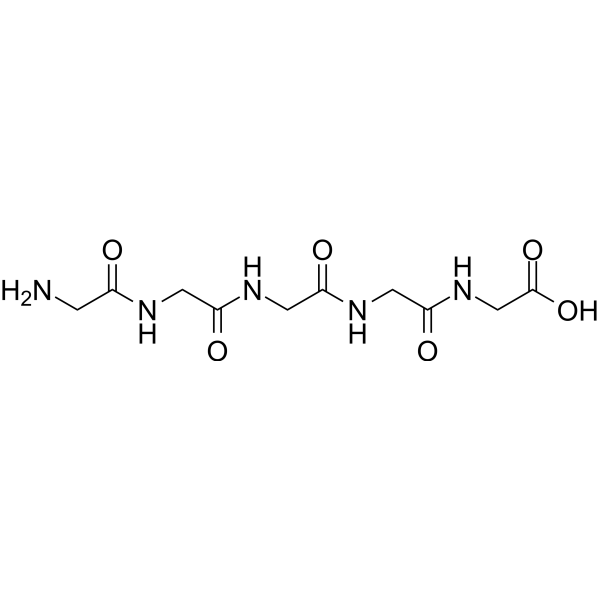
Pentaglycine (Tetraglycylglycine; NSC 96353) is a bridging structure composed of five glycine residues. Pentaglycine serves as a characteristic peptidoglycan cross-bridge component of staphylococci and a specific substrate for lysostaphin. Pentaglycine maintains the integrity of the peptidoglycan cell wall of Staphylococcus aureus via peptide chain cross-linking and regulates bacterial growth. Pentaglycine expression is downregulated in high-glucose environments, inhibiting bacterial proliferation. Pentaglycine can be applied to studies related to Staphylococcus aureus infection.
商品は「研究用試薬」です。人や動物の医療用・臨床診断用・食品用の製品ではありません。
研究用途以外に使用した場合、当社は一切の責任を負いかねます。
- 純度 : 99.47%
- CAS 番号: 7093-67-6
- 分子式: C10H17N5O6
- 分子量:303.27
-
保管条件:
Sealed storage, away from moisture and light.
Powder -80°C, 2 years , -20°C, 1 year* In solvent : -80°C, 6 months; -20°C, 1 month (sealed storage, away from moisture and light)

To place orders, for customer services and technical support, please contact: MedChemExpress USA
Tel: 609-228-6898 E-mail: [email protected] [email protected]


-
 生物活性
生物活性
-
化学情報
-
溶剤 & 溶解度
- プロトコル
- 純度とドキュメンテーション
- 参考文献
-
 Help & FAQs




生物活性
製品説明
体外実験
Pentaglycine (25 mM glucose; 24 h) is indicated to have reduced expression in Staphylococcus aureus Newman cells cultured in LB medium with 25 mM glucose, which exhibit significantly increased resistance to lysostaphin lysis[1].
Pentaglycine (15 mM glucose; 6 h) has decreased bridge synthesis in Staphylococcus aureus Newman cells cultured in LB medium with 15 mM glucose, as mRNA expression of femA, femB, and femX is significantly reduced[1].
Pentaglycine (25 mM glucose; 24 h) is indicated to have reduced expression in Staphylococcus epidermidis RP62A and Staphylococcus haemolyticus SH01 cells cultured in LB medium with 25 mM glucose, which exhibit significantly increased resistance to lysostaphin lysis[1].
MedChemExpress (MCE) has not independently confirmed the accuracy of these methods. They are for reference only.
-
Cell Line:Staphylococcus aureus Newman
-
Concentration:15 mM glucose
-
Incubation Time:6 h
-
Result:Significantly decreased relative mRNA expression of femA, femB, and femX compared to cells cultured without glucose.


化学情報
-
CAS 番号 7093-67-6
-
性状 Solid
-
分子量 303.27
-
分子式 C10H17N5O6
-
Color White to off-white
-
別名
Tetraglycylglycine; Gly-Gly-Gly-Gly-Gly; NSC 96353
-
輸送条件
Room temperature in continental US; may vary elsewhere.
-
保管条件
Sealed storage, away from moisture and light
Powder -80°C 2 years -20°C 1 year * In solvent : -80°C, 6 months; -20°C, 1 month (sealed storage, away from moisture and light)


溶剤 & 溶解度
体外:
H2O : 5 mg/mL (16.49 mM; Need ultrasonic)
Please refer to the solubility information to select the appropriate solvent. Once prepared, please aliquot and store the solution to prevent product inactivation from repeated freeze-thaw cycles.
Storage method and period of stock solution: -80°C, 6 months; -20°C, 1 month (sealed storage, away from moisture and light). When stored at -80°C, please use it within 6 months. When stored at -20°C, please use it within 1 month.
* Note: If you choose water as the stock solution, please dilute it to the working solution, then filter and sterilize it with a 0.22 μm filter before use.
Please refer to the solubility information to select the appropriate solvent. Once prepared, please aliquot and store the solution to prevent product inactivation from repeated freeze-thaw cycles.
Storage method and period of stock solution: -80°C, 6 months; -20°C, 1 month (sealed storage, away from moisture and light). When stored at -80°C, please use it within 6 months. When stored at -20°C, please use it within 1 month.
* Note: If you choose water as the stock solution, please dilute it to the working solution, then filter and sterilize it with a 0.22 μm filter before use.
濃度 (開始) × 体積 (開始) = 濃度 (終了) × 体積 (終了)


純度とドキュメンテーション
-
データシート (268 KB)
-
SDS (394 KB)
- English - EN (394 KB)
- Français - FR (394 KB)
- Deutsch - DE (394 KB)
- Norwegian - NO (394 KB)
- Español - ES (394 KB)
- Swedish - SV (394 KB)
- Italian - IT (394 KB)
- Korean - KR (394 KB)
- Portuguese - PT (394 KB)
-
取扱説明書 (2659 KB)
参考文献


Complete Stock Solution Preparation Table
Please refer to the solubility information to select the appropriate solvent. Once prepared, please aliquot and store the solution to prevent product inactivation from repeated freeze-thaw cycles.
Storage method and period of stock solution: -80°C, 6 months; -20°C, 1 month (sealed storage, away from moisture and light). When stored at -80°C, please use it within 6 months. When stored at -20°C, please use it within 1 month.
| Optional Solvent | Concentration Solvent Mass | 1 mg | 5 mg | 10 mg | 25 mg |
|---|---|---|---|---|---|
| H2O | 1 mM | 3.2974 mL | 16.4870 mL | 32.9739 mL | 82.4348 mL |
| 5 mM | 0.6595 mL | 3.2974 mL | 6.5948 mL | 16.4870 mL | |
| 10 mM | 0.3297 mL | 1.6487 mL | 3.2974 mL | 8.2435 mL | |
| 15 mM | 0.2198 mL | 1.0991 mL | 2.1983 mL | 5.4957 mL |
* Note: If you choose water as the stock solution, please dilute it to the working solution, then filter and sterilize it with a 0.22 μm filter before use.


Pentaglycine 関連分類
HY-W141916 関連分類
 Powered by Bioz
Keywords
- Pentaglycine
- 7093-67-6
- Tetraglycylglycine
- Gly-Gly-Gly-Gly-Gly
- NSC 96353
- NSC96353
- NSC 96353
- NSC-96353
- Amino Acid Derivatives
- Bacterial
- femB
- cell wall
- lysostaphin
- Staphylococcus aureus
- Staphylococcus aureus Newman cells
- Staphylococcus epidermidis RP62A
- Staphylococcus haemolyticus SH01 cells
- femX
- femA
- peptidoglycan
- Inhibitor
- inhibitor
- inhibit