1. Search Result
Search Result
Results for "

Bacillus thuringiensis

" in MedChemExpress (MCE) Product Catalog:

8

Inhibitors & Agonists

1

Peptides

7

Natural
Products

2

Recombinant Proteins

Cat. No. Product Name Target Research Areas Chemical Structure
  • HY-W012595

    Benzalacetone

    Environmental Pollutants Antibiotic Endogenous Metabolite Phospholipase Bacterial Tyrosinase Infection Metabolic Disease Inflammation/Immunology
    Benzylideneacetone (Benzalacetone) is an orally active antibiotic, tyrosinase inhibitor, phospholipase A2 inhibitor, and immunosuppressant. Benzylideneacetone has antibacterial activity against some gram-negative plant-pathogenic bacteria. Benzylideneacetone can also be used in the synthesis of chemicals and drugs, and as a flavoring additive for some foods .
    Benzylideneacetone
  • HY-121382

    Cholinesterase (ChE) Apoptosis Necroptosis Neurological Disease Cancer
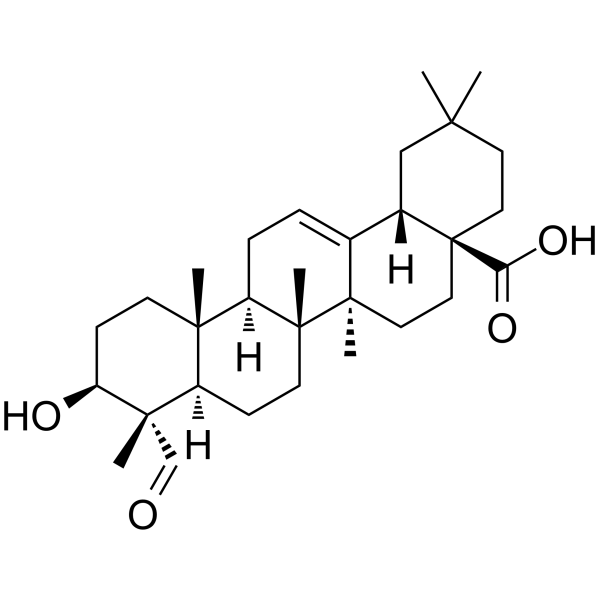
    Gypsogenin is a selective mixed-type BChE inhibitor (Ki=19.99 μM) that also exhibits significant cytotoxicity against various human cancer cell lines. Gypsogenin inhibits tumor growth by inducing cell cycle arrest and triggering apoptosis. Gypsogenin displays antibacterial activity against bacteria such as Bacillus subtilis and Bacillus thuringiensis, and often serves as a key parent nucleus for the synthesis of anticancer compounds. Gypsogenin is widely used in research on Alzheimer's disease and various cancers including colon cancer, melanoma, and leukemia .
    Gypsogenin
  • HY-P3472

    Cyclo(L-Pro-L-Ile)

    Amino Acid Derivatives Inflammation/Immunology
    Cyclo(IP) (Cyclo-(L-Pro-L-Ile)), a Diketopiperazine can be derived From Bacillus thuringiensis JCK-1233, results in suppression of PWD severity and increased the expression of defense-related genes similarly to Bacillus thuringiensis JCK-1233 treatment .
    Cyclo(IP)
  • HY-121382R

    Reference Standards Apoptosis Cholinesterase (ChE) Necroptosis Cardiovascular Disease
    Cinosulfuron (Standard) is the analytical standard of Cinosulfuron. This product is intended for research and analytical applications. Gypsogenin is a selective mixed-type BChE inhibitor (Ki=19.99 μM) that also exhibits significant cytotoxicity against various human cancer cell lines. Gypsogenin inhibits tumor growth by inducing cell cycle arrest and triggering apoptosis. Gypsogenin displays antibacterial activity against bacteria such as Bacillus subtilis and Bacillus thuringiensis, and often serves as a key parent nucleus for the synthesis of anticancer compounds. Gypsogenin is widely used in research on Alzheimer's disease and various cancers including colon cancer, melanoma, and leukemia .
    Gypsogenin (Standard)
  • HY-N8507

    Bacterial Fungal Infection
    Tunicamycin B is a Tunicamycin (HY-A0098) derivative with antimicrobial activity. Tunicamycin B shows antibacterial activity against Bacillus thuringiensis BT01 and B. thuringiensis W102 (MICs of 0.125 and 0.063 μg/mL, respectively) and antifungal activity against Candida albicans ATCC 96901 and C. albicans CMCC (F) 98001 (MICs of 8.0 and 4.0 μg/mL, respectively). Tunicamycin B can be used for antimicrobial research .
    Tunicamycin B
  • HY-N18360

    Tunicamycin 17:1

    Antibiotic Bacterial Fungal Infection
    Tunicamycin X (Tunicamycin 17:1) is a nucleoside Antibiotic. Tunicamycin X is isolated from Streptomyces xinghaiensis SCSIO S15077. Tunicamycin X acts as a growth inhibitor against bacteria and fungi. Tunicamycin X inhibits the growth of Bacillus thuringiensis strains. Tunicamycin X inhibits the growth of Candida albicans strains .
    Tunicamycin X
  • HY-N8310

    Tunicamycin 14:1; Tunicamycin II; Tunicamycin C

    Antibiotic Bacterial Infection
    Tunicamycin A1 (Tunicamycin 14:1; Tunicamycin II; Tunicamycin C) is an antibiotic . Tunicamycin A1 exhibits antibacterial activity against a variety of bacterial. Tunicamycin A1 can be used in studies related to bacterial infections .
    Tunicamycin A1
  • HY-N13838

    Bacterial Infection
    8,9-Dehydro-7,9-diisobutyryloxythymol is a Thymol (HY-N6810) derivative, as well as an antibacterial agent. 8,9-Dehydro-7,9-diisobutyryloxythymol can be found in the aerial parts of Ageratina adenophora, with selective activity against Gram-positive bacterial strains including Bacillus cereus. 8,9-Dehydro-7,9-diisobutyryloxythymol does not exhibit detectable in vitro cytotoxic activity against human cancer cell lines. 8,9-Dehydro-7,9-diisobutyryloxythymol can be used for the research of bacterial infection .
    8,9-Dehydro-7,9-diisobutyryloxythymol

Inquiry Online

Your information is safe with us. * Required Fields.

Salutation


Country or Region *

Applicant Name *


Organization Name *

Department *


Email Address *


Product Name *

Cat. No.


Requested quantity *

Phone Number *


Remarks

Inquiry Online

Inquiry Information

Product Name:
Cat. No.:
Quantity:
MCE Japan Authorized Agent:

