12 Results for "

ClpC1

" in MedChemExpress (MCE) Product Catalog:
Products (12)

12 Results for "ClpC1" in MCE Product Catalog:

  • Targets Recommended:
Cat. No.: HY-153575
Target:  

PROTACs Bacterial

Research Areas:  

Infection

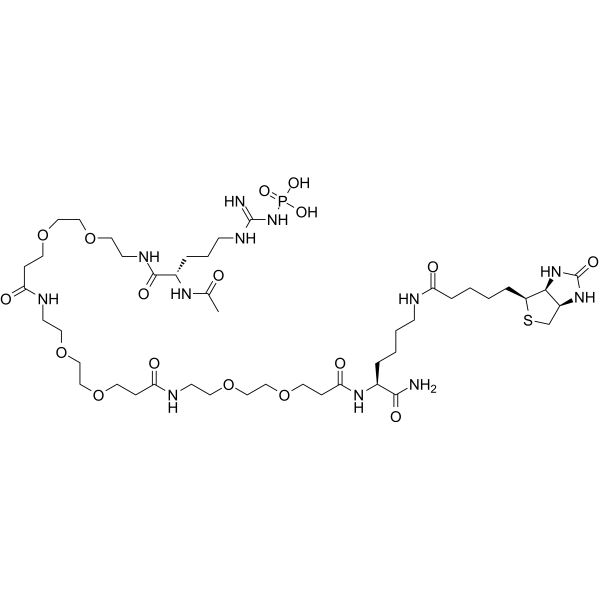
BacPROTAC-1 is a BacPROTAC degrader that induces the degradation of the target protein mSA by recruiting ClpC/ClpC1. BacPROTAC-1 binds to mSA, Bacillus subtilis ClpCNTD and Mycobacterium smegmatis ClpC1NTD with Kd values of 3.9, 2.8 and 0.69 μM, respectively. BacPROTAC-1 forms a ternary complex between the substrate and ClpC, promotes ClpC reassembly and activation, and induces ATP-dependent degradation of mSA and mSA fusion model substrates via the ClpCP or ClpC1P1P2 protease system. BacPROTAC-1 can be used in studies on bacterial targeted protein degradation, bacterial protein homeostasis and antibacterial target discovery [1].
loading...
    loading...
Cat. No.: HY-P11498
Research Areas:  

Infection

Cyclomarin monomer-2 (Compound 10), a cyclomarin monomer, is a pre-dimerization precursor that can form Homo-BacPROTACs targeting the degradation of ClpC1. Cyclomarin monomer-2 binds to the Mtb ClpC1 protein with a KD of 4.0 nM. The MIC of Cyclomarin monomer-2 against the Mtb H37Rv standard strain is 3.1 μM. Cyclomarin monomer-2 can be used as a key intermediate in the development of Homo-BacPROTACs [1].
loading...
    loading...
Cat. No.: HY-P11497
Research Areas:  

Infection

Cyclomarin monomer-1 (Compound 5), a cyclomarin monomer, is a pre-dimerization precursor that can form Homo-BacPROTACs targeting the degradation of ClpC1. Cyclomarin monomer-1 binds to the Mtb ClpC1 protein with a KD of 3.5 nM. The MIC of Cyclomarin monomer-1 against the Mtb H37Rv standard strain is 1.6 μM. Cyclomarin monomer-1 can be used as a key intermediate in the development of Homo-BacPROTACs [1].
loading...
    loading...
Cat. No.: HY-153574
Synonyms: pArg-JQ1
Research Areas:  

Infection

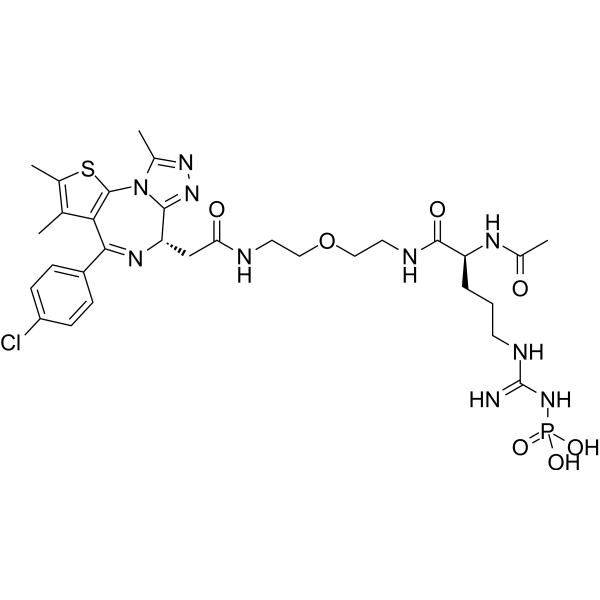
BI01826025 (pArg-JQ1) is a BacPROTAC-type bifunctional degrader that induces the degradation of BRDTBD1-containing substrates by recruiting the ClpC1P1P2 protease system. BI01826025 binds to the BRDTBD1 substrate via its JQ1 moiety and to ClpC1 via its pArg moiety; it delivers the substrate to ClpC1, where the substrate undergoes ClpC1-mediated unfolding followed by proteolysis by ClpP1P2. BI01826025 can be used to study ClpC1P1P2-mediated targeted protein degradation and ClpC2-regulated bacterial protein homeostasis [1].
loading...
    loading...
Cat. No.: HY-153571
Target:  

PROTACs Bacterial

Research Areas:  

Infection

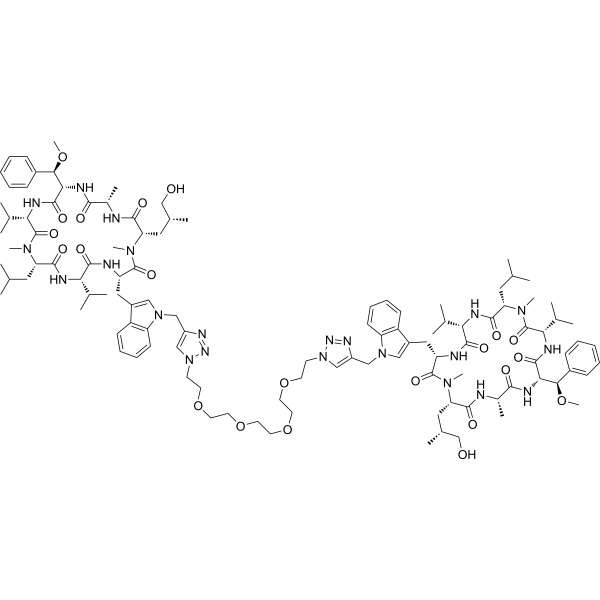
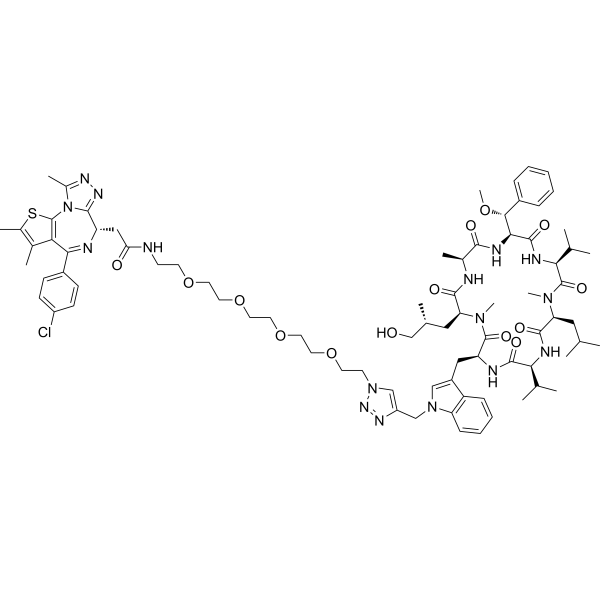
Homo-BacPROTAC6 is a ClpC1NTD BacPROTAC degrader and can targets ClpC2. Homo-BacPROTAC7 efficiently kill M. tuberculosis [1].
loading...
    loading...
Cat. No.: HY-P701867
Purity:  ≥ 90%, as determined by reducing SDS-PAGE.
Synonyms: ClpC1; ATP-dependent Clp protease ATP-binding subunit ClpC1
Species:  
Source:  
loading...
    loading...
Cat. No.: HY-P701868
Purity:  ≥ 90%, as determined by reducing SDS-PAGE.
Synonyms: ClpC1; ATP-dependent Clp protease ATP-binding subunit ClpC1
Species:  
Source:  
loading...
    loading...
Cat. No.: HY-153573
Synonyms: dCym-JQ1
Research Areas:  

Infection

SRG-II-19F (dCym-JQ1) is a BRDTBD1 PROTAC degrader. Its dCym moiety at one end binds to the N-terminal domain of ClpC1 (ClpC1NTD), while its JQ1 moiety at the other end binds to bromodomain 1 of BRDT (BRDTBD1). This molecule induces the degradation of BRDTBD1 by recruiting the BRDTBD1 substrate to the ClpC1P1P2 protease complex. SRG-II-19F serves as a research tool for studies related to mycobacterial protein degradation [1].
loading...
    loading...
Cat. No.: HY-130369
CAS No.: 6286-09-5
Target:  

Bacterial Necroptosis HSV

Research Areas:  

Infection Cancer

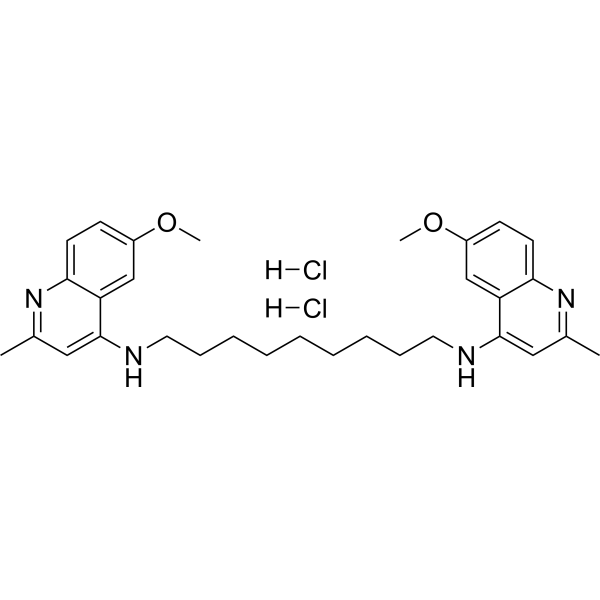
NSC10010 hydrochloride inhibits gammaherpesvirus associated B-lymphomas growth through activation of NF-kB and c-Myc-mediated signaling pathways. NSC10010 hydrochloride induces necrotic cell death in gammaherpesvirus infected B-cells. NSC10010 hydrochloride is also an inhibitor of Mtb ClpC1 ATPase [1] .
loading...
    loading...
Cat. No.: HY-P6300
CAS No.: 169062-92-4
Target:  

Bacterial Parasite

Research Areas:  

Infection

Cyclomarin A is an antibacterial agent with a Kd of 2.3 nM against Mycobacterium tuberculosis ClpC1, a Kd of 2.2 nM against ClpC2, and an IC50 of 0.004 μM against Plasmodium falciparum PfAp3Aase. Cyclomarin A binds to the N-terminal domain of ClpC1, stimulates ATPase and proteolytic activities, dysregulates proteolysis, and induces proteome imbalance; it also binds to ClpC2 and upregulates its transcription level. Cyclomarin A binds to PfAp3Aase in dimeric form, blocks the substrate-binding pathway, inhibits the growth of Plasmodium falciparum in the erythrocytic stage, and shows no activity against human cells. Cyclomarin A exhibits moderate cytotoxicity against a variety of cancer cell lines. Cyclomarin A can serve as a lead compound for the development of Homo-BacPROTAC. Cyclomarin A is applicable to research related to tuberculosis and malaria [1] .
loading...
    loading...
Cat. No.: HY-153572A
Target:  

PROTACs Bacterial

Research Areas:  

Infection

Homo-BacPROTAC7 TFA is a PROTAC protein degrader targeting ClpC1/ClpC2 with a Kd of 0.5-2.5 nM for both targets. Homo-BacPROTAC7 (TFA) acts as a bactericidal agent, induces killing of pathogenic mycobacteria, retains activity against dormant-like mycobacterial cells with reduced intracellular ATP levels, and shows elevated antibiotic potency relative to its parent monomer. Homo-BacPROTAC7 (TFA) can be used for the research of tuberculosis [1].
loading...
    loading...
Cat. No.: HY-175571
Target:  

Collagen

Research Areas:  

Infection

Ac-Phospho-L-arginine is a ClpC ligand. Ac-Phospho-L-arginine can be used to synthesize BacPROTAC-1 (HY-153575). BacPROTAC-1 is a BacPROTAC degrader that induces the degradation of the target protein mSA by recruiting ClpC/ClpC1 [1] .
loading...
    loading...
  • 1

