
1. Search Result
Search Result
Results for "

E. faecium

" in MedChemExpress (MCE) Product Catalog:

12

Inhibitors & Agonists

3

Peptides

1

Natural
Products

Cat. No. Product Name Target Research Areas Chemical Structure
  • HY-P1633

    PG1

    Bacterial ERK COX NF-κB Apoptosis NO Synthase Dengue Virus Infection Inflammation/Immunology
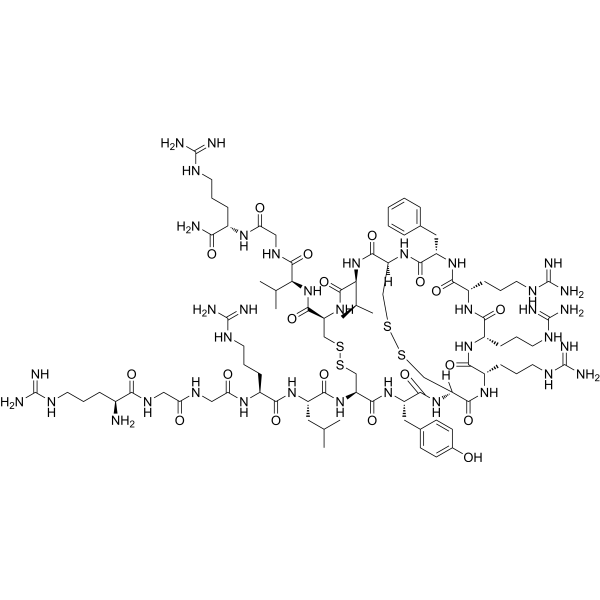
    Protegrin-1 is an orally active antibacterial peptide. Protegrin-1 activates ERK, COX2, NFκB, inhibits Apoptosis, and NO production. Protegrin-1 has antibacterial activity against S. aureus, E. faecium, E. coli, P. aeruginosa and K. Pneumoniae, with MBC values between 10 and 20 µM. Protegrin-1 has antiviral activity against dengue NS2B-NS3. Protegrin-1 has anti-inflammatory activity. Protegrin-1 is used in the study of inflammatory diseases and infections .
    Protegrin-1
  • HY-135813
    LtaS-IN-1
    1 Publications Verification

    Bacterial Infection
    LtaS-IN-1 (compound 1771) is a potent small-molecule inhibitor of Lipoteichoic acid (LTA) synthesis in multidrug-resistant (MDR) E. faecium and by altering the cell wall morphology. LtaS-IN-1 alone inhibits Enterococcus.spp 28 strains with varying MIC values ranging from 0.5 μg/mL to 64 μg/mL. LtaS-IN-1 combination with antibiotics abolishs multidrug-resistant E. faecium growth almost completely .
    LtaS-IN-1
  • HY-W099540

    Bacterial Infection
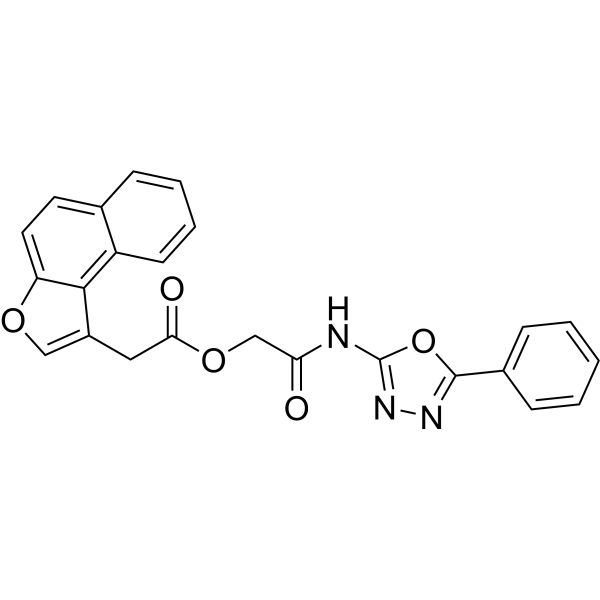
    OES2-0017 shows potent synergy with polyamines and growth-inhibitory effects at the low micromolar range. OES2-0017 inhibits spermine/spermidine acetyltransferase (SpeG) (IC50: 34.82 μM ) and other polyamine detoxification enzymes in low concentrations, perturbed the bacterial membrane in higher concentrations .
    OES2-0017
  • HY-N0983

    Bacterial Inflammation/Immunology
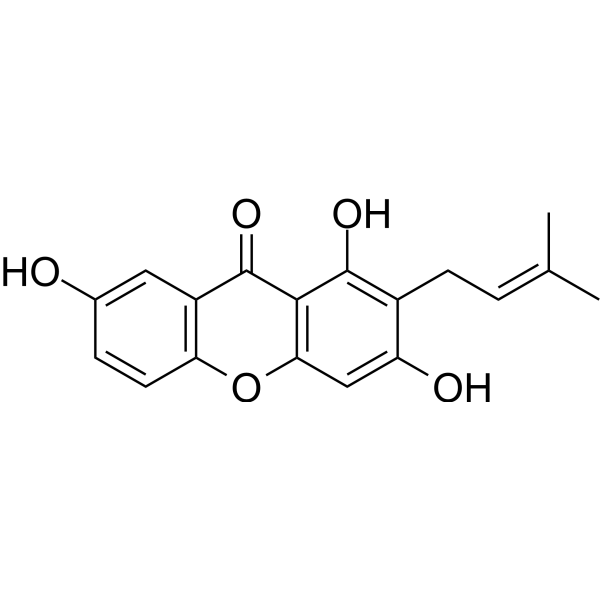
    1,3,7-Trihydroxy-2-prenylxanthone, a xanthone, shows weaker antibacterial activity. 1,3,7-Trihydroxy-2-prenylxanthone exhibits the MIC values of 6.25 mg/ml against VREs strains (E. faecalis, E. faecium, and E. gallinarum) .
    1,3,7-Trihydroxy-2-prenylxanthone
  • HY-111311

    Bacterial Drug Derivative Infection
    NVC-422 is a N-chlorotaurine analog, virucidal agent, antibacterial agent. NVC-422 exhibits virucidal activity against Ad5 by the oxidative inactivation of key viral proteins (fiber and hexon), leading to the loss of viral integrity and infectivity. NVC-422 is shown to be highly effective in killing all microbial strains tested, including antibiotic-resistant S. aureus and E. faecium. NVC-422 can be used in the research of adenoviral conjunctivitis .
    NVC-422
  • HY-P5204

    K1-EJ hybrid

    Bacterial Infection
    Enterocin Hybrid 1 is a antibacterial agent, a antibacterial composition. Enterocin Hybrid 1 inhibits Vancomycin (HY-B0671)-resistant E. faecium, Staphylococcus haemoliticus .
    Enterocin Hybrid 1
  • HY-178056

    Carbonic Anhydrase Bacterial Infection
    Carbonic anhydrase-IN-2 is an orally active carbonic anhydrase inhibitor. Carbonic anhydrase-IN-2 shows antibacterial effect against various vancomycin-resistant Enterococcus (VRE) strains. Carbonic anhydrase-IN-2 can be used for the research of infection, such as E. faecium .
    Carbonic anhydrase-IN-2
  • HY-19289

    RWJ 54428

    Bacterial Infection
    MC-02479 is a novel cephalosporin. RWJ-54428 has good activity against most of the organisms tested, including methicillin-resistant staphylococci, E. faecalis, and penicillin-resistant pneumococci, and has moderate activity against E. faecium .
    MC-02479
  • HY-P10681

    Bacterial Infection
    Crabrolin is a tridecapeptide that can be extracted from the venom of the European hornet (Vespa crabro). Crabrolin shows MIC/MBC of 2/2, 16/64, 4/8 μM, for S. aureus (NCTC 10788), MRSA (NCTC 12493) and E. faecium (NTCC 12697), respectively .
    Crabrolin
  • HY-176516

    Diarginine Peptidomimetic-1

    Antibiotic Infection
    dAPM-1 (acetate) is a peptidomimetic antibiotic agent. dAPM-1 (acetate) can selectively induces intracellular aggregation in B. subtilis. dAPM-1 (acetate) is active against S. aureus, methicillin-resistant S. aureus (MRSA), B. subtilis, E. faecium, and M. smegmatis with MICs of 8, 4, 4, 8, and 16 µg/ml, respectively .
    dAPM-1 acetate
  • HY-168729

    Bacterial Infection
    Antibacterial agent 256 (Compound C09) is an inhibitor for type I signal peptidase (SPase I). Antibacterial agent 256 inhibits gram-positive bacteria, that inhibits S. aureus ATCC 29213, E. faecium QF31, E. faecalis SF23-1 and S. suis P1/7, with MIC of 1-16 μg/mL. Antibacterial agent 256 exhibits cytotoxicity in cancer cell HEp-2 and Caco-2 with CC50 of 14.65 μg/mL and 21.93 μg/mL. Antibacterial agent 256 exhibits a hemolytic activity on mouse RBCs, with an HC50 of 13.29 μg/mL. Antibacterial agent 256 ameliorates the MRSA skin infection in mouse model .
    Antibacterial agent 256
  • HY-182315

    Bacterial Infection
    Antibacterial agent 334 is an antimicrobial peptide with in vitro activity against both Gram-negative and Gram-positive bacteria. Antibacterial agent 334 disrupts bacterial membrane integrity, induces membrane depolarization, impairs bacterial physiological processes without causing immediate bacterial lysis, and reduces the formation of Staphylococcus aureus biofilms. Antibacterial agent 334 can be used in studies related to Staphylococcus aureus infections .
    Antibacterial agent 334

Inquiry Online

Your information is safe with us. * Required Fields.

Salutation


Country or Region *

Applicant Name *


Organization Name *

Department *


Email Address *


Product Name *

Cat. No.


Requested quantity *

Phone Number *


Remarks

Inquiry Online

Inquiry Information

Product Name:
Cat. No.:
Quantity:
MCE Japan Authorized Agent:

