9 Results for "

E1 ligase

" in MedChemExpress (MCE) Product Catalog:
Products (9)

9 Results for "E1 ligase" in MCE Product Catalog:

10
10 Publications Verification
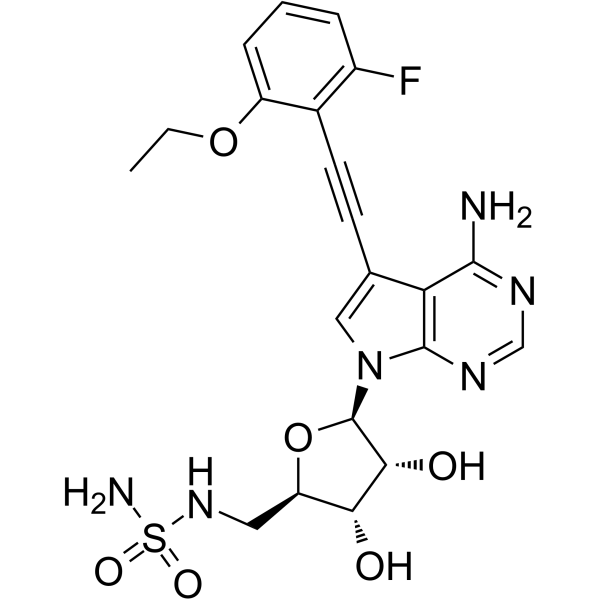
Cat. No.: HY-128586
CAS No.: 1848959-10-3
Purity:  99.52%
TAS4464 is a long-acting, highly selective covalent inhibitor targeting NEDD8-activating enzyme (NAE) (IC50=0.955 nM), and also inhibits CAII with an IC50 of 0.73 μM, which is less potent than MLN4924 (HY-70062). The IC50 values of TAS4464 against other E1 enzymes UAE and SAE are 449 nM and 1280 nM, respectively. TAS4464 targets NEDD8 in an ATP-dependent manner to inhibit NAE, blocks the neddylation pathway, causes accumulation of CRL ubiquitin ligase substrates (such as CDT1, p27, phosphorylated IκBα), and further induces tumor cell apoptosis. TAS4464 exhibits antiproliferative and cytotoxic effects, and has broad-spectrum antitumor activity against various hematologic and solid tumor cell lines as well as patient-derived tumor cells. TAS4464 has a wide selcetive window, without obvious toxicity. TAS4464 can be used in the research of hematologic malignancies (leukemia, lymphoma, multiple myeloma, etc.) and solid tumors (small cell lung cancer, colorectal cancer, sarcoma, endometrial cancer, ovarian cancer, etc.) .
loading...
    loading...
10
10 Publications Verification
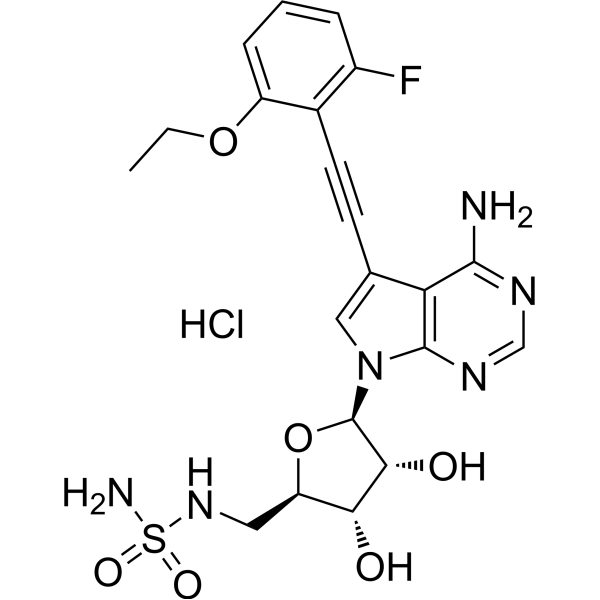
Cat. No.: HY-128586A
CAS No.: 1848959-11-4
Purity:  98.91%
TAS4464 hydrochloride is a long-acting, highly selective covalent inhibitor targeting NEDD8-activating enzyme (NAE) (IC50=0.955 nM), and also inhibits CAII with an IC50 of 0.73 μM, which is less potent than MLN4924 (HY-70062). The IC50 values of TAS4464 hydrochloride against other E1 enzymes UAE and SAE are 449 nM and 1280 nM, respectively. TAS4464 hydrochloride targets NEDD8 in an ATP-dependent manner to inhibit NAE, blocks the neddylation pathway, causes accumulation of CRL ubiquitin ligase substrates (such as CDT1, p27, phosphorylated IκBα), and further induces tumor cell apoptosis. TAS4464 hydrochloride exhibits antiproliferative and cytotoxic effects, and has broad-spectrum antitumor activity against various hematologic and solid tumor cell lines as well as patient-derived tumor cells. TAS4464 hydrochloride has a wide therapeutic window, without obvious toxicity. TAS4464 hydrochloride can be used in the research of hematologic malignancies (leukemia, lymphoma, multiple myeloma, etc.) and solid tumors (small cell lung cancer, colorectal cancer, sarcoma, endometrial cancer, ovarian cancer, etc.) .
loading...
    loading...
4
4 Cited Publications
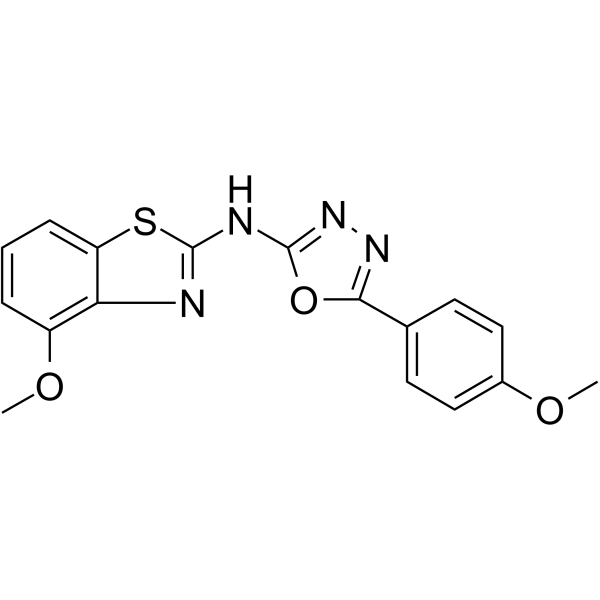
Cat. No.: HY-110273
CAS No.: 862974-25-2
Purity:  99.58%
Research Areas:  

Cardiovascular Disease

N106 is a first-in-class sarcoplasmic reticulum calcium ATPase (SERCA2a) SUMOylation activator. N106 directly activates the SUMO-activating enzyme, E1 ligase. N106 can be used for heart failure research .
loading...
    loading...
1
1 Cited Publications
Cat. No.: HY-115865
CAS No.: 2803617-91-4
Purity:  99.31%
Target:  

PROTACs IAP

Research Areas:  

Cancer

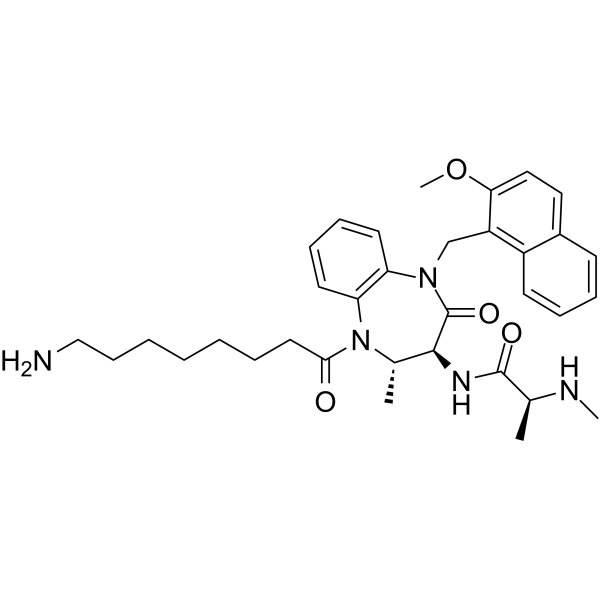
XIAP degrader-1 is a PROTAC-like degrader with a Kd value of 1 μM for XIAP. XIAP degrader-1 is metabolized into an active aldehyde species that covalently binds to Cys326 of FBXO22, thereby forming a ternary complex with the BIR2 domain of XIAP. XIAP degrader-1 induces polyubiquitination and proteasomal degradation of XIAP via the ubiquitin-proteasome system, a process dependent on NEDD8 conjugation, the SCF FBXO22 ligase complex, as well as the functional activities of XIAP ligase, E1 and the proteasome .
loading...
    loading...
1
1 Cited Publications
Cat. No.: HY-132991
Purity:  99.43%
Research Areas:  

Cancer

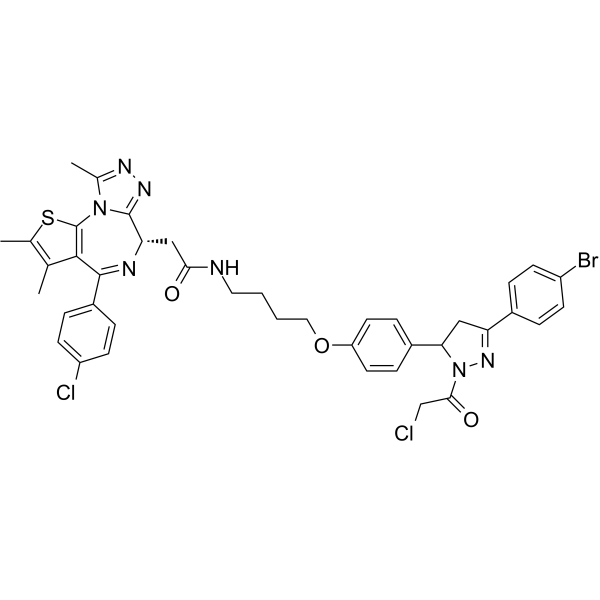
ML 2-14 is a PROTAC targeting BRD4 with a C4 alkyl linker. ML 2-14 consists of the E3 ligase ligand EN219 (HY-115715) (bule part), the target protein ligand JQ-1 (HY-13030) (red part), and the PROTAC linker (balck part). ML 2-14 can effectively degrade BRD4 in 231MFP breast cancer cells, and this effect can be reversed by the proteasome inhibitor Bortezomib (HY-10227) and the E1 activase inhibitor TAK-243 (HY-100487). ML 2-14 can be used for breast cancer-related research .
loading...
    loading...
Cat. No.: HY-169358
CAS No.: 3120166-93-7
Research Areas:  

Cancer

L134 is a BRD4 PROTAC degrader with a DC50 of 7.36 nM. L134 induces BRD4 protein degradation without inhibiting BRD4 gene expression, and recruits the E3 ubiquitin ligase DCAF11 to mediate this process, which can be blocked by proteasome inhibitors (MG132 (HY-13259), PS341 (HY-10227)) and E1 ubiquitin ligase inhibitors (PYR41 (HY-13296), MLN4924 (HY-70062)). L134 inhibits cancer cell migration, promotes cancer cell apoptosis and exerts antiproliferative activity. L134 can be used in studies related to triple-negative breast cancer .
loading...
    loading...
Cat. No.: HY-161960
EP300/CBP ligand 2 (compound S19) is a ligand targeting the bromodomain of CREB binding protein (CBP) and E1A-associated protein (EP300). EP300/CBP ligand 2 can be used as a target protein ligand in the PROTAC structure, and can be coupled to the E3 ubiquitin ligase ligand through the PTOTAC Linker to synthesize PROTAC molecules with degradation effects. For example, EP300/CBP ligand 2 can be coupled with the conjugate (E3 ubiquitin enzyme ligand + Linker) Thalidomide-NH-C10-Boc (HY-161961) to produce the PROTAC molecule dCE-2 (HY-161958) .
loading...
    loading...
Cat. No.: HY-110273R
CAS No.: 862974-25-2
N106 (Standard) is the analytical standard of N106 (HY-110273). This product is intended for research and analytical applications. N106 is a first-in-class sarcoplasmic reticulum calcium ATPase (SERCA2a) SUMOylation activator. N106 directly activates the SUMO-activating enzyme, E1 ligase. N106 can be used for heart failure research .
loading...
    loading...
Cat. No.: HY-L050
507 compounds

Protein ubiquitination is an enzymatic post-translational modification in which an ubiquitin protein is attached to a substrate protein. Ubiquitination involves three main steps: activation, conjugation, and ligation, performed by ubiquitin-activating enzymes (E1s), ubiquitin-conjugating enzymes (E2s), and ubiquitin ligases (E3s), respectively. Ubiquitination affects cellular processes such as apoptosis, cell cycle, DNA damage repair, and membrane transportation, etc. by regulating the degradation of proteins (via the proteasome and lysosome), altering the cellular localization of proteins, affecting proteins activity, and promoting or preventing protein-protein interactions. Deregulation of ubiquitin pathway leads to many diseases such as neurodegeneration, cancer, infection and immunity, etc.

MCE offers a unique collection of 507 small molecule modulators with biological activity used for ubiquitination research. Compounds in this library target the key enzymes in ubiquitin pathway. MCE Ubiquitination Compound Library is a useful tool for the research of ubiquitination regulation and the corresponding diseases.

