
28 Results for "

FIX

" in MedChemExpress (MCE) Product Catalog:
Products (28)

28 Results for "FIX" in MCE Product Catalog:

20
20 Publications Verification
Cat. No.: HY-145405
CAS No.: 1220890-25-4
Purity:  99.91%
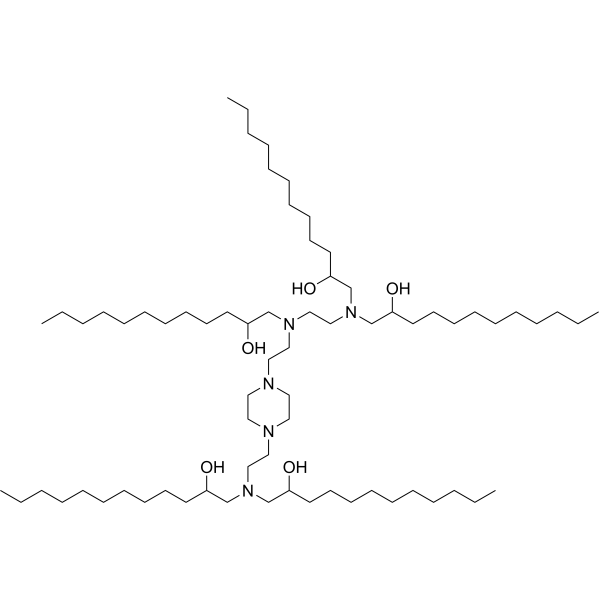
C12-200 is a type of ionizable cationic lipid and helper lipid commonly used for mRNA delivery. In the hemophilia B mouse model, mRNA encoding human erythropoietin (EPO) and coagulation factor IX (FIX) can be successfully delivered and expressed using C12-200. C12-200 is utilized in research related to hemophilia B .
loading...
    loading...
18
18 Cited Publications
Cat. No.: HY-D1300
CAS No.: 231946-72-8
Synonyms: LysoTracker Red DND-99
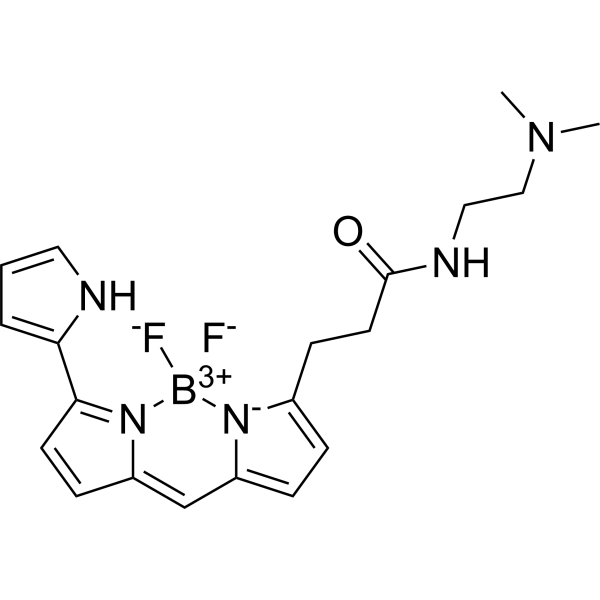
LysoTracker Red is a Red fluorescently labeled lysosomal probe with a maximum excitation/emission wavelength of 577/590 nm. The structure is composed of a fluorescein group and linked weak bases, which can freely cross the cell membrane and gather on spherical organelles. It is suitable for observing the internal biosynthesis and related pathogenesis of lysosomes .
loading...
    loading...
3
3 Cited Publications
Cat. No.: HY-DY3001
Glutaraldehyde Fixative (2.5%, For Electron Microscopy) is composed of glutaraldehyde, phosphate, deionized water, etc., with a pH range of 7.2-7.4. This fixative is effective in fixing fine structures of cell nuclei and cytoplasm and is commonly used for fixing electron microscopy specimens.
loading...
    loading...
Cat. No.: HY-DY1040
CAS No.: 231946-72-8
LysoTracker Red (solution) is a Red fluorescently labeled lysosomal probe with a maximum excitation/emission wavelength of 577/590 nm. The structure is composed of a fluorescein group and linked weak bases, which can freely cross the cell membrane and gather on spherical organelles. It is suitable for observing the internal biosynthesis and related pathogenesis of lysosomes .
Solvent and concentration: DMSO: 1 mM
loading...
    loading...
Cat. No.: HY-DY3003
Tissue and Cell Fixative (4% Paraformaldehyde, PFA) is mainly composed of paraformaldehyde, phosphate, and deionized water, with a pH of 7.0-7.4. Tissue and Cell Fixative (4% Paraformaldehyde, PFA) is suitable for fixing most tissues and cells, and can effectively protect the morphology and structure of tissues and cells as well as nucleic acids.
loading...
    loading...
Cat. No.: HY-B1937
CAS No.: 25155-30-0
Synonyms: Bio-Soft S 101 sodium
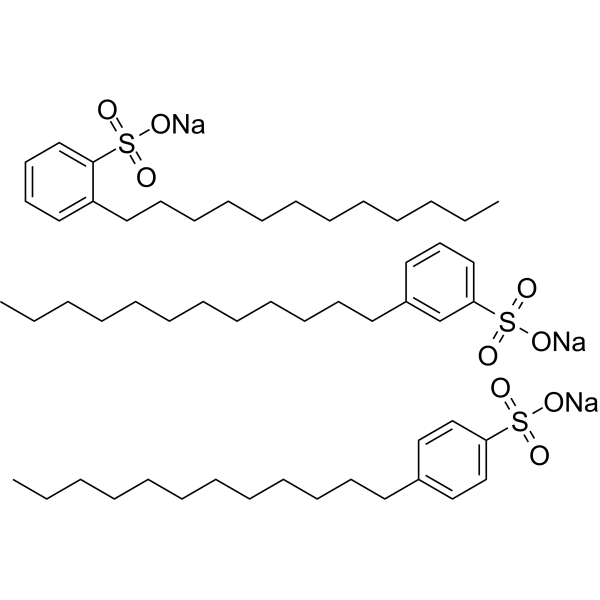
Sodium dodecylbenzenesulfonate (Bio-Soft S 101 sodium) is a nonionic surfactant commonly used in a variety of applications for cleaning and treating industrial equipment. It has good cleaning power and environmental compatibility, and can effectively remove oil, dirt and other forms of contamination. In addition, in textile, paper, leather and other industries, the compound can also be used for fixing and stabilizing dyes and colors. Although the compound has no direct application in the medical field, it plays an important role in industry and laboratory research.
loading...
    loading...
Cat. No.: HY-N12931F
Maackia amurensis Lectin (MAA/MAL II)-Biotinylated is a plant lectin modified by biotin. Maackia amurensis Lectin (MAA/MAL II)-Biotinylated has the activity to recognize specific sugar structures, specifically the alpha-2, 3-linked sialic acid (HY-I0400). Maackia amurensis Lectin (MAA/MAL II)-Biotinylated has a very high affinity with avidin or streptavidin and this interaction can be used to fix it to solid surfaces or bind it to other molecules. Maackia amurensis Lectin (MAA/MAL II)-Biotinylated can be used to isolate and purify proteins or other molecules with specific sugar chain structures in affinity chromatography as well as for disease marker discovery and cancer research .
loading...
    loading...
Cat. No.: HY-DY3002
Glutaraldehyde Fixative (4%, For Electron Microscopy) is composed of glutaraldehyde, phosphate, deionized water, etc., with a pH range of 7.2-7.4. This fixative is effective in fixing fine structures of cell nuclei and cytoplasm and is commonly used for fixing electron microscopy specimens.
loading...
    loading...
Cat. No.: HY-E70015
CAS No.: 9067-77-0
Synonyms: PEPC
Target:  

Others

Research Areas:  

Others

Phosphoenolpyruvate carboxylase, Microorganism (PEPC) is a carbon dioxide fixing enzyme that in an irreversible manner and in the presence of Mg 2+, converts phosphoenolpyruvate and bicarbonate into oxaloacetate and inorganic phosphorus. Phosphoenolpyruvate carboxylase catalyses the primary assimilation of CO(2) in Crassulacean acid metabolism plants. Phosphoenolpyruvate carboxylase plays a major role in setting the day-night pattern of metabolism in plants .
loading...
    loading...
Cat. No.: HY-122142A
CAS No.: 127428-47-1
Synonyms: S-2366 (hydrochloride)
Research Areas:  

Others

Pyr-​Pro-​Arg-​pNA (S-2366) hydrochloride is a chromogenic peptidyl substrate, and a noncompetitive inhibitor that occupies the active sites of FXIa and FXIa-LC to block factor IX activation. Pyr-​Pro-​Arg-​pNA hydrochloride functions as a hydrolyzable substrate for FXIa’s catalytic domain, human APC, murine APC, and purified plasma kallikrein .
loading...
    loading...
Cat. No.: HY-P99840
CAS No.: 2055206-13-6
Synonyms: CB-2679d; DalcA; ISU-304

Target:  

Inhibitory Antibodies

Research Areas:  

Others

Dalcinonacog alfa is a recombinant FIX factor that can be used in the study of Haemophilia B .
loading...
    loading...
Cat. No.: HY-122142
CAS No.: 72194-57-1
Synonyms: S-2366
Pyr-​Pro-​Arg-​pNA (S-2366) is a chromogenic peptidyl substrate, and a noncompetitive inhibitor that occupies the active sites of FXIa and FXIa-LC to block factor IX activation. Pyr-​Pro-​Arg-​pNA functions as a hydrolyzable substrate for FXIa’s catalytic domain, human APC, murine APC, and purified plasma kallikrein .
loading...
    loading...
Cat. No.: HY-P991213
Synonyms: Rixubis

Target:  

Factor XI

Research Areas:  

Cardiovascular Disease

Nonacog gamma is a coagulation factor IX (FIX) supplement. Nonacog gamma activates coagulation factor X (FX), promotes the generation of thrombin, and then converts fibrinogen into fibrin, forming a stable blood clot to exert hemostatic activity. Nonacog gamma is promising for research of hemophilia B .
loading...
    loading...
Cat. No.: HY-RS00507
Research Areas:  

Others

AK3 Human Pre-designed siRNA Set A contains three designed siRNAs for AK3 gene (Human), as well as a negative control, a positive control, and a FAM-labeled negative control.

loading...
    loading...
Cat. No.: HY-RS04648
Research Areas:  

Others

F9 Human Pre-designed siRNA Set A contains three designed siRNAs for F9 gene (Human), as well as a negative control, a positive control, and a FAM-labeled negative control.

loading...
    loading...
Cat. No.: HY-173249
Poly-L-lysine, succinylated (MW >50000) is a cationic polymer that can be used to fix cells on glass substrates or negatively charged substrates, and succinylation modification can be used for subsequent coupling.
loading...
    loading...
Cat. No.: HY-173241
Poly-L-lysine-Ahx-FITC (MW 15000-30000) is a cationic polymer, which is a polylysine modified with FITC (HY-66019). Poly-L-lysine-Ahx-FITC (MW 15000-30000) is used to fix cells on glass substrates or negatively charged substrates for subsequent labeling and localization experiments.
loading...
    loading...
Cat. No.: HY-173241A
Poly-L-lysine-Ahx-FITC (MW 30000-70000) is a cationic polymer, which is a polylysine modified with FITC (HY-66019). Poly-L-lysine-Ahx-FITC (MW 30000-70000) is used to fix cells on glass substrates or negatively charged substrates for subsequent labeling and localization experiments.
loading...
    loading...
Cat. No.: HY-159080
Target:  

Parasite

Research Areas:  

Infection

HgCht2-IN-1 (compound 1516b) is a HgCht2 inhibitor that successfully inhibits the antagonism of cyst nematodes against nitrogen-fixing rhizobia and phosphate-absorbing arbuscular mycorrhizal symbionts. HgCht2-IN-1 can be used in the study of cyst nematode antagonism against microbial symbionts .
loading...
    loading...
Cat. No.: HY-P10306
Target:  

Bacterial

Research Areas:  

Infection

Cys-LL37 is a biomaterial with antimicrobial properties developed by covalently fixing to the surface of titanium. Cys-LL37 uses a flexible hydrophilic polyethylene glycol spacer and selective n-terminal coupling LL37, a surface peptide layer that kills bacteria on contact is formed. Cys-LL37 can be used in research to develop new antimicrobial biomaterials .
loading...
    loading...

