8 Results for "

FcγR signaling

" in MedChemExpress (MCE) Product Catalog:
Products (8)

8 Results for "FcγR signaling" in MCE Product Catalog:

Cat. No.: HY-163565
CAS No.: 2770960-52-4
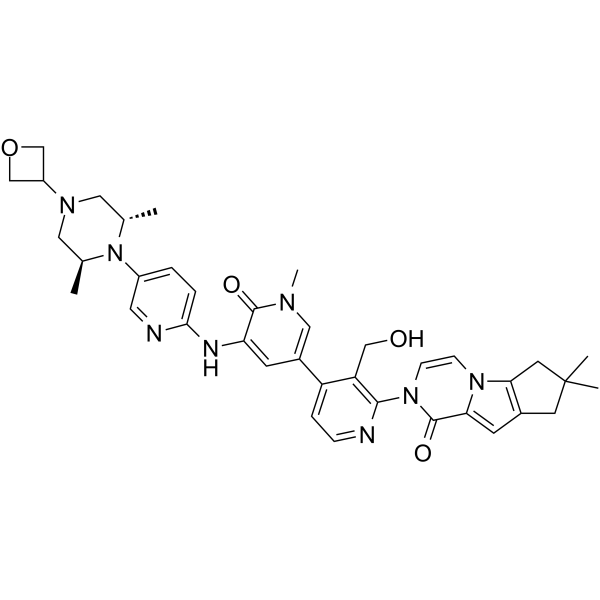
BIIB129 is a covalent, selective, orally active, and brain-penetrant BTK inhibitor (Kd = 0.63 nM). BIIB129 binds to Cys481 and forms a hydrogen bond with Asn484, blocking BCR and FcγR signaling. BIIB129 inhibits B cell activation and proliferation, FcγR-induced microglial proliferation, FcγR-mediated ROS production in neutrophils, FcγR-induced TNF secretion in monocytes, and B cell-mediated antigen presentation to T cells. BIIB129 can be used for research on multiple sclerosis .
loading...
    loading...
Cat. No.: HY-177578
NN3201 is a c-Kit-targeting antibody-drug conjugate (ADC) with high affinity (KD = 0.19 pM). NN3201 is composed of 4-(3-Tosyl-2-(tosylmethyl)propanoyl)benzoic acid-glu(PEG24-Me)-val-cit-NH-benzyloxyformic acid-MMAE (HY-178219) and an anti-c-Kit human monoclonal antibody NN2101 (HY-P991293). NN3201 rapidly internalizes and inhibits stem cell factor (SCF)-driven signaling, thereby delivering its payload to induce cell cycle arrest and apoptosis. NN3201 exhibits no Fc-mediated effector functions antibody-dependent cell-mediated cytotoxicity (ADCC)/complement-dependent cytotoxicity (CDC) due to reduced FcγR binding. NN3201 exhibits significant c-Kit-dependent anti-tumor efficacies in various tumor models. NN3201 can be used in small cell lung cancer (SCLC) and gastrointestinal stromal tumor (GIST) and acute myeloid leukemia (AML) research [1][2].
loading...
    loading...
Cat. No.: HY-P991193

Target:  

TNF Receptor

Research Areas:  

Cancer

NGM-438 is a humanized monoclonal antibody antagonist of LAIR1, with a Ka of 0.26 nM for human LAIR1 and 4.28 nM for cynomolgus monkey LAIR1. NGM-438 blocks the binding of LAIR1 to its Collagen ligand and antagonizes the Collagen-induced LAIR1 signaling pathway. NGM-438 reverses FcγR signaling inhibition in myeloid cells, induces dendritic cells to secrete TNFα, promotes T cell proliferation, and triggers myeloid inflammation and allogeneic T cell responses. NGM-438 sensitizes refractory mouse lung cancer to PD-1 blockade, increases the content of intratumoral CD8 + T cells and the expression of inflammatory genes. NGM-438 is applicable to research related to solid tumors, refractory solid tumors and non-small cell lung cancer .
loading...
    loading...
Cat. No.: HY-163962
CAS No.: 2451070-32-7
L18I is a Bruton's tyrosine kinase (BTK) PROTAC degrader that targets wild-type and BTK C481, and recruits the cereblon E3 ligase to mediate proteasomal degradation. L18I regulates the BCR, TLR, FcγR and NLRP3 inflammasome signaling pathways, inhibits the phosphorylation of PLCγ-2, ERK1/2 and p38, and reduces the levels of B cell activation markers CD25, CD69 and CD86. L18I downregulates the NF-κB, TNF and TLR signaling pathways, reduces the production of pro-inflammatory cytokines, and decreases immune cell infiltration and immune complex deposition. L18I inhibits the proliferation of BTK-expressing lymphoma cells, induces tumor regression in xenograft models, and exhibits synergistic activity when combined with inhibitors of SYK, PI3K or Lyn. L18I can be used in research related to lupus, diffuse alveolar hemorrhage and B-cell lymphoma .
loading...
    loading...
Cat. No.: HY-P991402

Target:  

TNF Receptor NF-κB

Research Areas:  

Cancer

BI-1910 is an agonistic human IgG2 monoclonal antibody targeting TNFR2, which selectively binds to human TNFR2 without inhibiting TNF-α binding. As an endogenous agonist, BI-1910 activates TNFR2 and mediates the activation of the NF-κB signaling pathway. Its agonistic activity is independent of FcγR or cross-linking; it can directly costimulate T cells and NK cells, induce T cell proliferation, and activate tumor-specific CD8+ T cells. BI-1910 exhibits antitumor activity in vivo, and shows an additive antitumor effect when combined with anti-PD-1 (HY-P9902). It can be used in research related to advanced/metastatic non-small cell lung cancer and hepatocellular carcinoma. Recommended isotype control: Human IgG2 lambda, Isotype Control (HY-P991206) .
loading...
    loading...
Cat. No.: HY-147584
CAS No.: 2764674-60-2
Target:  

Btk

Research Areas:  

Inflammation/Immunology Cancer

BTK-IN-14 is a potent inhibitor of BTK. BTK plays an important role in signaling mediated by B cell antigen receptor (BCR) and Fcγreceptor (FcγR) in B cells and myeloid cells, respectively. BTK-IN-14 has the potential for the research of related diseases, especially autoimmune diseases, inflammatory diseases or cancer (extracted from patent WO2022057894A1, compound 1) .
loading...
    loading...
Cat. No.: HY-147581
CAS No.: 2765852-46-6
Target:  

Btk

Research Areas:  

Inflammation/Immunology Cancer

BTK-IN-11 is a potent inhibitor of BTK. BTK plays an important role in signaling mediated by B cell antigen receptor (BCR) and Fcγreceptor (FcγR) in B cells and myeloid cells, respectively. BTK-IN-11 has the potential for the research of related diseases, especially autoimmune diseases, inflammatory diseases or cancer (extracted from patent WO2022063101A1, compound Z2) .
loading...
    loading...
Cat. No.: HY-182943
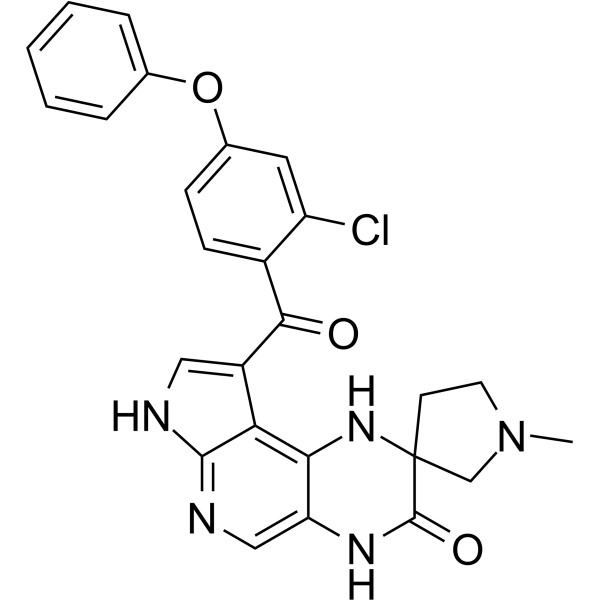
BTK-IN-49 is a selective, orally active and brain-penetrant BTK inhibitor with an IC50 of 0.14 nM. BTK-IN-49 binds to BTK and blocks B-cell receptor and Fcγ receptor signaling. BTK-IN-49 inhibits the proliferation of CNS-compartmentalized B-cells and FcγR-induced microglial proliferation in a BTK-dependent manner. BTK-IN-49 can be used for the study of multiple sclerosis .
loading...
    loading...

