1. Search Result
Search Result
Results for "

Leishmania braziliensis

" in MedChemExpress (MCE) Product Catalog:

15

Inhibitors & Agonists

4

Natural
Products

Cat. No. Product Name Target Research Areas Chemical Structure
  • HY-19567
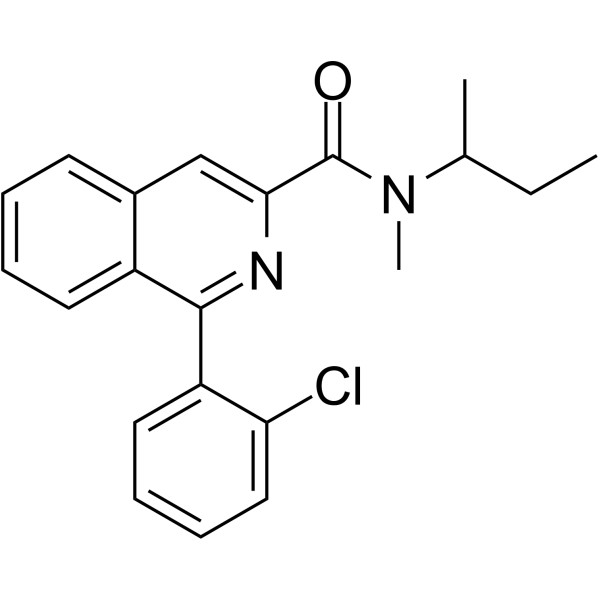
    PK 11195
    5+ Cited Publications

    RP 52028

    Parasite Infection
    PK 11195 (RP 52028) is a ligand of translocator protein (TSPO), which targets Leishmania chemotherapy, with IC50s of 14.2 μM, 8.2 μM, 3.5 μM for L. amazonensis, L. major and L. braziliensis, respectively.
    PK 11195
  • HY-125371
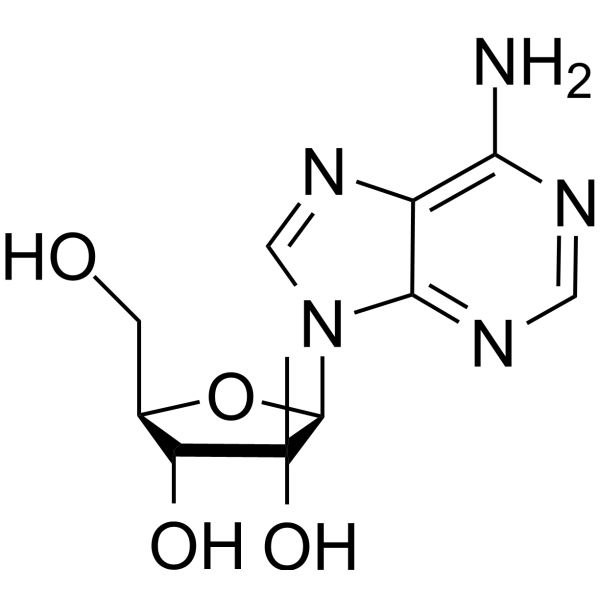
    2'-C-Methyladenosine
    2 Publications Verification

    HCV Infection Inflammation/Immunology
    2'-C-Methyladenosine is an inhibitor of hepatitis C virus (HCV) replication. 2'-C-Methyladenosine inhibits HCV replicon and NS5B-catalyzed RNA synthesis with IC50 values of 0.3μM and 1.9 μM, respectively. 2'-C-Methyladenosine also potently inhibits LRV1 in Leishmania guyanensis (Lgy) and Leishmania braziliensis .
    2'-C-Methyladenosine
  • HY-N4267

    Calcium Channel Platelet-activating Factor Receptor (PAFR) UGT Leukotriene Receptor TNF Receptor PGE synthase Interleukin Related Cardiovascular Disease Infection Inflammation/Immunology
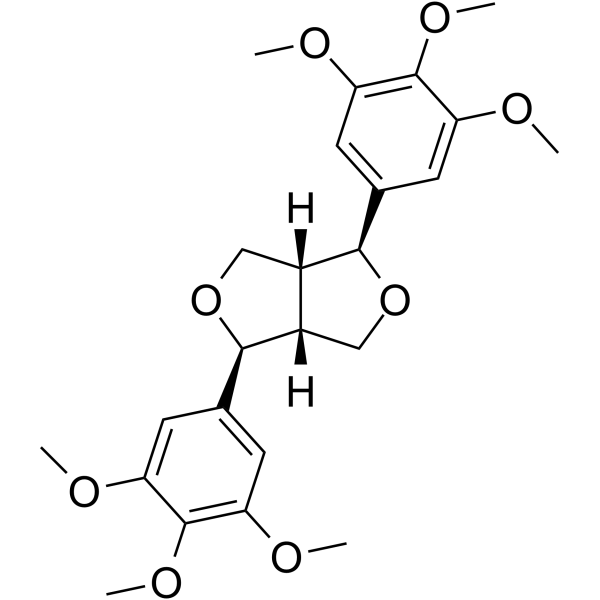
    Yangambin is a PAF receptor antagonist and UGT1A1/UGT1A3 inhibitor, with an IC50 of 29.7 μM and a Ki of 17.1 μM against human UGT1A1, and an IC50 of 56.5 μM and a Ki of 66.8 μM against human UGT1A3. Yangambin blocks PAF-mediated responses, inhibits LTB4-mediated neutrophil infiltration, and suppresses inflammatory events and anaphylactic contraction. Yangambin acts as a central nervous system inhibitor to reduce spontaneous activity, and also exhibits analgesic, anticonvulsant, antileishmanial, vasodilatory and hypotensive effects. Yangambin blocks voltage-gated Ca 2+ channels, reduces the production of NO, TNF-α, IL-6 and PGE2 in cells, increases the production of IL-10, and exerts a protective effect against cardiovascular injury. Yangambin can be used in research related to allergies, cutaneous leishmaniasis, central nervous system diseases and cardiovascular diseases .
    Yangambin
  • HY-N3702

    Syk Infection Inflammation/Immunology
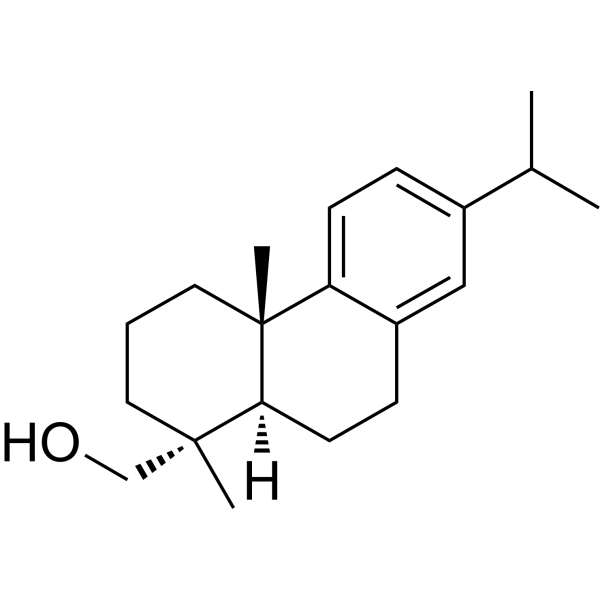
    Dehydroabietinol is a SYK inhibitor with an IC50 of 46.4 μM. Dehydroabietinol inhibits the growth of Trypanosoma cruzi epimastigotes, Leishmania braziliensis promastigotes and Leishmania infantum promastigotes. Dehydroabietinol indirectly inhibits the growth of Plasmodium falciparum, alters the erythrocyte membrane, and induces spherostomatocyte transformation and endovesicle formation. Dehydroabietinol can be used in studies related to immune-mediated diseases, Chagas disease, leishmaniasis and malaria .
    Dehydroabietinol
  • HY-125698

    Parasite Infection
    3-Deoxyaphidicolin exhibits phytotoxic efficacy, that inhibits root growth of lettuce seedlings. 3-Deoxyaphidicolin also exhibits leishmanicidal activity against Leishmania major and Leishmania braziliensis .
    3-Deoxyaphidicolin
  • HY-175259

    Dihydroorotate Dehydrogenase Parasite Infection
    DHODH-IN-29 (Compound 2i) is a covalent inhibitor of Leishmania braziliensis Dihydroorotate Dehydrogenase (LbDHODH) with an IC50 value of 0.5 μM. DHODH-IN-29 is promising for research of antileishmaniasis .
    DHODH-IN-29
  • HY-155549

    Parasite Infection
    Antileishmanial agent-20 is selective towards Leishmania parasite. Antileishmanial agent-20 has IC50 value of 2.8 μM and 0.2 μM for L. infantum and L. braziliensis, respectively. Antileishmanial agent-20 can be used for parasites research .
    Antileishmanial agent-20
  • HY-185556

    Parasite Infection
    14-Hydroxydehydroabietane is a ribosomal enzyme inhibitor. 14-Hydroxydehydroabietane exhibits in vitro antileishmanial activity against promastigotes, amastigotes and intracellular amastigotes of Leishmania infantum and Leishmania braziliensis. 14-Hydroxydehydroabietane induces ultrastructural changes in Leishmania braziliensis promastigotes. 14-Hydroxydehydroabietane reduces the infection rate of macrophages by Leishmania infantum and Leishmania braziliensis. 14-Hydroxydehydroabietane can be used for the research of leishmaniasis .
    14-Hydroxydehydroabietane
  • HY-19567R

    RP 52028 (Standard)

    Parasite Reference Standards Infection
    PK 11195 (Standard) is the analytical standard of PK 11195. This product is intended for research and analytical applications. PK 11195 (RP 52028) is a ligand of translocator protein (TSPO), which targets Leishmania chemotherapy, with IC50s of 14.2 μM, 8.2 μM, 3.5 μM for L. amazonensis, L. major and L. braziliensis, respectively.
    PK 11195 (Standard)
  • HY-146166

    Parasite Reactive Oxygen Species (ROS) Infection Inflammation/Immunology
    PT4 is a therapeutic agent against Cutaneous leishmaniasis (CL). PT4 is effective against both species of Leishmania, with IC50s of 125.18 and 233.18 μM for L. amazonensis and L. braziliensis, respectively. PT4 decreases of mitochondrial membrane potential and increases production of reactive oxygen species, which leads to parasite death. PT4 has a potent in vivo anti-inflammatory activity .
    PT4
  • HY-124210

    Antibiotic Parasite Infection Cancer
    Formycin B is an antibiotic, which exhibits antiparasitic activity against Leishmania. Formycin B exhibits toxicity to leukocytes, reversibly decreases neutrophils. Formycin B can be used in research about myeloid leukemia .
    Formycin B
  • HY-183008

    Parasite TNF Receptor Interleukin Related NF-κB Toll-like Receptor (TLR) Infection Inflammation/Immunology
    BSF2 is a anti-Leishmania agent. BSF2 modulates gene expression linked to ubiquitination, chromatin remodeling, and peroxisomal membrane transport pathways in Leishmania braziliensis. BSF2 downregulates TNF, IL-17, NF-κB, and Toll-like receptor pathways in Leishmania-infected macrophages. BSF2 exerts leishmanicidal activity against intracellular Leishmania braziliensis amastigotes. BSF2 can be used for the research of american tegumentary leishmaniasis .
    BSF2
  • HY-W676872

    COX Parasite Infection Inflammation/Immunology
    Dihydroflavokawin B is a selective COX-1 inhibitor with an IC50 of 1.22 μM. Dihydroflavokawin B weakly inhibits COX-2 and 5-LOX. Dihydroflavokawin B inhibits promastigote forms of Leishmania panamensis and Leishmania braziliensis. Dihydroflavokawin B inhibits rabbit platelet aggregation induced by Arachidonic acid, platelet activating factor, and adenosine diphosphate. Dihydroflavokawin B exhibits in vitro anti-inflammatory activity. Dihydroflavokawin B can be used for the research of leishmaniasis .
    Dihydroflavokawin B
  • HY-19688

    WR 6026

    Parasite Succinate Dehydrogenase Apoptosis Calcium Channel Mitochondrial Metabolism Infection
    Sitamaquine (WR 6026) is an orally active Antileishmanial agent and Succinate dehydrogenase inhibitor. Sitamaquine accumulates in the acidocalcisomes of Leishmania, induces organelle alkalization, and crosses the plasma membrane of Leishmania via temperature- and energy-independent diffusion. Sitamaquine disrupts oxidative phosphorylation in Leishmania, induces mitochondrial depolarization, oxidative stress, elevated intracellular calcium, plasma membrane depolarization, and Apoptosis-like cell death. Sitamaquine can be used in the research of leishmaniasis .
    Sitamaquine
  • HY-183362

    Parasite Adenosine Kinase Infection
    Antileishmanial agent-42 is an antileishmanial agent. Antileishmanial agent-42 has favorable interactions with key active site residues (e.g., Ser63, Asn66/295/299) of adenosine kinase. Antileishmanial agent-42 exerts activity against promastigote and amastigote forms of L. amazonensis, L. braziliensis, L. infantum, and L. donovani .
    Antileishmanial agent-42

Inquiry Online

Your information is safe with us. * Required Fields.

Salutation


Country or Region *

Applicant Name *


Organization Name *

Department *


Email Address *


Product Name *

Cat. No.


Requested quantity *

Phone Number *


Remarks

Inquiry Online

Inquiry Information

Product Name:
Cat. No.:
Quantity:
MCE Japan Authorized Agent:

