14 Results for "

NOD mouse

" in MedChemExpress (MCE) Product Catalog:
Products (14)

14 Results for "NOD mouse" in MCE Product Catalog:

Cat. No.: HY-W746708
CAS No.: 79335-75-4
FK-565 is a synthetic immunomodulatory peptide with a nucleotide oligomerization domain-1 (NOD1) ligand. FK-565 can activate macrophages, NK cells, and peritoneal exudative cells, enhancing the innate immune response. FK-565 has antiviral activity against a variety of viruses in vivo, and its effect is achieved through immunomodulation rather than direct viral inhibition. FK-565 can induce mouse models of arteritis and coronary arteritis (Kawasaki disease-like disease) through a NOD1-mediated mechanism. FK-565 can be used for research on viral infections and inflammatory vascular diseases .
loading...
    loading...
Cat. No.: HY-P99148

Target:  

TNF Receptor

Anti-Mouse TNF alpha Antibody (TN3-19.12) is an anti-mouse TNF alpha IgG antibody inhibitor derived from host Armenian Hamster. Anti-Mouse TNF alpha Antibody (TN3-19.12) neutralizes cytotoxic activity in supernatants obtained from LNC-8 cells. Anti-Mouse TNF alpha Antibody (TN3-19.12) reduces the symptoms and severity of EAE (experimental allergic encephalomyelitis) in LNC-8 cells xenograft mice models. Anti-Mouse TNF alpha Antibody (TN3-19.12) prevents diabetes in NOD mice. Anti-Mouse TNF alpha Antibody (TN3-19.12) shows apparent radiosensitizing effect in CD2F1 mice .
loading...
    loading...
Cat. No.: HY-175278
BAL-1516 is an orally active NLRP3 inhibitor with human NLRP3 Kd of 14.2 nM, mouse NLRP3 Kd of 200 nM, and blood-brain barrier penetration.BAL-1516 binds to a surface groove of the NLRP3 nucleotide-binding domain, contacts FISNA and WHD subdomains, forms three hydrogen bonds to the peripheral β-strand of the triple-ATPase, and does not alter NLRP3 ATP-hydrolysis activity.BAL-1516 shows specificity for NLRP3 over other NOD-like receptors, directly binds mouse NLRP3, and inhibits inflammasome formation in monocytes and microglia .
loading...
    loading...
Cat. No.: HY-RS09404

Nod1 Mouse Pre-designed siRNA Set A contains three designed siRNAs for Nod1 gene (Mouse), as well as a negative control, a positive control, and a FAM-labeled negative control.

loading...
    loading...
Cat. No.: HY-RS09407
Research Areas:  

Others

Nod2 Mouse Pre-designed siRNA Set A contains three designed siRNAs for Nod2 gene (Mouse), as well as a negative control, a positive control, and a FAM-labeled negative control.

loading...
    loading...
Cat. No.: HY-P5396A
Research Areas:  

Others

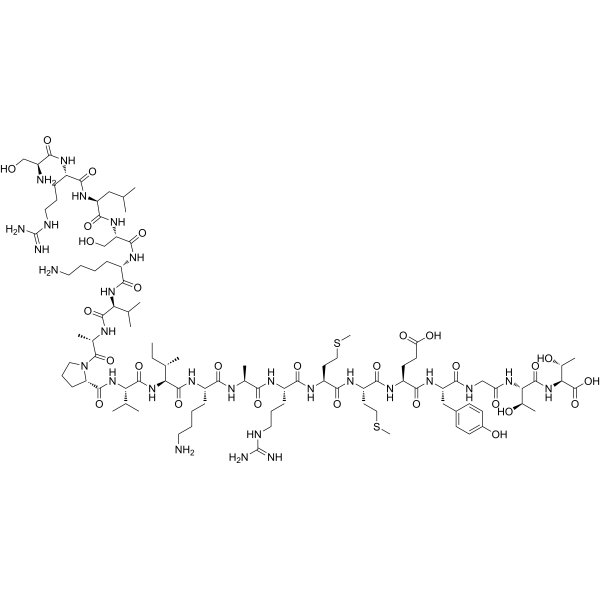
GAD65 (524-543) acetate is a biological active peptide with amino acids 524 to 543 fragment of glutamic acid decarboxylase 65 (GAD65). GAD65 (524-543) acetate is one of the first fragments of the islet antigen to induce proliferative T cell responses in the non-obese diabetic (NOD) mouse model of spontaneous autoimmune diabetes. GAD65 (524-543) acetate is a specific, possibly low affinity, stimulus for the spontaneously arising diabetogenic T cell clone BDC2.5. Immunization with GAD65 (524-543) acetate increases the susceptibility of the NOD mice to type 1 diabetes induced by the adoptive transfer of BDC2.5 T cells .
loading...
    loading...
Cat. No.: HY-170447
CAS No.: 3099180-63-6
Research Areas:  

Inflammation/Immunology

NOD1 antagonist-2 (compound 66) is an orally active selective antagonist of both human and mouse NOD1. NOD1 antagonist-2 (compound 66) antagonizes NOD1-induced NF-κB and MAPK pathways .
loading...
    loading...
Cat. No.: HY-168137
Research Areas:  

Inflammation/Immunology

NOD2 agonist 2 (compound 23) enhanced the antigen presentation of mouse bone marrow-derived dendritic cells (BMDCs), highlighting its potential as a vaccine adjuvant.
loading...
    loading...
Cat. No.: HY-P5396
CAS No.: 152468-44-5
Research Areas:  

Others

GAD65 (524-543) is a biological active peptide with amino acids 524 to 543 fragment of glutamic acid decarboxylase 65 (GAD65). GAD65 (524-543) is one of the first fragments of islet antigen to induce proliferative T cell responses in the non-obese diabetic (NOD) mouse model of spontaneous autoimmune diabetes. GAD65 (524-543) is a specific, possibly low affinity, stimulus for the spontaneously arising diabetogenic T cell clone BDC2.5. Immunization with GAD65 (524-543) increases the susceptibility of the NOD mice to type 1 diabetes induced by the adoptive transfer of BDC2.5 T cells .
loading...
    loading...
Cat. No.: HY-118912
CAS No.: 457937-39-2
BMH-9 (Compound Z54) is a modulator for nuclear receptor subfamily 2, group F, member 6 (NR2F6) (also known as nuclear orphan receptor Ear2) . BMH-9 is an activator for p53 signaling pathway through interaction with DNA. BMH-9 inhibits proliferation of human cancer cells, exhibits antitumor efficacy in NOD-SCID mouse models .
loading...
    loading...
Cat. No.: HY-184473
NOD1/TLR7 agonist-1 is a dual NOD1 and TLR7 agonist. NOD1/TLR7 agonist-1 exhibits adjuvant effects in mouse vaccine models and induces increased ovalbumin-specific IgG titers. NOD1/TLR7 agonist-1 can be used for research on immune-related diseases .
loading...
    loading...
Cat. No.: HY-184472
Research Areas:  

Inflammation/Immunology

NOD1 agonist-1 is a NOD1 agonist with immunostimulatory and adjuvant activities. NOD1 agonist-1 enhances ovalbumin-specific total IgG antibody responses in mouse vaccination models. NOD1 agonist-1 can be used for the research of immune-related diseases .
loading...
    loading...
Cat. No.: HY-P10492
Target:  

Inhibitory Antibodies

Research Areas:  

Others Metabolic Disease

Tregitope 289 is a peptide derived from the Fc region of immunoglobulin G (IgG) and is a highly conserved T cell epitope that stimulates the expansion of natural regulatory T cells. Co-delivery of Tregitope 289 with type 1 diabetes (T1D) antigens delays the development of hyperglycemia and reduces the incidence of diabetes in the NOD mouse model. Tregitope 289 can be used to study T1D and other autoimmune diseases .
loading...
    loading...
Cat. No.: HY-181821
Target:  

Parasite Na+/K+ ATPase

Research Areas:  

Infection

MMV1581361 is a PfATP4 inhibitor and an orally active, transmission-blocking agent with nanomolar activity against Plasmodium falciparum blood-stage isolates. MMV1581361 disrupts sodium ion (Na +) homeostasis in Plasmodium falciparum. MMV1581361 inhibits male gamete exflagellation, reduces oocyst intensity, and blocks transmission of Plasmodium falciparum. MMV1581361 demonstrates efficacy in the humanized Plasmodium falciparum NOD scid IL2Rγ null mouse model. MMV1581361 can be used for the research of malaria .
loading...
    loading...
  • 1

