32 Results for "

PCL 016-d4

" in MedChemExpress (MCE) Product Catalog:
Products (32)

32 Results for "PCL 016-d4" in MCE Product Catalog:

1
1 Cited Publications
Cat. No.: HY-I0660
CAS No.: 98-98-6
Synonyms: PCL 016
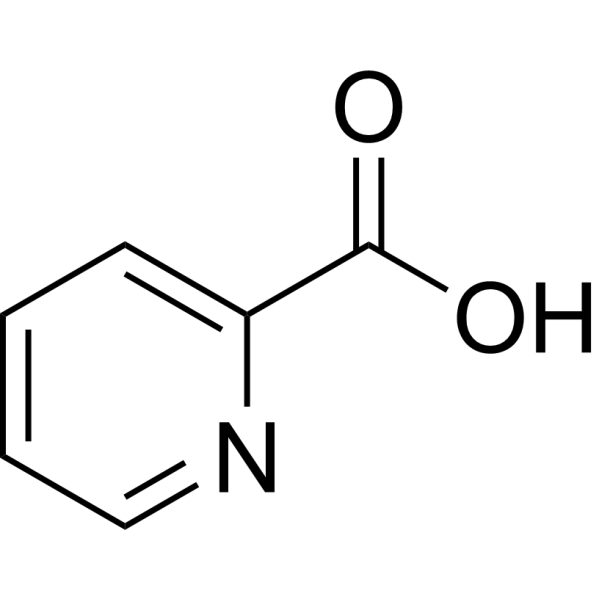
Picolinic acid (PCL 016) is a topical antiviral agent, which inhibits adenovirus replication in rabbits.
loading...
    loading...
Cat. No.: HY-W1048558A
Synonyms: mPEG2000-COOH
mPEG2000-CM (mPEG2000-COOH) is a carboxyl-terminated monomethoxy polyethylene glycol. mPEG2000-CM bears a reactive carboxyl group (-COOH) at its structural terminal site, which can form stable amide bonds with amino groups and ester bonds with hydroxyl groups. mPEG2000-CM binds to PCA-g-PCL copolymers via electrostatic interaction to form polyion complex micelles with a hydrophilic PEG surface, which enhances the stability of micelles in aqueous media. mPEG2000-CM can be used for drug delivery .
loading...
    loading...
Cat. No.: HY-W392100A
CAS No.: 36890-68-3
Synonyms: PCL-diol (MW 530)
Polycaprolactone diol (MW 530) (PCL-diol (MW 530)) is a poly (ε-caprolactone) diol with an average molecular weight of 530 g·mol −1, which serves as a monomer for biodegradable network elastic polyesters. Network polyester films undergo enzymatic hydrolysis by Rhizopus delemar lipase .
loading...
    loading...
Cat. No.: HY-172380A
PCL-PEG-PCL diacrylate (MW 800) is an amphiphilic triblock copolymer composed of PEG and two polycaprolactones (PCL). PCL-PEG-PCL diacrylate (MW 800) can be cross-linked by free radical polymerization and/or photopolymerization to form a cross-linked hydrogel network .
loading...
    loading...
Cat. No.: HY-W392100B
CAS No.: 36890-68-3
Synonyms: PCL-diol (MW 2000)
Polycaprolactone diol (MW 2000) (PCL-diol (MW 2000)) can be used as a precursor of biodegradable and bioabsorbable polycaprolactone .
loading...
    loading...
Cat. No.: HY-W392100C
CAS No.: 36890-68-3
Synonyms: PCL-diol (MW 10000)
Polycaprolactone diol (MW 10000) is a biocompatible, biodegradable polymer and also a castor oil-based polyurethane additive. Polycaprolactone diol (MW 10000) is used in studies of wound dressings and non-absorbable suture biomaterials .
loading...
    loading...
Cat. No.: HY-I0660R
CAS No.: 98-98-6
Synonyms: PCL 016 (Standard)
Picolinic acid (Standard) is the analytical standard of Picolinic acid. This product is intended for research and analytical applications. Picolinic acid (PCL 016) is a topical antiviral agent, which inhibits adenovirus replication in rabbits.
loading...
    loading...
Cat. No.: HY-P2219A
Research Areas:  

Cancer

CGGRGD TFA, a RGD derivative with cysteine as its N-terminal .
loading...
    loading...
Cat. No.: HY-172380
PCL-PEG-PCL diacrylate (MW 800) is an amphiphilic triblock copolymer composed of PEG and two polycaprolactones (PCL). PCL-PEG-PCL diacrylate (MW 800) can be cross-linked by free radical polymerization and/or photopolymerization to form a cross-linked hydrogel network .
loading...
    loading...
Cat. No.: HY-W259489S
CAS No.: 284487-61-2
Synonyms: PCL 016-d4
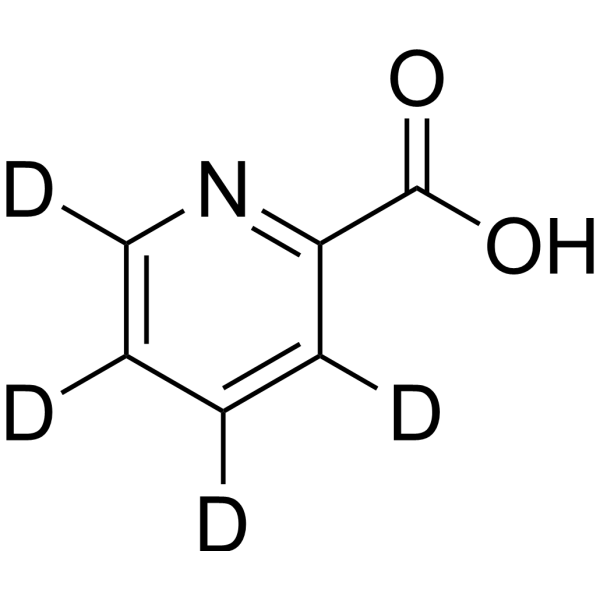
Ppicolinic-3,4,5,6-d4 acid is the deuterium labeled Ppicolinic acid .
loading...
    loading...
Cat. No.: HY-P2219
CAS No.: 1260223-44-6
Research Areas:  

Cancer

CGGRGD, a RGD derivative with cysteine as its N-terminal .
loading...
    loading...
Cat. No.: HY-Y0927
CAS No.: 823-22-3
Synonyms: 5-Hexanolide
Research Areas:  

Others

δ-Hexalactone (5-Hexanolide) is a cyclic lactone monomer that modulates the crystallinity and biodegradability of poly(ε-caprolactone) (PCL) via copolymerization .
loading...
    loading...
Cat. No.: HY-W888515
Research Areas:  

Neurological Disease

mPEG-PCL is an amphiphilic biodegradable block copolymer composed of hydrophilic methoxy poly (ethylene glycol) (mPEG) and hydrophobic poly (ε-caprolactone) (PCL). mPEG-PCL possesses excellent biocompatibility and can form delivery carriers such as micelles and nanoparticles. Through its amphiphilic block structure, mPEG-PCL forms nanocarriers and encapsulates hydrophobic molecules, thereby enhancing the loading capacity of hydrophobic molecules, reducing burst release, and achieving sustained release. mPEG-PCL can be used in research on nanodelivery, tissue engineering, and ocular delivery systems related to age-related macular degeneration (AMD) .
loading...
    loading...
Cat. No.: HY-D3168
CAS No.: 1421277-81-7
PCL-2 is a reactive oxygen species (ROS)-responsive fluorescent probe. PCL-2 reacts with ROS to release 6-hydroxy-2-cyanobenzothiazole (HCBT), which then reacts with D-cysteine ​​to form firefly luciferin in situ. PCL-2 must be used in conjunction with IETDC (HY-D3169) to detect the co-existence of hydrogen peroxide and caspase 8. PCL-2 is applicable to studies related to acute inflammation .
loading...
    loading...
Cat. No.: HY-NP016
Brucella bacterial protein is native protein that purified from Brucella for life science related research .
loading...
    loading...
Cat. No.: HY-D3169
CAS No.: 1476735-95-1
Target:  

Fluorescent Dye Caspase

Research Areas:  

Inflammation/Immunology

IETDC is a caspase 8-responsive fluorescent probe. IETDC is cleaved by activated caspase 8 to release D-cysteine, which then reacts with 6-hydroxy-2-cyanobenzothiazole (HCBT) ​​to form firefly luciferin in situ. IETDC must be used in conjunction with PCL-2 (HY-D3168) to detect the co-existence of hydrogen peroxide and caspase 8. IETDC is applicable to studies related to acute inflammation .
loading...
    loading...
Cat. No.: HY-P8F016D
Synonyms: CD38,CD38-PE-Cy7,HB-7

Host:  

Mouse

Application:  

FC

Reactivity:  

Human

loading...
    loading...
Cat. No.: HY-L016
1,673 compounds

Protein tyrosine kinases (PTKs) are key signaling molecules and important drug targets. Two classes of PTKs are present in cells: the transmembrane receptor PTKs (RTKs) and the nonreceptor PTKs. The RTK family includes the receptors for insulin and for many growth factors, such as EGFR, FGFR, PDGFR, VEGFR, and NGFR. RTKs are transmembrane glycoproteins that are activated by the binding of their ligands, and they transduce the extracellular signal to the cytoplasm by phosphorylating tyrosine residues on the receptors themselves (autophosphorylation) and on downstream signaling proteins. Their principal functions of PTKs involve the regulation of multicellular aspects of the organism. Cell to cell signals concerning growth, differentiation, adhesion, motility, and death are frequently transmitted through tyrosine kinases. In humans, tyrosine kinases have been demonstrated to play significant roles in the development of many disease states, including diabetes and cancers.

MCE designs a unique collection of 1,673 compounds that act as a useful tool for PTKs-related drug screening and disease research.

Cat. No.: HY-P811113
Synonyms: PCL1, PHF1, PHD finger protein 1, Protein PHF1, hPHF1, Polycomb-like protein 1, hPCL1

Host:  

Rabbit

Application:  

WB, IHC-P

Reactivity:  

Human, Bovine

loading...
    loading...
Cat. No.: HY-P78538
Purity:  ≥ 95%, as determined by Bis-Tris PAGE.
Synonyms: VEGFR-3; FLT-4; LMPH1A; PCLFLT41; VEGFR3; FLT-41; PCL
Species:  
Source:  
loading...
    loading...

