24 Results for "

Raman spectra

" in MedChemExpress (MCE) Product Catalog:
Products (24)

24 Results for "Raman spectra" in MCE Product Catalog:

1
1 Cited Publications
Cat. No.: HY-101891
CAS No.: 157134-53-7
Purity:  99.46%
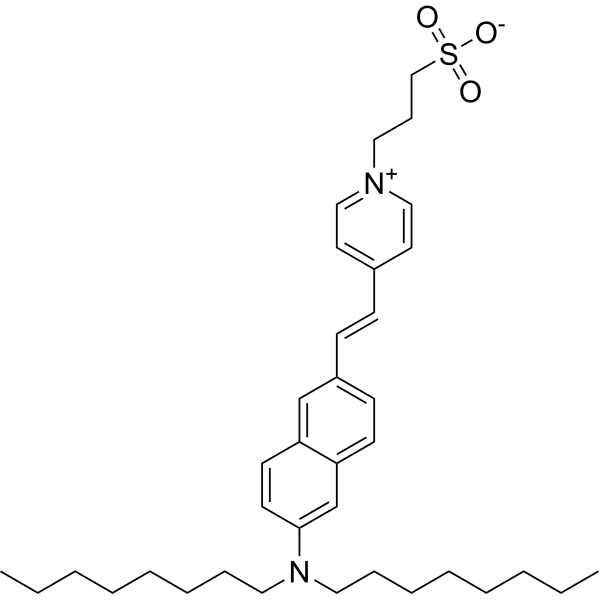
Di-8-ANEPPS is a naphthylstyryl voltage-sensitive dye, shifting both their fluorescence excitation and emission spectra upon changes in Vm .
loading...
    loading...
1
1 Cited Publications
Cat. No.: HY-149170
CAS No.: 2210244-83-8
Purity:  99.79%
Research Areas:  

Neurological Disease

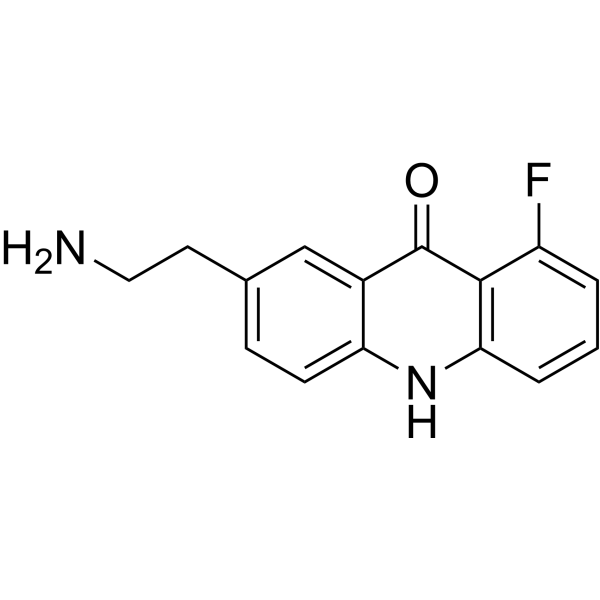
FFN246 is a fluorescent, dual substrate of serotonin transporter (SERT) probe and vesicular monoamine transporter 2 (VMAT2) with excitation and emission spectra 392/427 nm. FFN246 can be used for labeling serotonergic neurons in mouse brain tissue through SERT-dependent accumulation .
loading...
    loading...
Cat. No.: HY-W016510
CAS No.: 515-42-4
Benzenesulfonate sodium is the sodium salt of Benzenesulfonic acid. Benzenesulfonate sodium facilitates the identification of -SO3H and -SO3 - vibrational bands in compounds in Raman spectroscopy. Benzenesulfonate sodium was used in the synthesis of 1-Butyl-3-propanenitrile imidazolium benzenesulfonate [C2CN Bim]BS .
loading...
    loading...
Cat. No.: HY-NP026
Synonyms: C-phycocyaninfromporphyratenera
Spirulina C-phycocyanin, a component of the light-harvesting phycobilisome complex in photosystem II, is a highly dominant chromoprotein in Spirulina. Spirulina C-phycocyanin can be detected by Raman spectral measurement. Spirulina C-phycocyanin has antioxidant, anti-inflammatory, antiplatelet, liver-protective and cholesterol-lowering effects .
loading...
    loading...
Cat. No.: HY-W011607
CAS No.: 16305-75-2
Research Areas:  

Others

L-Alanyl-L-tryptophan is a dipeptide formed from L-alanyl and L-tryptophan, and is also a metabolite. L-Alanyl-L-tryptophan can be adsorbated on the surface of gold nanoparticles, and the Raman signal can be enhanced by SERS technology to obtain the enhanced Raman spectroscopy .
loading...
    loading...
Cat. No.: HY-P3983
CAS No.: 123380-68-7
Target:  

Inhibitory Antibodies

Research Areas:  

Others

[Cys(Bzl)84] CD (81-92) is an acidic peptide. [Cys(Bzl)84] CD (81-92) can be sequencing by negative ion postsource decay (PSD) spectra .
loading...
    loading...
Cat. No.: HY-160728
CAS No.: 1048021-78-8
Synonyms: 3′-O-Azidomethyl dATP
Research Areas:  

Others

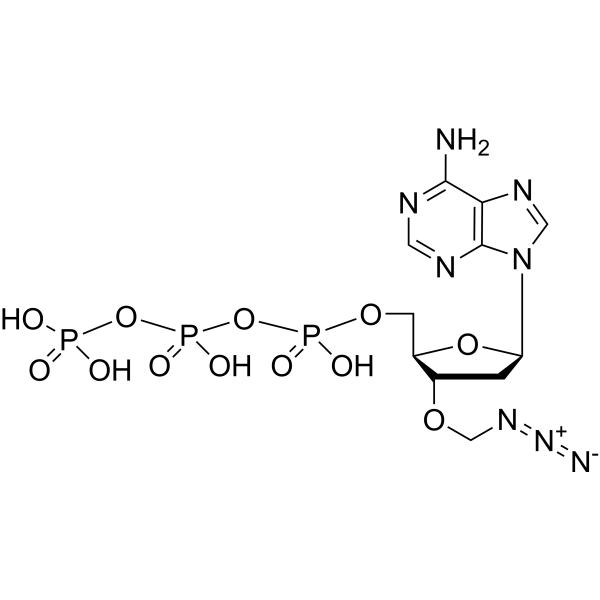
3′-O-N3-dATP (3′-O-Azidomethyl dATP) is a modified nucleotide, which is utilized for DNA polymerase. 3′-O-N3-dATP acts as reversible terminator with enhanced raman scattering (SERS) at 2125 cm -1, which determines the DNA sequences continuously .
loading...
    loading...
Cat. No.: HY-125385
CAS No.: 187099-99-6
Purity:  ≥95.0%
Target:  

Endogenous Metabolite

Research Areas:  

Metabolic Disease

Sulforhodamine 101 DHPE is a fluorescent probe made from the conjugation of the phospholipid 1,2-dipalmitoyl-sn-glycero-3-PE to sulforhodamine 101, a red fluorescent dye that displays excitation/emission spectra of 586/605 nm, respectively. It integrates into phospholipid bilayers and has been used for imaging of solid supported lipid bilayers, detection of protein-ligand binding on bilayers, and to monitor colocalization of lipid probes in liposomes via resonance energy transfer (RET).
loading...
    loading...
Cat. No.: HY-123583
CAS No.: 1644119-76-5
Target:  

Fluorescent Dye

Research Areas:  

Others

MitoBADY is a mitochondria-selective Raman probe that successfully visualizes mitochondria in live HeLa cells at a concentration of 200-400 nM for 10 minutes. MitoBADY can be utilized for the study of mitochondrial dynamics .
loading...
    loading...
Cat. No.: HY-W110781
CAS No.: 82-94-0
Target:  

DNA Stain

Research Areas:  

Others

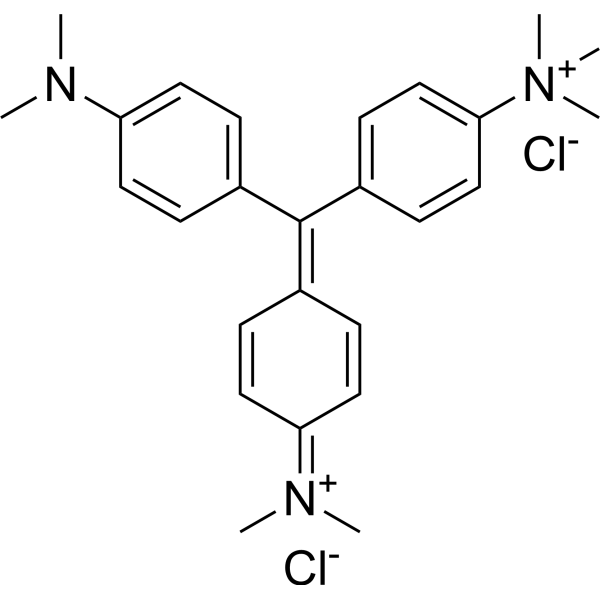
Basic Blue 20 is a very convenient red-emitting DNA stains. Basic Blue 20 has relatively narrow excitation and emission spectra, with peaks at 633 and 677 nm, respectively. Basic Blue 20 also has a very high resistance to photobleaching .
loading...
    loading...
Cat. No.: HY-160728A
Synonyms: 3′-O-Azidomethyl dATP trisodium
Research Areas:  

Others

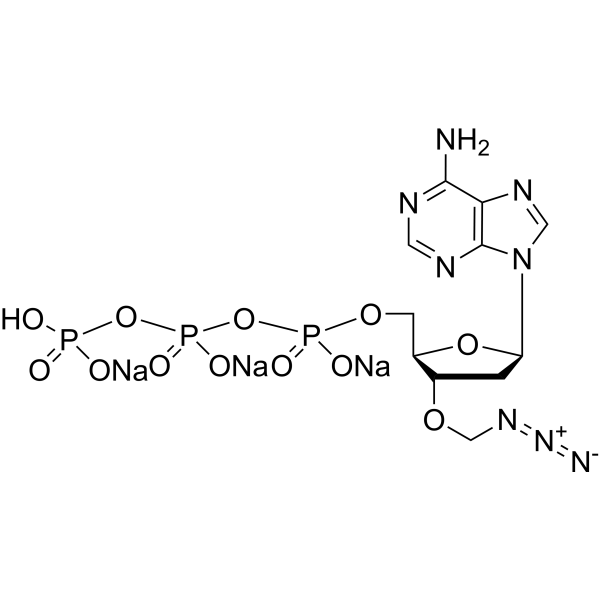
3′-O-N3-dATP trisodium (3′-O-Azidomethyl dATP trisodium) is the trisodium salt form of 3′-O-N3-dATP. 3′-O-N3-dATP trisodium is a modified nucleotide, which is utilized for DNA polymerase. 3′-O-N3-dATP trisodium acts as reversible terminator with enhanced raman scattering (SERS) at 2125 cm -1, which determines the DNA sequences continuously .
loading...
    loading...
Cat. No.: HY-D2749
CAS No.: 2353410-10-1
Sulfo-Bis-(N,N'-carboxylic acid)-Cy5 is a free unactivated carboxylic acid. Its absorbance and emission spectra are identical with Cy5 fluorophore.
loading...
    loading...
Cat. No.: HY-W016510R
CAS No.: 515-42-4
Benzenesulfonate (sodium) (Standard) is an analytical standard for Benzenesulfonate sodium (HY-W016510). This product is intended for research and analytical applications. Benzenesulfonate sodium is the sodium salt of Benzenesulfonic acid. Benzenesulfonate sodium facilitates the identification of -SO3H and -SO3 - vibrational bands in compounds in Raman spectroscopy. Benzenesulfonate sodium was used in the synthesis of 1-Butyl-3-propanenitrile imidazolium benzenesulfonate [C2CN Bim]BS .
loading...
    loading...
Cat. No.: HY-P3630
CAS No.: 102067-93-6
Research Areas:  

Others

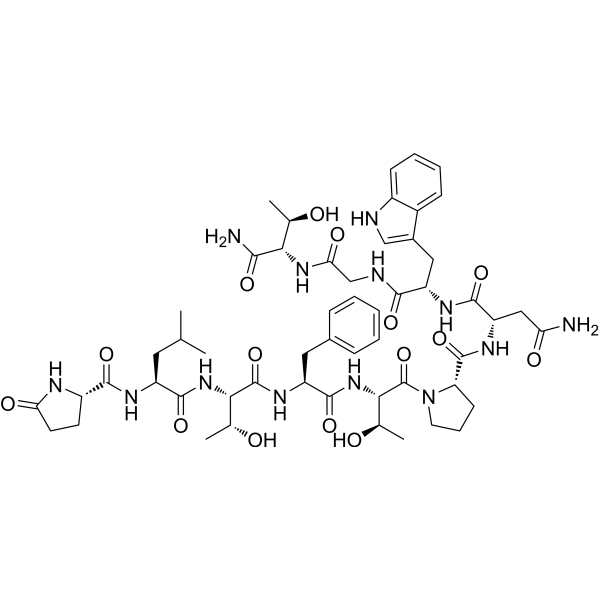
Stick Insect Hypertrehalosaemic Factor II is a synthetic peptide. Stick Insect Hypertrehalosaemic Factor II has the same FAB spectra, reversed-phase high-performance liquid chromatographic behavior, and biological behavior as the natural material. Stick Insect Hypertrehalosaemic Factor II can be used for the research of hypertrehalosaemic effect .
loading...
    loading...
Cat. No.: HY-118205
CAS No.: 637772-75-9
Target:  

Bacterial

Research Areas:  

Infection

SCH-538415 is a novel acyl carrier protein synthase inhibitor isolated from an unknown bacterial microorganism. The structural elucidation of compound 1 was completed by analyzing spectral data including UV, MS and 2D-NMR spectra. Compound 1 showed inhibitory activity in the acyl carrier protein synthase (AcpS) test with an IC50 value of 4.19 μM and exhibited antibacterial activity against Staphylococcus aureus in the agar diffusion test.
loading...
    loading...
Cat. No.: HY-109716
CAS No.: 3325-11-9
Target:  

Drug Intermediate

Research Areas:  

Others

5-Aminobenzotriazole is a benzotriazole derivative and coupling agent in the synthesis of trifunctional benzotriazole monoazo dyes for surface enhanced resonance Raman scattering (SERRS) .
loading...
    loading...
Cat. No.: HY-D2774
CAS No.: 105237-27-2
BP Fluor 488 Alkyne is a fluorophore. Its absorption and emission spectra are similar to fluorescein, but it is fluorescent in acidic media, and it is much more stable against photobleaching and oxidation.
loading...
    loading...
Cat. No.: HY-N18127
CAS No.: 1028708-26-0
Oxystemoninine is a Stemona alkaloid of the stemonamide type, which can be isolated from the roots of Stemona tuberosa. Oxystemoninine exhibits 1H- and 13C-NMR spectra similar to those of stemoninine (HY-134006) .
loading...
    loading...
Cat. No.: HY-184602
Gold nanoclusters (AuNCs) are molecular-level aggregates consisting of a core of several to dozens of gold atoms, protected by organic monomers such as thiol compounds or proteins. GSH-AuNCs utilize glutathione (a thiol-containing tripeptide) as both a reducing agent and a protecting group, reacting chemically with gold atoms to form nanoclusters, representing a transitional state between metal atoms and metal nanoparticles. Due to size effects and the emergence of quantized energy levels, GSH-AuNCs possess unique optical properties, such as tunable fluorescence emission spectra. Their fluorescence emission wavelength can be tuned with variations in particle size and composition.
loading...
    loading...
Cat. No.: HY-D3105
Target:  

Fluorescent Dye

Research Areas:  

Others

DCA is a Fluorescent probe for visualization of phase behavior in ER membranes. DCA is an ER-targeting, polarity-responsive NIR ratiometric probe, with its p-toluenesulfonamide group responsible for ER localization; its sensitivity to polarity relies on its donor-π-acceptor (D-π-A) structure, where aniline acts as the donor and dicyanomethylene acts as the acceptor, driving an intramolecular charge transfer (ICT) process upon excitation. In environments with low polarity, such as the closely packed, low water content ERₒ phase of ER membranes, DCA emits at a shorter wavelength, while in high polarity environments like the loosely packed, higher water content ERd phase, ICT leads to a red-shifted emission, allowing discrimination of the two phases via dual NIR emission colors and ratiometric imaging. Ex/Em = 488/570–620 nm and 488/665–735 nm; additional excitation/emission pairs include Ex/Em = 488/631 nm in low polarity 1,4-dioxane and Ex/Em = 488/677 nm in 1,4-dioxane with 30% water, the higher polarity condition. It shows a large Stokes shift of ~170 nm, and pH, viscosity, and biologically relevant species including Cys, GSH, H₂O₂, and metal ions do not exert marked interference on its fluorescence spectra[1].
loading...
    loading...