16 Results for "

STAT3 dimerization

" in MedChemExpress (MCE) Product Catalog:
Products (16)

16 Results for "STAT3 dimerization" in MCE Product Catalog:

  • Targets Recommended:
6
6 Publications Verification
Cat. No.: HY-122214
CAS No.: 775294-71-8
Purity:  99.84%
Target:  

Autophagy

Research Areas:  

Cancer

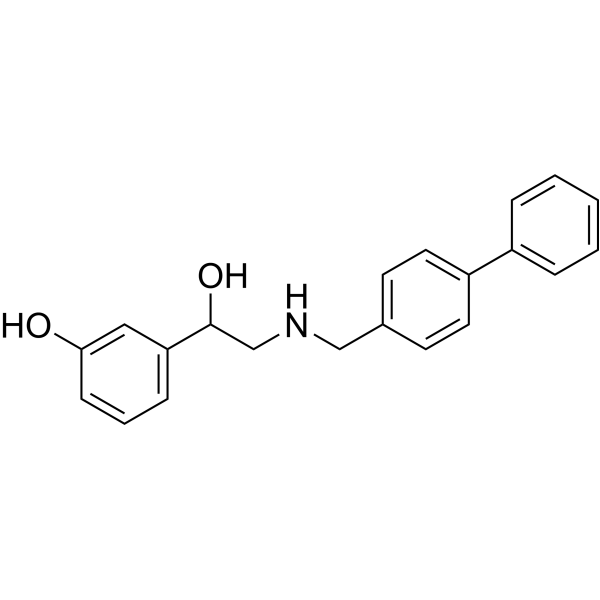
AC-73 is a first specific, orally active inhibitor of cluster of differentiation 147 (CD147), which specifically disrupts CD147 dimerization, thereby mainly suppressing the CD147/ERK1/2/STAT3/MMP-2 pathways. AC-73 inhibits the motility and invasion of hepatocellular carcinoma cells . AC-73 is also an anti-proliferative agent and an inducer of autophagy in leukemic cells .
loading...
    loading...
3
3 Cited Publications
Cat. No.: HY-18061
CAS No.: 111540-00-2
Synonyms: (Rac)-STA-21
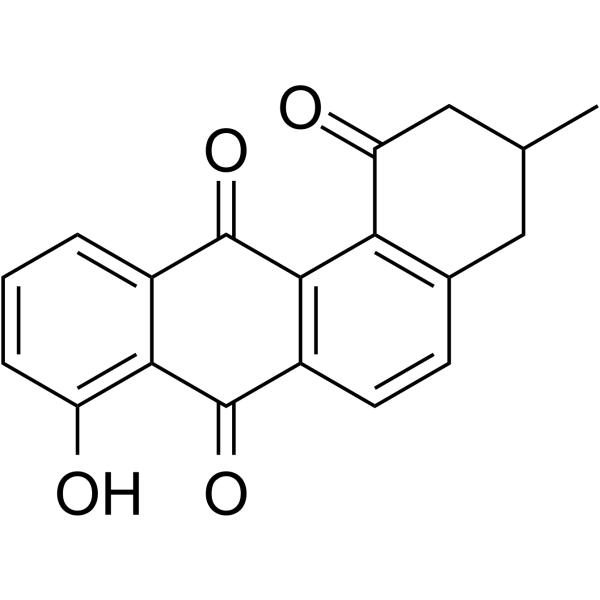
Ochromycinone ((Rac)-STA-21) is a natural antibiotic and a STAT3 inhibitor. Ochromycinone can inhibits STAT3 DNA binding activity, STAT3 dimerization. Ochromycinone has anticancer and antimicrobial activity .
loading...
    loading...
2
2 Cited Publications
Cat. No.: HY-103692
CAS No.: 851095-32-4
Purity:  99.21%
Target:  

STAT

Research Areas:  

Cancer

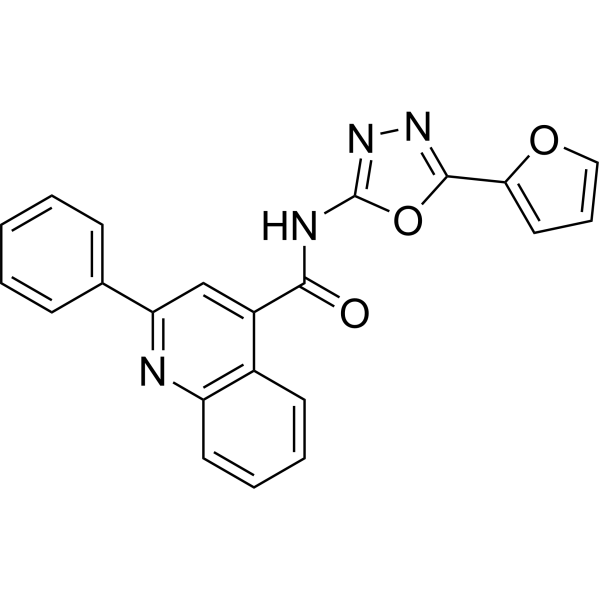
STX-0119 is a selective, orally active STAT3 dimerization inhibitor. STX-0119 inhibits STAT3 transcription with an IC50 of 74 μM .
loading...
    loading...
1
1 Cited Publications
Cat. No.: HY-124843
CAS No.: 63972-38-3
Purity:  97.20%
Synonyms: CLT-005
Target:  

STAT Apoptosis

Research Areas:  

Cancer

LLL3 (CLT-005) is a STAT3 inhibitor. LLL3 inhibits dimerization and phosphorylation of STAT3, thereby preventing intraconuclear transfer of STAT3 and inhibits the expression of STAT3 dependent genes, which encode proteins such as Bcl-xL and cyclin D1. In addition, LLL3 can induce cell growth inhibition and apoptosis in human breast cancer and rhabdomyosarcoma cells via the caspase pathway. LLL3 can be used in the study of STAT3 persistent activation types of cancer .
loading...
    loading...
Cat. No.: HY-W035137
CAS No.: 22112-89-6
Synonyms: 5,15-DPP
Target:  

STAT

Research Areas:  

Cancer

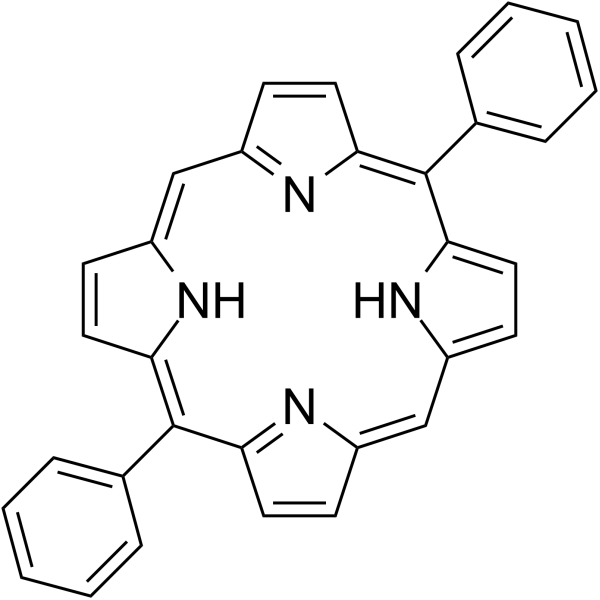
5,15-Diphenylporphyrin (5,15-DPP) is an inhibitor of the oncogenic transcription factor STAT3. 5,15-Diphenylporphyrin specifically binds to the SH2 domain of STAT3, blocking the pTyr-SH2 interaction, thereby inhibiting the dimerization, nuclear translocation and DNA binding activity of STAT3, and ultimately inhibiting the expression of cancer cell-related genes. 5,15-Diphenylporphyrin can be used in research fields related to the development of anticancer drugs[1][2].
loading...
    loading...
Cat. No.: HY-P10114
CAS No.: 400628-16-2
Synonyms: PpYLKTK-mts; STAT3 PI
Target:  

STAT

Research Areas:  

Cancer

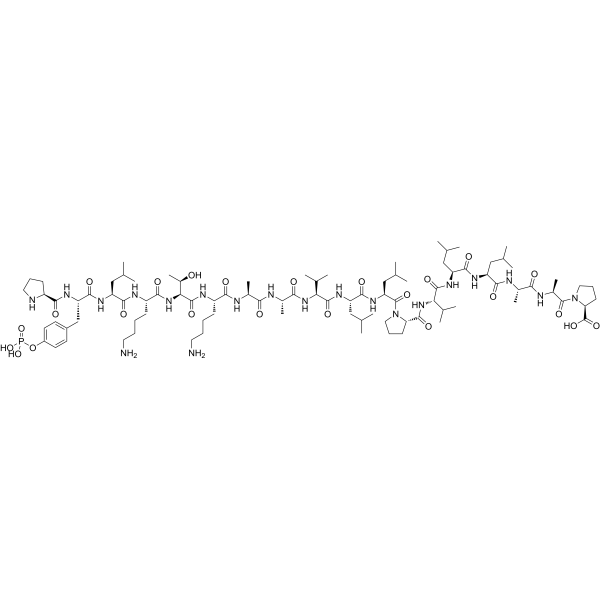
STAT3-IN-24, cell-permeable (PpYLKTK-mts) is a STAT3 peptide inhibitor. STAT3-IN-24, cell-permeable inhibits recruitment of STAT3 to Jak2 and phosphorylation of Y705, thus preventing the dimerization and the nuclear translocation of STAT3 .
loading...
    loading...
Cat. No.: HY-100610
CAS No.: 1456602-51-9
Target:  

STAT

Research Areas:  

Cancer

S3I-1757 is a STAT3 inhibitor. S3I-1757 inhibits the phosphorylation and dimerization of STAT3. S3I-1757 can be used for the research of STAT3 hyperactive cancers such as melanoma .
loading...
    loading...
Cat. No.: HY-18061R
CAS No.: 111540-00-2
Synonyms: (Rac)-STA-21 (Standard)
Ochromycinone (Standard) ((Rac)-STA-21 (Standard)) is the analytical standard of Ochromycinone (HY-18061). This product is intended for research and analytical applications. Ochromycinone is a natural antibiotic and a STAT3 inhibitor. Ochromycinone can inhibits STAT3 DNA binding activity, STAT3 dimerization. Ochromycinone has anticancer and antimicrobial activity.
loading...
    loading...
Cat. No.: HY-103692R
CAS No.: 851095-32-4
Research Areas:  

Cancer

STX-0119 (Standard) is the analytical standard of STX-0119 (HY-103692). This product is intended for research and analytical applications. STX-0119 is a selective, orally active STAT3 dimerization inhibitor. STX-0119 inhibits STAT3 transcription with an IC50 of 74 μM .
loading...
    loading...
Cat. No.: HY-E70717
Target:  

FGFR

Research Areas:  

Cancer

FGFR1 has been implicated in numerous cancer types including non-small cell lung cancer (NSCLC). FGFR1 is activated upon FGF binding to its extracellular domain, resulting in protein dimerization and transautophosphorylation of the intracellular tyrosine kinase domains. FGFR1 V561M gatekeeper mutation drives Fexagratinib (AZD4547) (HY-13330) resistance through STAT3 Activation and EMT. FGFR1 V561M Recombinant Human Active Protein Kinase is a recombinant FGFR1 V561M protein that can be used to study FGFR1 V561M-related functions .
loading...
    loading...
Cat. No.: HY-184734
Target:  

STAT NF-κB

Research Areas:  

Cancer

STAT3/NF-κB-IN-2 is a dual STAT3/NF-κB inhibitor that exhibits antiproliferative, antimigratory and anti-invasive activities in cancer cells. STAT3/NF-κB-IN-2 inhibits the transcriptional activities of NF-κB and STAT3, binds to the STAT3-SH2 domain, and blocks STAT3 dimerization. STAT3/NF-κB-IN-2 can be used in studies related to triple-negative breast cancer .
loading...
    loading...
Cat. No.: HY-N17494
CAS No.: 1666128-87-5
Crispene E is a STAT3 inhibitor with an IC50 of 10.27 μM against STAT3 dimerization. Crispene E exerts specific cytotoxicity against STAT3-dependent MDA-MB-231 breast cancer cells. Crispene E is applicable to research related to breast cancer .
loading...
    loading...
Cat. No.: HY-183370
Research Areas:  

Inflammation/Immunology

JAK2/STAT3-IN-2 is an orally active JAK2/STAT3 inhibitor. JAK2/STAT3-IN-2 inhibits the phosphorylation of tyrosine residues in JAK2 and STAT3, blocks downstream signal transduction, disrupts the dimerization and nuclear translocation of STAT3, and suppresses pro-inflammatory transcriptional activity. JAK2/STAT3-IN-2 inhibits the expression of IL-17A and IL-17F, reduces immune cell infiltration, and inhibits the production of NO simultaneously. JAK2/STAT3-IN-2 exerts a protective effect in a mouse model of ulcerative colitis induced by DSS (HY-116282C). JAK2/STAT3-IN-2 can be used for the research of ulcerative colitis .
loading...
    loading...
Cat. No.: HY-184891
CAS No.: 3028770-95-5
W1307 is a selective STAT3 inhibitor with a KD value of 1.74 μM. W1307 inhibits STAT3 Tyr705 phosphorylation, disrupts STAT3 dimerization, and suppresses STAT3 transcriptional activity. W1307 downregulates the expression of STAT3 downstream targets c-Myc, Mcl-1 and Bcl-2. W1307 transcriptionally inhibits SREBP1 and CPT2 expression to disrupt lipid homeostasis. W1307 shows potent anti-leukemic activity and synergizes with Cytarabine (Ara-C) (HY-13605) to overcome chemoresistance in acute myeloid leukemia (AML) .
loading...
    loading...
Cat. No.: HY-182380
CAS No.: 1632152-27-2
ODZ10117 is a STAT3 and NLRP3 inhibitor with a human STAT3 SH2 domain IC50 of 7.5 μM. ODZ10117 binds to the STAT3 SH2 domain, suppressing tyrosine phosphorylation, dimerization, nuclear translocation, and transcriptional activity. ODZ10117 binds to NLRP3, impairs NEK7 interaction, prevents inflammasome formation, and inhibits caspase-1 and IL-1β cleavage.ODZ10117 reduces MSU (HY-B2130A)-induced IL-1β release, lowers LPS (HY-D1056)-induced sepsis mortality, and exhibits anti-inflammatory effects. ODZ10117 induces apoptosis, suppresses breast cancer cell migration and invasion, reduces tumor growth and lung metastasis, and extends survival in breast cancer models. ODZ10117 can be used for the research of Monosodium urate (HY-B2130A)-induced peritonitis, LPS-induced sepsis, breast cancer, glioblastoma, and Alzheimer's disease .
loading...
    loading...
Cat. No.: HY-L008
727 compounds

The Janus kinase (JAK)/signal transducer and activator of transcription (STAT) pathway is central to signaling by cytokine receptors, a superfamily of more than 30 transmembrane proteins that recognize specific cytokines, and is critical in blood formation and immune response. Canonical JAK/STAT signaling begins with the association of cytokines and their corresponding transmembrane receptors. Activated JAKs then phosphorylate latent STAT monomers, leading to dimerization, nuclear translocation, and DNA binding. In mammals, there are four JAKs (JAK1, JAK2, JAK3, TYK2) and seven STATs (STAT1, STAT2, STAT3, STAT4, STAT5a, STAT5b, STAT6). Since the JAK/STAT pathway plays a major role in many fundamental processes, such as apoptosis and inflammation, dysfunctional proteins in the pathway may lead to a number of diseases. For example, alterations in JAK/STAT signalling can result in cancer and diseases affecting the immune system, such as severe combined immunodeficiency disorder (SCID).

MCE provides 727 compounds that can be used in the study of the JAK/STAT signaling pathway and related diseases.

  • 1

