20 Results for "

Shc

" in MedChemExpress (MCE) Product Catalog:
Products (20)

20 Results for "Shc" in MCE Product Catalog:

1
1 Cited Publications
Cat. No.: HY-14604
CAS No.: 90494-79-4
Purity:  98.57%
Synonyms: SR57746A; SR57746 hydrochloride
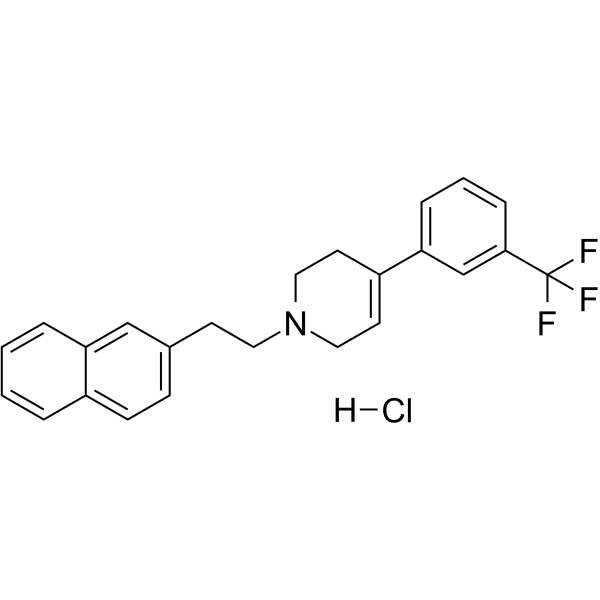
Xaliproden (SR57746) hydrochloride (SR57746A) is an orally active, highly selective 5-HT1A receptor agonist. Xaliproden hydrochloride activates pertussis toxin-sensitive G protein-coupled signaling cascades, as well as the PKC, ERK1/ERK2, Akt and p21 Ras/MEK-1 pathways. Xaliproden hydrochloride also downregulates the JNK/p66/c-Jun signaling pathway, induces phosphorylation of the shc adaptor protein, regulates extracellular dopamine and 5-HT levels, and induces [ 35S]GTPγS labeling in rat brain structures rich in 5-HT1A receptors. Xaliproden hydrochloride exerts neurotrophic, neuroprotective, renoprotective, anti-inflammatory, anti-apoptotic, anti-fibrotic and analgesic effects. Xaliproden hydrochloride also enhances NGF-induced neurite outgrowth, promotes motor neuron survival, attenuates renal tubular injury and inhibits chemotherapy-induced mechanical allodynia, without activating or altering NGF-induced TrkA receptor activation. Xaliproden hydrochloride can be used in the research of motor neuron disease, diabetic nephropathy, chemotherapy-induced peripheral neuropathy, amyotrophic lateral sclerosis, Alzheimer's disease, acute tonic nociceptive pain, inflammatory pain, depression and anxiety .
loading...
    loading...
Cat. No.: HY-125857C
CAS No.: 9007-43-6
Purity:  95.00%
Cytochrome C (bovine heart) is composed of 104 amino acids and is a nuclear-encoded mitochondrial protein. Cytochrome C (bovine heart) acts as an effective ROS scavenger, but when combined with the cofactor p66Shc, it promotes the generation of ROS to initiate apoptosis. Cytochrome C (bovine heart) can act as a single electron carrier .
loading...
    loading...
Cat. No.: HY-161464
Target:  

HDAC Apoptosis

Research Areas:  

Cancer

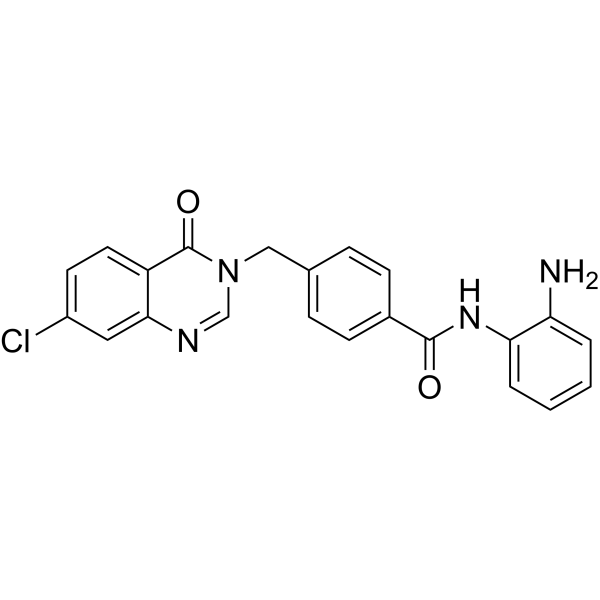
Chlopynostat (Compound 6c) is a HDAC1 inhibitor with a IC50 value of 67 nM. Chlopynostat reverses STAT4/p66Shc defects by inhibiting HDAC1-induced < b>Apoptosis .
loading...
    loading...
Cat. No.: HY-168867
CAS No.: 3053537-06-4
Target:  

PROTACs RET Apoptosis

Research Areas:  

Cancer

RD-23 is an orally active and selective RET PROTAC degrader, with DC50 values of 5.6 nM and 11.7 nM against RET WT and RET G810C mutants, respectively. RD-23 inhibits purified RET kinase activity with an IC50 of 0.371 nM. RD-23 suppresses the activation of downstream Shc signaling and induces apoptosis. RD-23 can be used for the research of RET-related cancers .
loading...
    loading...
Cat. No.: HY-RS12858
Research Areas:  

Others

SHC3 Human Pre-designed siRNA Set A contains three designed siRNAs for SHC3 gene (Human), as well as a negative control, a positive control, and a FAM-labeled negative control.

loading...
    loading...
Cat. No.: HY-178061
CAS No.: 2598870-24-5
Target:  

ERK RET

Research Areas:  

Cancer

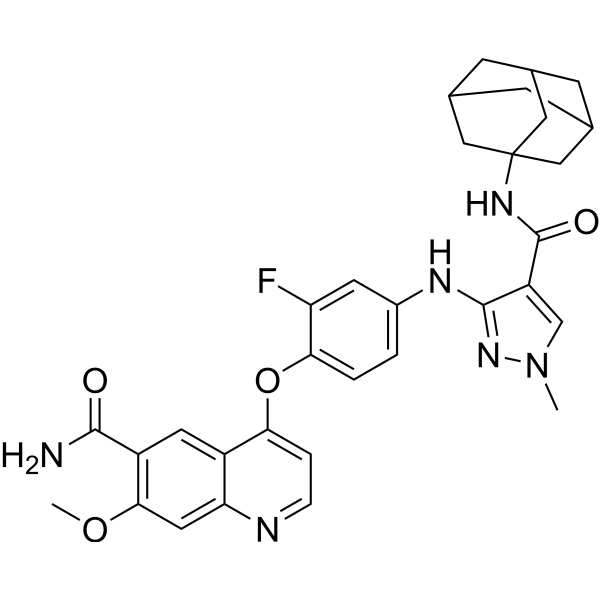
APS03118 is an orally active, potent and selective rearranged during transfection (RET) inhibitor. APS03118 broadly inhibits RET fusions and mutations (including G810, V804, L730, and Y806 variants), with IC50 values predominantly below 1 nM (0.095 nM for WT; ranging from 0.00438 to 5.72 nM for mutants), and demonstrates marked superiority against RET G810 mutations. APS03118 inhibits the entire RET signaling pathway (including RET, Shc, and ERK1/2), with >20-fold selectivity over most off-target kinases (except FLT3 and YES). APS03118 induces complete tumor regression in KIF5B-RET and CCDC6-RET V804 M patient derived xenografts (PDXs) and significantly prolongs survival in an intracranial CCDC6-RET metastasis mice model. APS03118 can be used for selective RET inhibitor (SRI)-resistant, RET-driven cancer research .
loading...
    loading...
Cat. No.: HY-RS12856
Research Areas:  

Others

SHC1 Human Pre-designed siRNA Set A contains three designed siRNAs for SHC1 gene (Human), as well as a negative control, a positive control, and a FAM-labeled negative control.

loading...
    loading...
Cat. No.: HY-RS21432
Research Areas:  

Others

Shc1 Mouse Pre-designed siRNA Set A contains three designed siRNAs for Shc1 gene (Mouse), as well as a negative control, a positive control, and a FAM-labeled negative control.

loading...
    loading...
Cat. No.: HY-RS12857
Research Areas:  

Others

SHC2 Human Pre-designed siRNA Set A contains three designed siRNAs for SHC2 gene (Human), as well as a negative control, a positive control, and a FAM-labeled negative control.

loading...
    loading...
Cat. No.: HY-RS12859
Research Areas:  

Others

SHC4 Human Pre-designed siRNA Set A contains three designed siRNAs for SHC4 gene (Human), as well as a negative control, a positive control, and a FAM-labeled negative control.

loading...
    loading...
Cat. No.: HY-151987
CAS No.: 3033547-06-4
Target:  

RET Apoptosis

Research Areas:  

Cancer

RET-IN-20 is a potent RET inhibitor with an IC50 value of 13.7 nM. RET-IN-20 decreases the expression of p-Ret, p-Shc protein. RET-IN-20 induces apoptosis. RET-IN-20 shows antiproliferative and anti-tumor activity .
loading...
    loading...
Cat. No.: HY-170926
Target:  

RET Apoptosis

Research Areas:  

Cancer

CQ1373 is a potent RET inhibitor, demonstrating cellular potency with IC50 values of 13.0, 25.7 and 28.4 nM against BaF3 cells expressing CCDC6-RET, CCDC6-RET-G810C and CCDC6-RET-G810R, respectively. CQ1373 exhibits good selectivity toward wild-type RET and solvent front mutants G810C/R with IC50 values of 4.2, 7.1 and 32.4 nM, respectively. CQ1373 inhibits RET phosphorylation and downstream signaling through SHC. CQ1373 induces Apoptosis and cell cycle arrest in BaF3 cells. CQ1373 exhibits anti-tumor efficacy and can be used for cancer research .
loading...
    loading...
Cat. No.: HY-RS22323
Research Areas:  

Others

Shc3 Mouse Pre-designed siRNA Set A contains three designed siRNAs for Shc3 gene (Mouse), as well as a negative control, a positive control, and a FAM-labeled negative control.

loading...
    loading...
Cat. No.: HY-RS27950
Research Areas:  

Others

Shc1 Rat Pre-designed siRNA Set A contains three designed siRNAs for Shc1 gene (Rat), as well as a negative control, a positive control, and a FAM-labeled negative control.
loading...
    loading...
Cat. No.: HY-RS28845
Research Areas:  

Others

Shc3 Rat Pre-designed siRNA Set A contains three designed siRNAs for Shc3 gene (Rat), as well as a negative control, a positive control, and a FAM-labeled negative control.
loading...
    loading...
Cat. No.: HY-119820
CAS No.: 135354-02-8
Synonyms: SR57746A free base
Xaliproden (SR57746) free base is an orally active, highly selective 5-HT1A receptor agonist. Xaliproden free base activates pertussis toxin-sensitive G protein-coupled signaling cascades, as well as the PKC, ERK1/ERK2, Akt and p21 Ras/MEK-1 pathways. Xaliproden free base also downregulates the JNK/p66/c-Jun signaling pathway, induces phosphorylation of the shc adaptor protein, regulates extracellular dopamine and 5-HT levels, and induces [ 35S]GTPγS labeling in rat brain structures rich in 5-HT1A receptors. Xaliproden free base exerts neurotrophic, neuroprotective, renoprotective, anti-inflammatory, anti-apoptotic, anti-fibrotic and analgesic effects. Xaliproden free base also enhances NGF-induced neurite outgrowth, promotes motor neuron survival, attenuates renal tubular injury and inhibits chemotherapy-induced mechanical allodynia, without activating or altering NGF-induced TrkA receptor activation. Xaliproden free base can be used in the research of motor neuron disease, diabetic nephropathy, chemotherapy-induced peripheral neuropathy, amyotrophic lateral sclerosis, Alzheimer's disease, acute tonic nociceptive pain, inflammatory pain, depression and anxiety .
loading...
    loading...
Cat. No.: HY-P82649
Synonyms: Shc1; Shc; ShcA; Shc-transforming protein 1; Shc-transforming protein 3; Shc-transforming protein A; Src homology 2 domain-containing-transforming protein C1; SH2 domain protein C1

Host:  

Rabbit

Application:  

WB, IHC-P, ICC/IF, FC

Reactivity:  

Human, Mouse, Rat

loading...
    loading...
Cat. No.: HY-P87942

Host:  

Rabbit

Application:  

WB, IHC-P, ICC/IF, ELISA

Reactivity:  

Human, Mouse, Rat

loading...
    loading...
Cat. No.: HY-183684
Target:  

RET VEGFR PDGFR Akt ERK

Research Areas:  

Endocrinology Cancer

RET-IN-33 is a moderately selective inhibitor of RET mutants. RET-IN-33 potently inhibits G810 mutants, with IC50 values of 4.43 nM (G810R), 3.28 nM (G810C) and 0.51 nM (G810S), respectively. RET-IN-33 also inhibits other RET mutants: V804M (IC50 0.73 nM), V804L (IC50 0.36 nM), Y806H (IC50 0.74 nM) and M918T (IC50 0.55 nM). RET-IN-33 also inhibits other kinases, with an IC50 of 1.50 nM against VEGFR2 and 1.60 nM against PDGFRα. RET-IN-33 blocks the autophosphorylation of RET mutants and the downstream SHC/AKT/ERK signaling pathway. RET-IN-33 selectively inhibits the proliferation of RET-driven cell models without affecting non-RET-dependent or normal cells. RET-IN-33 exhibits dose-dependent antitumor efficacy in RET-driven xenograft models. RET-IN-33 can be used for the research of medullary thyroid carcinoma, papillary thyroid carcinoma and non-small cell lung cancer .
loading...
    loading...
Cat. No.: HY-14604R
CAS No.: 90494-79-4
Synonyms: SR57746A (Standard); SR57746 hydrochloride (Standard)
Xaliproden (hydrochloride) (Standard) is the analytical standard of Xaliproden (hydrochloride). This product is intended for research and analytical applications. Xaliproden (SR57746) hydrochloride (SR57746A) is an orally active, highly selective 5-HT1A receptor agonist. Xaliproden hydrochloride activates pertussis toxin-sensitive G protein-coupled signaling cascades, as well as the PKC, ERK1/ERK2, Akt and p21 Ras/MEK-1 pathways. Xaliproden hydrochloride also downregulates the JNK/p66/c-Jun signaling pathway, induces phosphorylation of the shc adaptor protein, regulates extracellular dopamine and 5-HT levels, and induces [ 35S]GTPγS labeling in rat brain structures rich in 5-HT1A receptors. Xaliproden hydrochloride exerts neurotrophic, neuroprotective, renoprotective, anti-inflammatory, anti-apoptotic, anti-fibrotic and analgesic effects. Xaliproden hydrochloride also enhances NGF-induced neurite outgrowth, promotes motor neuron survival, attenuates renal tubular injury and inhibits chemotherapy-induced mechanical allodynia, without activating or altering NGF-induced TrkA receptor activation. Xaliproden hydrochloride can be used in the research of motor neuron disease, diabetic nephropathy, chemotherapy-induced peripheral neuropathy, amyotrophic lateral sclerosis, Alzheimer's disease, acute tonic nociceptive pain, inflammatory pain, depression and anxiety .
loading...
    loading...
  • 1

