

12 Results for "

T-cell mediated inflammation

" in MedChemExpress (MCE) Product Catalog:
Products (12)

12 Results for "T-cell mediated inflammation" in MCE Product Catalog:

29
29 Publications Verification
Cat. No.: HY-N1724
CAS No.: 80890-47-7
Synonyms: Antibiotic X 4357B; Folimycin; X 4357B
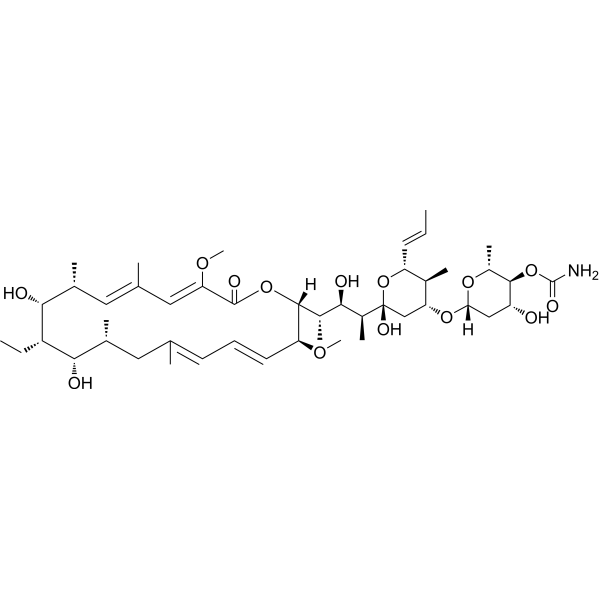
Concanamycin A (Folimycin; Antibiotic X 4357B) is a macrolide antibiotic, a vacuolar type H +-ATPase (V-ATPase) inhibitor. Concanamycin A is also an inhibitor of lysosomal acidification, can be used to T cell-mediated inflammation research - .
loading...
    loading...
29
29 Publications Verification
Cat. No.: HY-N1724A
CAS No.: 80890-47-7
Synonyms: Antibiotic X 4357B (purity≥70%); Folimycin (purity≥70%); X 4357B (purity≥70%)
Concanamycin A (purity≥70%) (Antibiotic X 4357B) is a macrolide antibiotic, a vacuolar type H +-ATPase (V-ATPase) inhibitor. Concanamycin A (purity≥70%) is also an inhibitor of lysosomal acidification, can be used to T cell-mediated inflammation research - .
loading...
    loading...
1
1 Cited Publications
Cat. No.: HY-W145657
CAS No.: 61512-20-7
Synonyms: Cord Factor
Trehalose 6,6'-dimycolate (Cord Factor) is trehalose 6,6'-dimycolate, a cell wall glycolipid of Mycobacterium tuberculosis, which can be used to simulate inflammation and granuloma induced by Mycobacterium tuberculosis (MTB) form. Trehalose 6,6′-dimycolate also protects Mycobacterium tuberculosis from macrophage-mediated killing, inhibits efficient antigen presentation, and reduces the development of protective T cell responses .
loading...
    loading...
Cat. No.: HY-P10056
CAS No.: 174641-44-2
Synonyms: Human ezrin peptide (324-337)
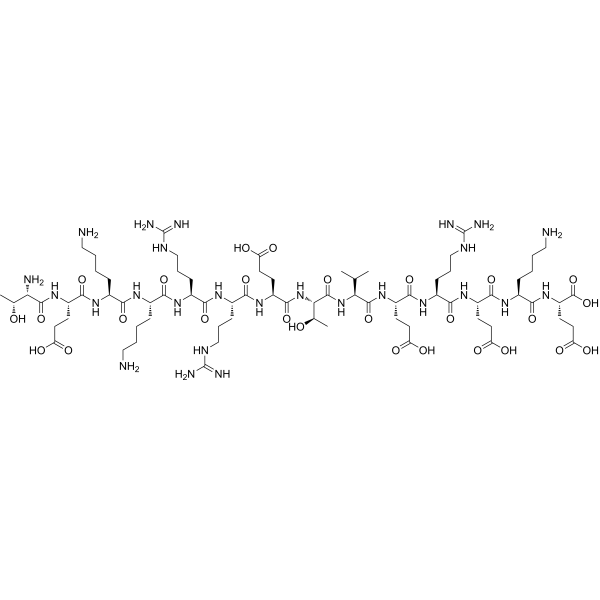
HEP-1 (Human ezrin peptide (324 - 337)) is an orally active peptide with antiviral, anti-inflammatory, and immunomodulatory activities. HEP-1 is effective against infections by various viruses such as HIV, HCV, herpes viruses, HPV, and influenza viruses. As an immunomodulator, HEP-1 can enhance the adaptive immunity mediated by B cells and T cells. HEP-1 can also increase the antibody titers after hepatitis B vaccination. HEP-1 can be used in the research of viral infections and inflammation-related diseases .
loading...
    loading...
Cat. No.: HY-P99140
Anti-Mouse IL-1R Antibody (JAMA-147) is an anti-mouse IL-1R IgG2b antibody inhibitor derived from host Armenian Hamster. Anti-Mouse IL-1R Antibody (JAMA-147) diminishes Spp1hi-TAM-mediated T cell suppression. Anti-Mouse IL-1R Antibody (JAMA-147) can be used for the researches of inflammation, metabolic disease and infection, such as diabetes .
loading...
    loading...
Cat. No.: HY-P990061
CAS No.: 2640981-19-5
Synonyms: JTX 8064
Polzastobart (JTX-8064) is a humanized IgG4 monoclonal antibody and LILRB2 (ILT4) antagonist. Polzastobart specifically binds to and antagonizes LILRB2, relieves ILT4-mediated myeloid immunosuppression, and promotes the polarization of macrophages from an M2-like phenotype to an M1-like phenotype. Polzastobart induces macrophage polarization, IFNγ signaling, and T cell inflammation-related pharmacodynamic responses in ex vivo human renal cancer, lung cancer, and head and neck cancer tissues. Polzastobart can be used in studies related to tumor-associated macrophages and tumor immunity. For the isotype control of Polzastobart, refer to: Human IgG4 (S228P) kappa, Isotype Control (HY-P99003) .
loading...
    loading...
Cat. No.: HY-174604
Target:  

mRNA

Research Areas:  

Inflammation/Immunology

Human IL4 mRNA encodes the human interleukin 4 (IL4) protein, a pleiotropic cytokine produced by activated T cells. IL4 is considered an important cytokine for tissue repair, counterbalancing the effects of proinflammatory type 1 cytokines, however, it also promotes allergic airway inflammation. Moreover, IL-4 mediates and regulates a variety of human host responses such as allergic, anti-parasitic, wound healing, and acute inflammation.
loading...
    loading...
Cat. No.: HY-19108
CAS No.: 104795-68-8
Target:  

Calcium Channel Actin

Research Areas:  

Inflammation/Immunology Cancer

CI-959 is an orally active cell activation inhibitor. CI-959 selectively suppresses inflammatory cell activation post-receptor signaling via inhibiting calcium influx and weak calmodulin antagonism, without targeting PLC, PKC or NADPH oxidase. CI-959 blocks lung allergic mediator release, anti-IgE bronchial contraction, neutrophil function, T-cell proliferation and DC marker expression while sparing monocytes. CI-959 provides gastric cytoprotection by inhibiting leukocyte adhesion and suppresses tumor motility through F-actin reduction. CI-959 can be used for research on allergies, inflammation, autoimmune diseases, gastric injury, and tumor metastasis .
loading...
    loading...
Cat. No.: HY-N1724B
CAS No.: 80890-47-7
Synonyms: Antibiotic X 4357B (purity≥90%); Folimycin (purity≥90%); X 4357B (purity≥90%)
Concanamycin A (purity≥90%) (Antibiotic X 4357B) is a macrolide antibiotic, a vacuolar type H +-ATPase (V-ATPase) inhibitor. Concanamycin A (purity≥90%) is also an inhibitor of lysosomal acidification, can be used to T cell-mediated inflammation research - .
loading...
    loading...
Cat. No.: HY-113886
CAS No.: 104795-66-6
Target:  

Calcium Channel Actin

Research Areas:  

Inflammation/Immunology Cancer

CI-959 free acid is an orally active cell activation inhibitor. CI-959 free acid selectively suppresses inflammatory cell activation post-receptor signaling via inhibiting calcium influx and weak calmodulin antagonism, without targeting PLC, PKC or NADPH oxidase. CI-959 free acid blocks lung allergic mediator release, anti-IgE bronchial contraction, neutrophil function, T-cell proliferation and DC marker expression while sparing monocytes. CI-959 free acid provides gastric cytoprotection by inhibiting leukocyte adhesion and suppresses tumor motility through F-actin reduction. CI-959 free acid can be used for research on allergies, inflammation, autoimmune diseases, gastric injury, and tumor metastasis .
loading...
    loading...
Cat. No.: HY-187837
CAS No.: 1426216-93-4
Synonyms: OPS-2071
Abimufloxacin (OPS-2071) is a broad-spectrum quinolone antibacterial agent. Abimufloxacin inhibits the supercoiling activity of DNA gyrase, the decatenation activity of topoisomerase IV, the activation and proliferation of T cells, macrophage activity, as well as the production of TNF-α and IFN-γ. Abimufloxacin exhibits activity against enteropathogenic Gram-positive bacteria, Gram-negative bacteria, quinolone-resistant bacteria, and Crohn's disease-associated bacteria (including Clostridioides difficile and Campylobacter jejuni). Abimufloxacin alleviates colonic inflammation in a mouse model of T cell-mediated colitis. Abimufloxacin can be used in research related to diseases such as intestinal infections and Crohn's disease .
loading...
    loading...
Cat. No.: HY-187390
BRD4 RIMTAC-1 is a BRD4 PROTAC degrader based on the RIPK1-mediated targeted chimera (RIMTAC) technology. It hijacks the endogenous RIPK1-VHL complex via the RIPK1 inhibitor moiety to indirectly recruit the VHL E3 ligase, forming a BRD4-Compound 10-RIPK1-VHL quaternary complex, and degrades BRD4 through the ubiquitin-proteasome system (UPS). BRD4 RIMTAC-1 exhibits selectivity over other BET proteins, induces concentration- and time-dependent, reversible post-translational degradation of BRD4 without altering the target mRNA level. BRD4 RIMTAC-1 potently induces endogenous BRD4 degradation in RAW264.7 and HEK-293T cells, with DC50 values of 179.1 nM and 54.12 nM, respectively. BRD4 RIMTAC-1 can be used for the research of cancer and inflammation-related diseases .
loading...
    loading...
  • 1

