15 Results for "

Testosterone Blocker

" in MedChemExpress (MCE) Product Catalog:
Products (15)

15 Results for "Testosterone Blocker" in MCE Product Catalog:

Art. -Nr.: HY-B1623
CAS. Nr.: 2098-66-0
Target:  

Estrogen Receptor/ERR

Forschungsgebiete:  

Cancer

Cyproterone is an antiandrogen that suppresses the actions of testosterone via blocking androgen receptors. Cyproterone’s acetate form can be used in the research of hypersexuality and prostate cancer .
loading...
    loading...
Art. -Nr.: HY-118382
CAS. Nr.: 502628-66-2
Synonyms: STX1383
Target:  

17β-HSD

Forschungsgebiete:  

Cancer

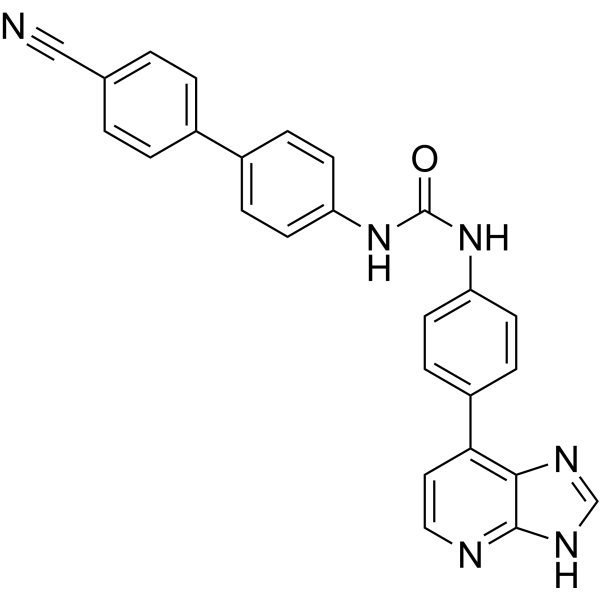
SCH-451659 (STX1383) is an orally active, selective 17β-HSD3 inhibitor with an IC50 of 2.4 nM against h17β-HSD3. SCH-451659 selectively blocks the conversion of androstenedione to testosterone. SCH-451659 reduces testosterone levels in mice. SCH-451659 exhibits anticancer activity against androstenedione-dependent prostate tumors .
loading...
    loading...
Art. -Nr.: HY-120696
CAS. Nr.: 1361414-26-7
Reinheit:  98.06%
Synonyms: ML368
Forschungsgebiete:  

Infection Cancer

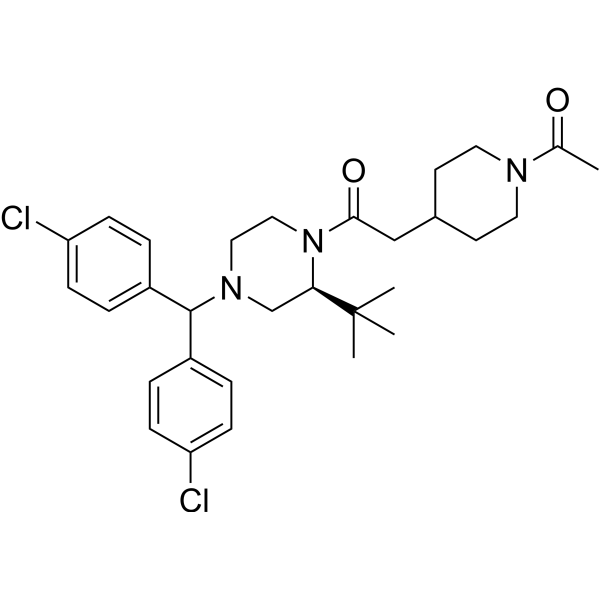
SR9186 (ML368) is a selective CYP3A4 inhibitor with IC50 values of 9, 4, and 38 nM for Midazolam → 1'-hydroxymidazolam, Testosterone → 6β-hydroxytestosterone, and Vincristine → Vincristine M1, respectively. SR-9186 inhibits the development of hepatic-stage P. falciparum and blocks ivermectin metabolism. SR-9186 can be used in breast cancer research .
loading...
    loading...
Art. -Nr.: HY-106614
CAS. Nr.: 105149-00-6
Forschungsgebiete:  

Endocrinology

Osaterone acetate is an orally active steroid anti-androgen agent, mainly used for benign prostatic hyperplasia (BPH) in dogs. Osaterone acetate competitively antagonizes androgen receptor and inhibits 5α-reductase, reducing the concentration of dihydrotestosterone (DHT) while blocking the growth-stimulating effects of testosterone and DHT on prostate cells. Osaterone acetate can rapidly alleviate the symptoms of BPH in dogs without affecting the fertility of breeding dogs .
loading...
    loading...
Art. -Nr.: HY-165478
CAS. Nr.: 155651-56-2
Target:  

5 alpha Reductase

Forschungsgebiete:  

Endocrinology

FCE 28260 is an orally active 4-azacyclic 5α-reductase (5αR) inhibitor. FCE 28260 exhibits IC₅₀ values for human 5αR type 1 and 5αR type 2 of 36 and 3.3 nM, respectively, and for human and rat prostates with IC₅₀ values of 16 and 15 nM, respectively. FCE 28260 simultaneously blocks the production of dihydrotestosterone (DHT) in the prostate and peripheral tissues. FCE 28260 can significantly inhibit the induction of prostatic and seminal vesicle hyperplasia by testosterone (T) in rat models, without inhibiting the growth of the prostate in DHT implantation models. FCE 28260 can be used for the studies DHT-dependent diseases such as benign prostatic hyperplasia (BPH) .
loading...
    loading...
Art. -Nr.: HY-123247
CAS. Nr.: 112959-07-6
Target:  

Cytochrome P450

Forschungsgebiete:  

Endocrinology

LY113174 is an orally active aromatase inhibitor (IC50 = 24 nM). LY113174 blocks testosterone induced increase in uterine weight in rat, and inhibits ovarian estrogen biosynthesis .
loading...
    loading...
Art. -Nr.: HY-B1623R
CAS. Nr.: 2098-66-0
Forschungsgebiete:  

Cancer

Cyproterone (Standard) is the analytical standard of Cyproterone. This product is intended for research and analytical applications. Cyproterone is an antiandrogen that suppresses the actions of testosterone via blocking androgen receptors. Cyproterone’s acetate form can be used in the research of hypersexuality and prostate cancer .
loading...
    loading...
Art. -Nr.: HY-105122
CAS. Nr.: 107000-34-0
Synonyms: WIN 49596
Target:  

Androgen Receptor

Forschungsgebiete:  

Endocrinology Cancer

Zanoterone is an orally active antagonist of the androgen receptor (AR) with a Ki of 2.2 μM. Zanoterone blocks the binding of androgens such as testosterone and dihydrotestosterone (DHT), inhibiting the androgen signaling pathway, thereby reducing androgen-dependent prostate hyperplasia and prostate cancer growth .
loading...
    loading...
Art. -Nr.: HY-W699238
CAS. Nr.: 57288-04-7
S-(-)-Aminoglutethimide D-tartrate is an aromatase inhibitor with activity that blocks adrenal steroidogenesis. S-(-)-Aminoglutethimide D-tartrate can be used to inhibit steroid-related diseases. S-(-)-Aminoglutethimide D-tartrate is often used clinically to control certain types of cancer. S-(-)-Aminoglutethimide D-tartrate effectively reduces testosterone and estrogen levels through an enzyme inhibition mechanism.
loading...
    loading...
Art. -Nr.: HY-121656
CAS. Nr.: 56600-73-8
Target:  

17β-HSD

Forschungsgebiete:  

Cancer

AKR1C2/3-IN-2 is a potential AKR1C3 inhibitor with selective AKR1C3 activity. AKR1C2/3-IN-2 is able to block AKR1C3-mediated testosterone (T) production and PSA induction, affecting the endocrine activity of prostate cancer cells. AKR1C2/3-IN-2 shows selectivity over other AKR1C enzymes, indicating its potential application in inhibiting drug-resistant prostate cancer. AKR1C2/3-IN-2 has no inhibitory activity against COX isomerases, further emphasizing its specificity as a prostate cancer inhibitory compound .
loading...
    loading...
Art. -Nr.: HY-155666
CAS. Nr.: 2952994-34-0
Forschungsgebiete:  

Cancer

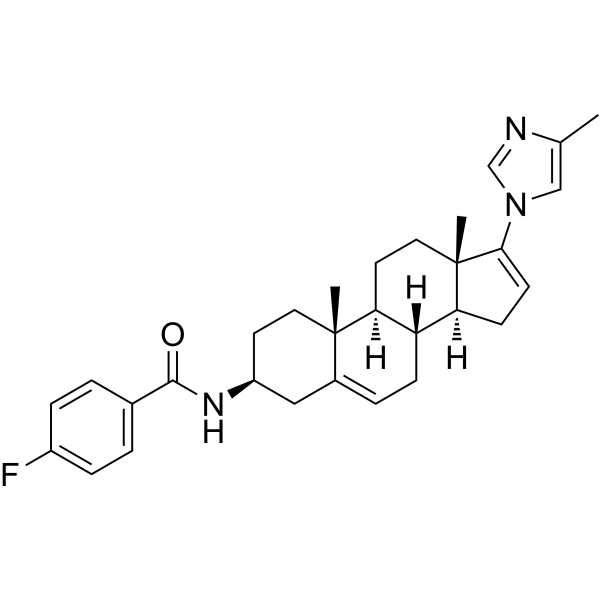
YXG‑158 is an orally active, anticancer bifunctional steroid analog with both androgen receptor (AR) degradation activity (DC50 = 1.28 μM) and CYP17A1 inhibitory activity (IC50 = 100 nM). YXG-158 reduces AR protein and mRNA expression via proteasome-dependent degradation, degrades AR-V7, and inhibits CYP17A1 enzymatic activity to block androgen biosynthesis. YXG-158 inhibits the activities of ERα and ERβ, as well as cancer cell proliferation. YXG-158 decreases the weight of androgen-sensitive organs in castrated rats treated with testosterone propionate, downregulates AR protein, reduces PSA levels, and suppresses tumor growth in Enzalutamide (HY-70002)-sensitive and -resistant xenograft models. YXG-158 can be used in prostate cancer-related research .
loading...
    loading...
Art. -Nr.: HY-W673613
CAS. Nr.: 1067191-08-5
Forschungsgebiete:  

Endocrinology

ADX68692 is an orally active FSHR negative allosteric regulator, with an IC50 value of 140 nM against hFSHR. ADX68692 antagonizes hCG (HY-107953)-mediated cAMP production, β-arrestin 2 recruitment, and the LH/CGR signaling pathway. ADX68692 partially inhibits testosterone synthesis. ADX68692 blocks follicle growth, disrupts the estrous cycle in rats, and reduces the pregnancy rate in rats. ADX68692 can be used in research related to contraception and endometriosis .
loading...
    loading...
Art. -Nr.: HY-W490804
CAS. Nr.: 2971-36-0
Forschungsgebiete:  

Metabolic Disease

HPTE is the active in vivo metabolite of Methoxychlor (HY-B1873), and acts as an inhibitor of 3β‑HSD and 17β‑HSD3. HPTE binds to the substrate-binding pocket of 3β‑HSD in a non-competitive manner, but competitively occupies the coenzyme NAD +-binding site, thereby inhibiting the conversion of pregnenolone to progesterone. HPTE binds to the androstenedione-binding pocket (the substrate pocket) of 17β‑HSD3 in a non-competitive manner, and competitively occupies the coenzyme NADPH-binding site, thus blocking the conversion of androstenedione to testosterone. HPTE interferes with androgen biosynthesis in Leydig cells by inhibiting the activities of these two key steroidogenic enzymes. HPTE can be used in studies related to androgen biosynthesis .
loading...
    loading...
Art. -Nr.: HY-187614
CAS. Nr.: 1597-68-8
Target:  

Cytochrome P450

Forschungsgebiete:  

Endocrinology

6α-Fluorotestosterone is a non-aromatizable aromatase inhibitor, with IC50 values of 115 nM and 580 nM against human and rat aromatase, respectively. 6α-Fluorotestosterone binds to the substrate site of human aromatase P450arom with a Ki of 150 nM, but is not aromatized into estrogen. In vivo, 6α-Fluorotestosterone maintains sexual behavior in castrated male rats (with an effect comparable to that of testosterone), induces defeminization of sexual development, and inhibits nuclear translocation of hypothalamic estrogen receptors; its pro-mating effect is blocked by the aromatase inhibitors ATD and Fadrozole (HY-14247A). Combined with Progesterone (HY-N0437), 6α-Fluorotestosterone induces lordosis behavior in ovariectomized female rats. 6α-Fluorotestosterone can be used in studies related to anovulatory infertility and sexual behavior regulation .
loading...
    loading...
Art. -Nr.: HY-141764S
CAS. Nr.: 1794780-53-2
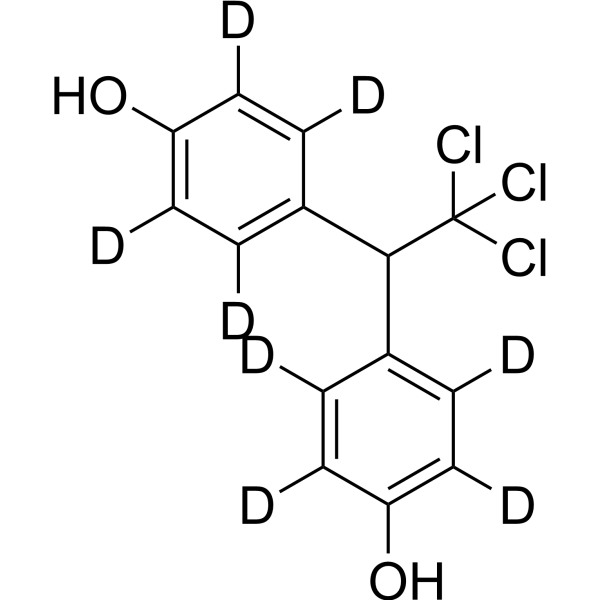
2,2-Bis(p-hydroxyphenyl)-1,1,1-trichloroethane-d8 is the deuterated-labeled HPTE (HY-W490804). HPTE is the active in vivo metabolite of Methoxychlor (HY-B1873), and acts as an inhibitor of 3β‑HSD and 17β‑HSD3. HPTE binds to the substrate-binding pocket of 3β‑HSD in a non-competitive manner, but competitively occupies the coenzyme NAD +-binding site, thereby inhibiting the conversion of pregnenolone to progesterone. HPTE binds to the androstenedione-binding pocket (the substrate pocket) of 17β‑HSD3 in a non-competitive manner, and competitively occupies the coenzyme NADPH-binding site, thus blocking the conversion of androstenedione to testosterone. HPTE interferes with androgen biosynthesis in Leydig cells by inhibiting the activities of these two key steroidogenic enzymes. HPTE can be used in studies related to androgen biosynthesis .
loading...
    loading...
  • 1

