10 Results for "

Thermal stabilization

" in MedChemExpress (MCE) Product Catalog:
Products (10)

10 Results for "Thermal stabilization" in MCE Product Catalog:

26
26 Publications Verification
Cat. No.: HY-19745
CAS No.: 1675203-84-5
Target:  

PD-1/PD-L1 Apoptosis

Research Areas:  

Cancer

BMS-202 is a potent and nonpeptidic PD-1/PD-L1 complex inhibitor with an IC50 of 18 nM and a KD of 8 μM. BMS-202 binds to PD-L1 and blocks human PD-1/PD-L1 interaction. BMS-202 has antitumor activity .
loading...
    loading...
26
26 Publications Verification
Cat. No.: HY-19745B
CAS No.: 2089334-95-0
Target:  

PD-1/PD-L1 Apoptosis

Research Areas:  

Cancer

BMS-202 hydrochloride is a potent and nonpeptidic PD-1/PD-L1 complex inhibitor with an IC50 of 18 nM and a KD of 8 μM. BMS-202 hydrochloride binds to PD-L1 and blocks human PD-1/PD-L1 interaction. BMS-202 hydrochloride has antitumor activity .
loading...
    loading...
Cat. No.: HY-111772A
CAS No.: 2229860-99-3
Purity:  99.44%
Synonyms: (R)-VX-445
Target:  

Drug Isomer CFTR

Research Areas:  

Inflammation/Immunology

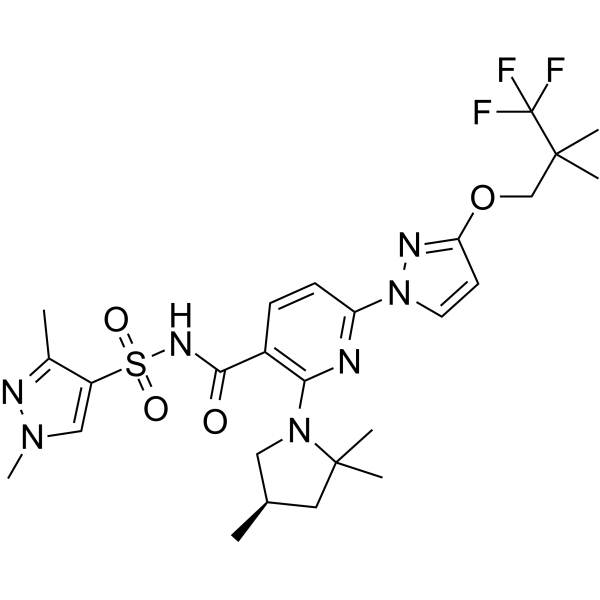
(R)-Elexacaftor ((R)-VX-445) is the enantiomer of Elexacaftor (HY-111772). Elexacaftor is an orally active CFTR modulator that targets nucleotide-binding domain 1. Elexacaftor stabilizes misfolded F508del-CFTR protein, enhances its trafficking to the plasma membrane, and significantly improves metabolic stability, thermal stability and ion conductivity. Elexacaftor not only restores chloride transport function in nasal epithelial cells and rescues multiple CFTR mutation subtypes, but also exerts multiplicative synergistic effects with Ivacaftor (HY-13017), and is often used in a triple combination therapy with Tezacaftor (HY-15448). Elexacaftor is widely used in basic and clinical translational research on cystic fibrosis .
loading...
    loading...
Cat. No.: HY-W087905
CAS No.: 1889-67-4
Research Areas:  

Others

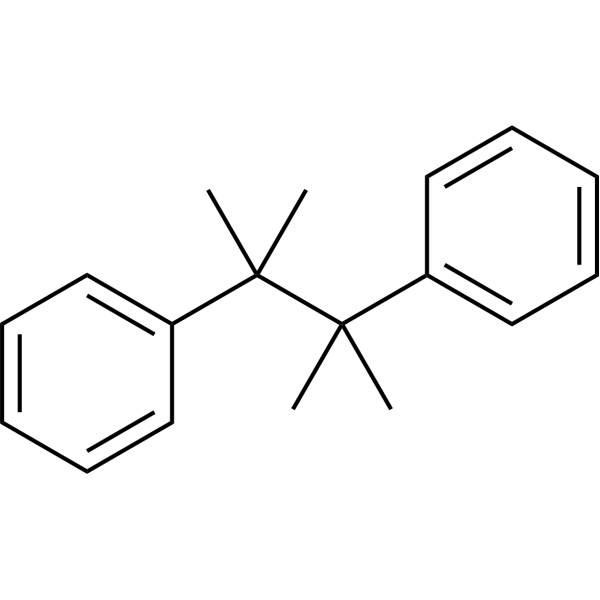
2,3-Dimethyl-2,3-diphenylbutane is a minor product formed during the thermal decomposition of dicumyl peroxide (DCP) in cumene, generated through radical coupling reactions. As an initiator capable of producing free radicals, 2,3-dimethyl-2,3-diphenylbutane promotes cross-linking or decomposition processes via initiating free radical reactions in fields such as polymer polymerization (e.g., modification of polyphenylene oxide processing), organic synthesis (e.g., DCP decomposition reactions), and coal processing (e.g., oxidation stabilization of coal tar pitch), thereby enhancing material properties or reaction efficiency .
loading...
    loading...
Cat. No.: HY-125209A
CAS No.: 2253744-57-7
Research Areas:  

Cancer

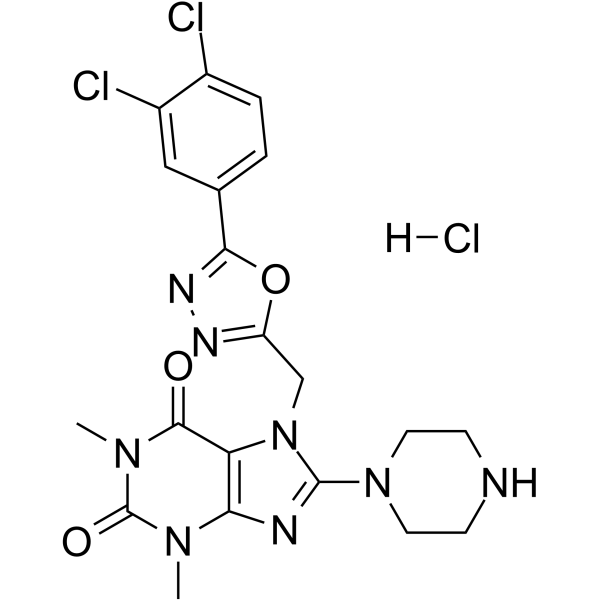
TH5427 hydrochloride is a NUDT5 inhibitor with a human target IC50 of 29 nM, ~690-fold selectivity over MTH1 in vitro, and selective functional inhibition over other NUDIX hydrolases including NUDT9 .TH5427 hydrochloride binds to the active site of NUDT5, blocking enzymatic activity related to ADP-ribose metabolism and PAR-derived ATP synthesis .TH5427 hydrochloride blocks progestin-dependent nuclear ATP synthesis, impairs progestin-induced chromatin remodeling, inhibits histone H1 displacement, disrupts progestin-dependent gene regulation, and abrogates progestin-dependent proliferation in breast cancer cells .TH5427 hydrochloride functions as a versatile probe to study nuclear ATP dynamics and ADP-ribose-related metabolism in cells .TH5427 hydrochloride engages NUDT5 at physiological temperatures, as demonstrated by Drug Affinity Responsive Target Stability (DARTS) assay .TH5427 hydrochloride stabilizes NUDT5 against thermal denaturation in cell lysates and intact cells, as shown by cellular thermal shift assay (CETSA) .TH5427 hydrochloride functionally inhibits NUDT5 activity, leading to downstream effects on oxidative DNA damage and DNA replication in triple-negative breast cancer (TNBC) cells .TH5427 hydrochloride suppresses proliferation of TNBC cells without inducing cell death or apoptosis, slows DNA replication in TNBC cells, promotes accumulation of oxidative DNA lesions, and triggers DNA damage response in TNBC cells .TH5427 hydrochloride suppresses growth of TNBC cells in vitro, inhibits growth of TNBC xenograft tumors in nude mice in vivo, and shows greater potency against TNBC cell lines compared to ER-positive and normal-like breast cell lines .TH5427 hydrochloride can be used for the research of breast cancer and triple-negative breast cancer .
loading...
    loading...
Cat. No.: HY-120594
CAS No.: 124436-97-1
Target:  

Enterovirus

Research Areas:  

Others

R78206 is an antiviral pyridazinamine compound with the activity of protecting poliovirus from thermal inactivation, having different effects on different poliovirus strains at different concentrations, and having a highly effective stabilizing effect on Mahoney procapsids.
loading...
    loading...
Cat. No.: HY-147934
CAS No.: 2432825-93-7
Target:  

HDAC Apoptosis

Research Areas:  

Cancer

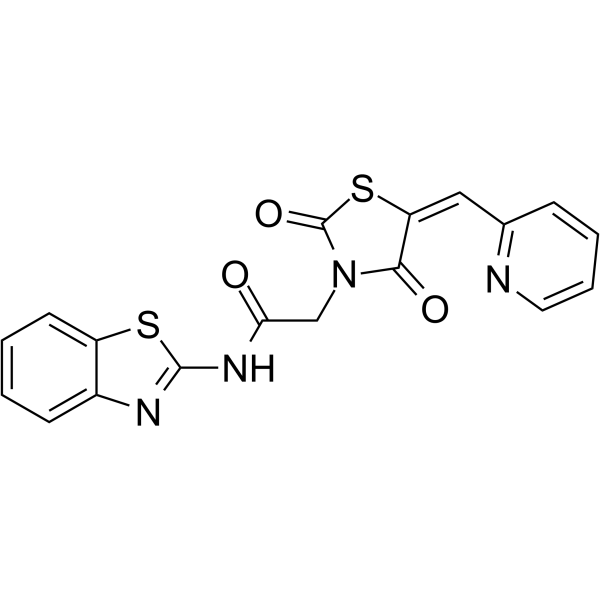
HDAC8-IN-3 (compound P19) is a potent HDAC8 inhibitor with IC50 value of 9.3 μM and produces thermal stabilization. HDAC8-IN-3 has cytotoxicity and induces apoptosis in leukemic cell lines .
loading...
    loading...
Cat. No.: HY-116258
CAS No.: 123065-37-2
Target:  

Liposome

Research Areas:  

Others

C16 Ceramide (d16:1,C16:0) is a bioactive sphingolipid that induces ordered- and gel-phase formation and thermal stabilization of palmitoylsphingomyelin-rich domains in palmitoylphosphocholine (POPC) bilayers. C16 Ceramide (d16:1,C16:0) is found in sphingomyelins in human erythrocytes .
loading...
    loading...
Cat. No.: HY-W002006
CAS No.: 6642-31-5
Research Areas:  

Others

6-Amino-1,3-dimethyluracil is a 6-aminouracil derivative and also functions as an organic thermal stabilizer for polyvinyl chloride (PVC). Its compatibility with PVC is lower than that of Ca 2+/Zn 2+ stabilizers and alkyl-substituted bis(6-amino-1,3-dimethyluracil-5-yl)methane derivatives. 6-Amino-1,3-dimethyluracil can be used to prepare PVC films, which exhibit lower transparency compared to PVC films stabilized by its derived bis-uracil compounds .
loading...
    loading...
Cat. No.: HY-184447
CAS No.: 3091508-49-2
Target:  

PAK

Research Areas:  

Others

RN193 is a type II kinase inhibitor with a human PAK1 IC50 of 4.28 μM. RN193 functionally inhibits kinase activity of PAK1, PAK2, and PAK3, and engages with their kinase domains in live cells. RN193 induces thermal shifts in CLK1, GSK3B, ULK1, MELK, MAPK13, BRAF, and STK10, indicating binding and stabilization of these proteins. RN193 induces formation of PAK3:PAK2 heterodimers and displaces PAK2 homodimers in live cells. RN193 acts as a tool compound for studying group I PAK conformational states .
loading...
    loading...

