14 Results for "

amoebiasis

" in MedChemExpress (MCE) Product Catalog:
Products (14)

14 Results for "amoebiasis" in MCE Product Catalog:

1
1 Cited Publications
Cat. No.: HY-B1118
CAS No.: 3366-95-8
Synonyms: RP-14539; PM-185184
Target:  

Bacterial Parasite

Research Areas:  

Infection

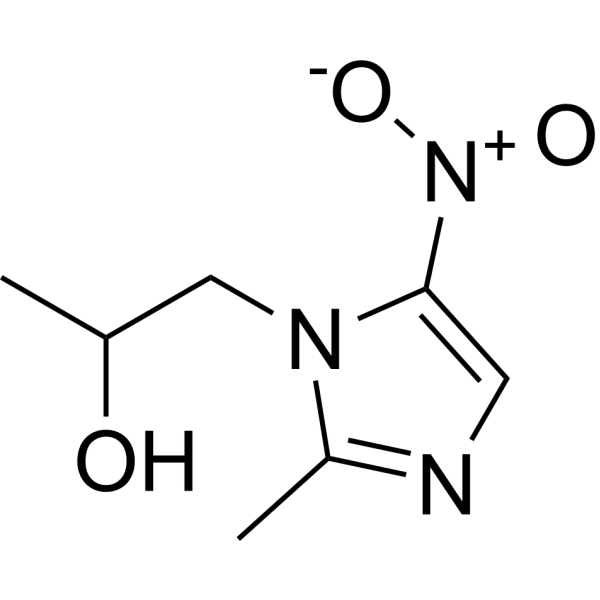
Secnidazole (RP-14539) is an orally active azole antibiotic and a imidazole mitigator of Serratia marcescens virulence. Secnidazole, as an analog of acylhomoserine lactones, effectively inhibits QS resulting in the attenuation of Pseudomonas aeruginosa pathogenesis. Secnidazole has antimicrobial activity against many anaerobic Gram-negative and Gram-positive bacterial species in vitro. Secnidazole can be used for the research of various diseases, such as amoebiasis and giardiasis, and bacterial vaginitis .
loading...
    loading...
1
1 Cited Publications
Cat. No.: HY-15537
CAS No.: 7175-09-9
Purity:  98.02%
Target:  

Parasite Bacterial

Research Areas:  

Infection

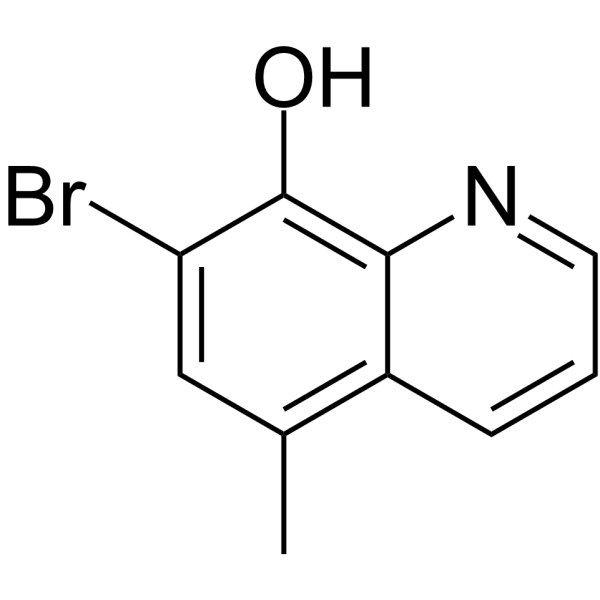
Tilbroquinol is an orally active halogenated hydroxyquinoline antiprotozoal agent, mainly used for anti-amoebic infections . Tilbroquinol targets intestinal protozoa and Entamoeba histolytica to eliminate parasites in the intestinal lumen. Tilbroquinol can be used in research related to intestinal infections, intestinal amoebiasis and hepatic amoebiasis .
loading...
    loading...
Cat. No.: HY-119826
CAS No.: 62265-68-3
Purity:  99.69%
Synonyms: WIN-40014
Target:  

Parasite

Research Areas:  

Infection

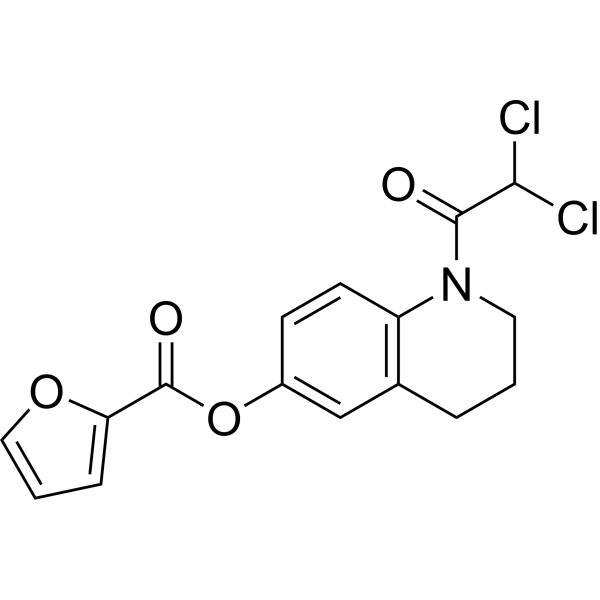
Quinfamide (WIN-40014) is an orally active class of dichloroacetyl derivative with significant anti-intestinal protozoan, particularly mmoeba histolytica activity. Quinfamide exhibits antiamoebic activity under solvent-free conditions with an IC50 of 28.15 μg/mL in a suspension condition. Quinfamide particles are actively engulfed by the amoebas, then cells are affected, and finally, amoebas are killed and lysed, and this process directly relies on the physical intake of the drug particles. Quinfamide can be used in the research of tropical parasitic infections such as amoebiasis and helminthiasis .
loading...
    loading...
Cat. No.: HY-B0956A
CAS No.: 7542-37-2
Synonyms: Aminosidine
Paromomycin (Aminosidine) is an orally active broad-spectrum aminoglycoside aminocyclitol. Paromomycin is produced by Streptomyces riomosus var. Paromomycinus. Paromomycin binding induces local conformational changes in the 16S rRNA A-site. Paromomycin exhibits inhibitory activity against C. parvum. Paromomycin can be used in research related to leishmaniasis, amoebiasis and cryptosporidiosis .
loading...
    loading...
Cat. No.: HY-B1118R
CAS No.: 3366-95-8
Synonyms: RP-14539 (Standard); PM-185184 (Standard)
Research Areas:  

Infection

Secnidazole (Standard) is the analytical standard of Secnidazole. This product is intended for research and analytical applications. Secnidazole (RP-14539) is an orally active azole antibiotic and a imidazole mitigator of Serratia marcescens virulence. Secnidazole, as an analog of acylhomoserine lactones, effectively inhibits QS resulting in the attenuation of Pseudomonas aeruginosa pathogenesis. Secnidazole has antimicrobial activity against many anaerobic Gram-negative and Gram-positive bacterial species in vitro. Secnidazole can be used for the research of various diseases, such as amoebiasis and giardiasis, and bacterial vaginitis .
loading...
    loading...
Cat. No.: HY-B1118A
CAS No.: 227622-73-3
Synonyms: RP-14539 hemihydrate; PM-185184 hemihydrate
Target:  

Bacterial Parasite

Research Areas:  

Infection

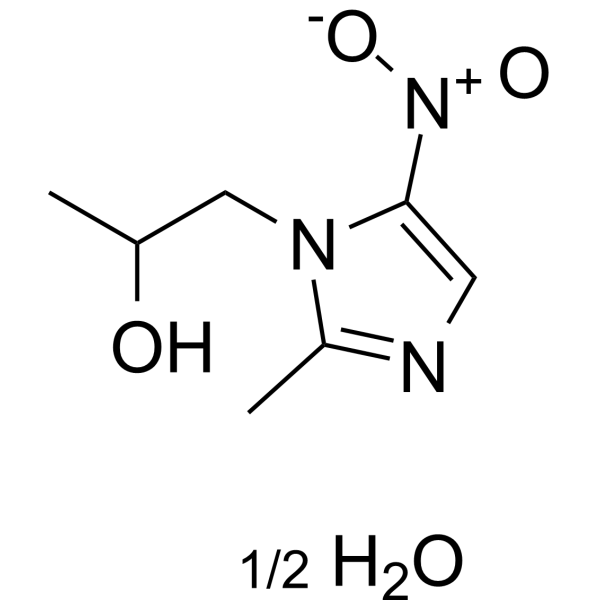
Secnidazole (RP-14539) hemihydrate is an orally active azole antibiotic and a imidazole mitigator of Serratia marcescens virulence. Secnidazole hemihydrate, as an analog of acylhomoserine lactones, effectively inhibits QS resulting in the attenuation of Pseudomonas aeruginosa pathogenesis. Secnidazole hemihydrate has antimicrobial activity against many anaerobic Gram-negative and Gram-positive bacterial species in vitro. Secnidazole hemihydrate can be used for the research of various diseases, such as amoebiasis and giardiasis, and bacterial vaginitis .
loading...
    loading...
Cat. No.: HY-B2085
CAS No.: 119-96-0
Synonyms: Arsthinol; Balarsen
Arsthinenol (Arsthinol; Balarsen) is an orally active small organic arsenic molecule. Arsthinenol exhibits anti-amoebic activity by eliminating cysts and trophozoites of Entamoeba histolytica in feces and promoting the healing of amoebic rectal ulcers. Arsthinenol forms the hydroxypropyl-β-cyclodextrin inclusion complex STB-HPβCD, which has an IC50 of 31.6 μM against U87 MG cells and possesses anti-tumor activity. Arsthinenol can be used in the research of intestinal amoebiasis and glioblastoma .
loading...
    loading...
Cat. No.: HY-B1118S2
Synonyms: RP-14539-d4; PM-185184-d4
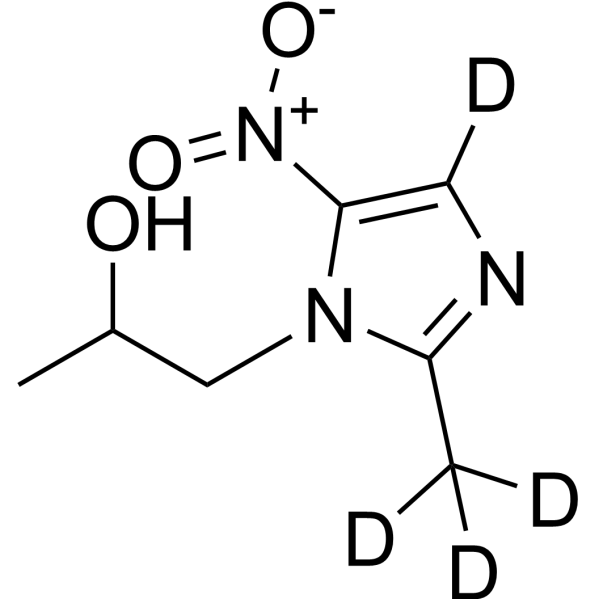
Secnidazole-d4 is the deuterium labeled Secnidazole . Secnidazole (RP-14539) is an orally active azole antibiotic and a imidazole mitigator of Serratia marcescens virulence. Secnidazole, as an analog of acylhomoserine lactones, effectively inhibits QS resulting in the attenuation of Pseudomonas aeruginosa pathogenesis. Secnidazole has antimicrobial activity against many anaerobic Gram-negative and Gram-positive bacterial species in vitro. Secnidazole can be used for the research of various diseases, such as amoebiasis and giardiasis, and bacterial vaginitis .
loading...
    loading...
Cat. No.: HY-B1118S3
Synonyms: RP-14539-d3; PM-185184-d3
Secnidazole-d3 (RP-14539-d3; PM-185184-d3) is the deuterium labeled Secnidazole (HY-B1118). Secnidazole (RP-14539) is an orally active azole antibiotic and a imidazole mitigator of Serratia marcescens virulence. Secnidazole, as an analog of acylhomoserine lactones, effectively inhibits QS resulting in the attenuation of Pseudomonas aeruginosa pathogenesis. Secnidazole has antimicrobial activity against many anaerobic Gram-negative and Gram-positive bacterial species in vitro. Secnidazole can be used for the research of various diseases, such as amoebiasis and giardiasis, and bacterial vaginitis .
loading...
    loading...
Cat. No.: HY-165615
CAS No.: 3613-83-0
Target:  

Parasite

Research Areas:  

Infection

M&B 4935 is an orally active Amoebicide. M&B 4935 reduces the levels of *Entamoeba histolytica* parasites in rodents. M&B 4935 can be used for the research of amoebiasis .
loading...
    loading...
Cat. No.: HY-119475
CAS No.: 56302-13-7
Research Areas:  

Infection

Satranidazole is an orally active insecticide and antimicrobial agent with high electron affinity. Satranidazole forms reduced nitro intermediates, which interact with DNA, causing helix instability, strand breakage and release of thymidine derivatives. Satranidazole exhibits antitrichomonal activity against Trichomonas vaginalis and Trichomonas foetus, and antiamoebic activity in rodent models of hepatic amoebiasis and caecal amoebiasis. Satranidazole inhibits the replication of bacteriophage φX174 DNA. Satranidazole can be used in research related to caecal amoebiasis, trichomoniasis and anaerobic bacterial infections .
loading...
    loading...
Cat. No.: HY-119475S
Satranidazole-d3 is the deuterium labeled Satranidazole. Satranidazole is an orally active insecticide and antimicrobial agent with high electron affinity. Satranidazole forms reduced nitro intermediates, which interact with DNA, causing helix instability, strand breakage and release of thymidine derivatives. Satranidazole exhibits antitrichomonal activity against Trichomonas vaginalis and Trichomonas foetus, and antiamoebic activity in rodent models of hepatic amoebiasis and caecal amoebiasis. Satranidazole inhibits the replication of bacteriophage φX174 DNA. Satranidazole can be used in research related to caecal amoebiasis, trichomoniasis and anaerobic bacterial infections.
loading...
    loading...
Cat. No.: HY-181643
CAS No.: 3075693-57-8
Target:  

MetAP

Research Areas:  

Infection

YOK24 is an orally active MetAP2 inhibitor and anti-amoebic agent. YOK24 binds covalently to MetAP2 and inhibits its peptidase activity, where MetAP2 is a protein essential for the proliferation of *Entamoeba histolytica*. YOK24 can be used in the research of amoebiasis .
loading...
    loading...
Cat. No.: HY-N18080
CAS No.: 508-59-8
Parthenin is a pseudoguaianolide-type sesquiterpene lactone present in Parthenium hysterophorus L. Parthenin induces chromosomal aberrations, mainly chromatid breaks, in human peripheral blood lymphocytes. Parthenin exhibits toxicity against Salmonella typhimurium and Escherichia coli strains, with reduced toxicity in the presence of a metabolic activation system (S9). Parthenin acts as an antifeedant against the 6th instar larvae of the tobacco cutworm (Spodoptera litura). Parthenin shows insecticidal activity against adult cowpea weevils (Callosobruchus maculatus). Parthenin inhibits seed germination and seedling growth of sicklepod (Cassia tora). Parthenin possesses nematicidal activity against the 2nd instar larvae of the southern root-knot nematode (Meloidogyne incognita). Parthenin serves as a research agent for studies related to cancer, malaria, amoebiasis, inflammatory diseases, and bacterial infections .
loading...
    loading...
  • 1

