18 Results for "

aqueous buffer

" in MedChemExpress (MCE) Product Catalog:
Products (18)

18 Results for "aqueous buffer" in MCE Product Catalog:

10
10 Publications Verification
Cat. No.: HY-B1610N
Sodium Citrate Buffer, 0.1M, pH 4.0 is an acidic, aqueous buffer solution. Sodium Citrate Buffer, 0.1M, pH 4.0 resists pH fluctuations, chelates metal ions, and regulates the redox potential of the system. Sodium Citrate Buffer, 0.1M, pH 4.0 is widely used in molecular biology, immunohistochemistry (IHC), and biochemistry .
loading...
    loading...
1
1 Cited Publications
Cat. No.: HY-W014837
CAS No.: 15471-17-7
Synonyms: 3-(1-Pyridinio)-1-propanesulfonate
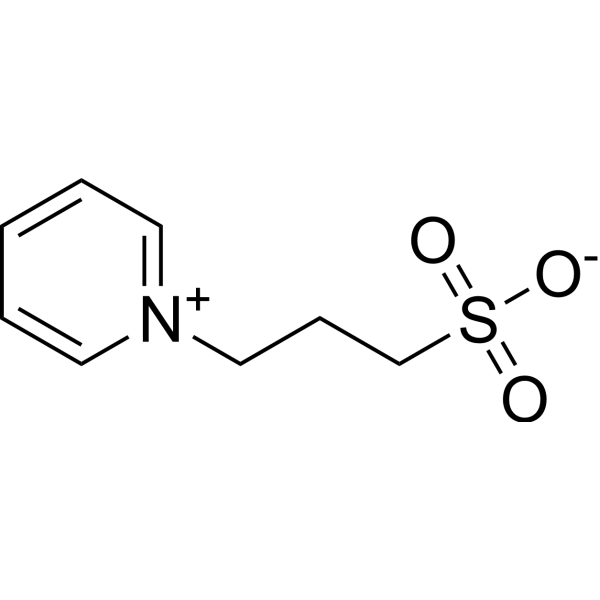
NDSB-201 consists of a pyridine group attached to a propane chain, which in turn is attached to a sulfonate group. This compound is commonly used as a buffer in biochemical and biological research, especially in electrophoretic applications. It maintains a stable pH in aqueous solutions and has low UV absorption, making it suitable for use in the UV spectrum. Furthermore, due to its ability to form stable complexes with DNA and other biomolecules, 3-(pyridin-1-ium-1-yl)propane-1-sulfonate has been investigated for its potential in drug delivery and genetic research.
loading...
    loading...
1
1 Cited Publications
Cat. No.: HY-D0784
CAS No.: 216699-35-3
Synonyms: 5-Carboxy-X-rhodamine
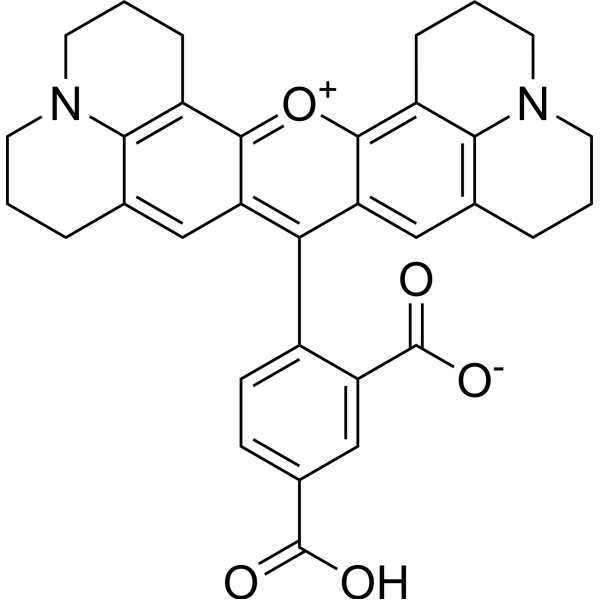
5-ROX (5-Carboxy-X-rhodamine), a rhodamine dye, exhibits strong fluorescence property in aqueous buffer with the λexit of 580 nm (ε=3.6×10 4 M -1 cm -1), and λemit of 604 nm (=0.94) .
loading...
    loading...
Cat. No.: HY-160113
Sodium phosphate buffer 0.02 M, pH 6.9 is a commonly used aqueous biological buffer that maintains a stable pH value. Sodium phosphate buffer 0.02 M, pH 6.9 is often used in enzyme activity assays, such as α-amylase assays. Sodium phosphate buffer 0.02 M, pH 6.9 is prepared by mixing disodium hydrogen phosphate (Na2HPO4) (HY-B2243) and sodium dihydrogen phosphate (NaH2PO4) (HY-Y0308) to a total concentration of 0.02 M .
loading...
    loading...
Cat. No.: HY-D0874
CAS No.: 68399-78-0
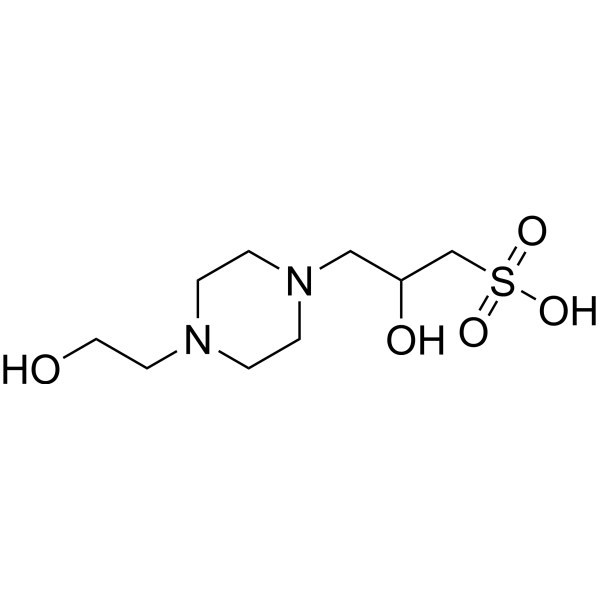
HEPPSO is a zwitterionic Good's buffer suitable for physiological pH conditions. HEPPSO forms high-order oligomers in aqueous solutions and can form a 1:1 complex with Cu 2+ via its hydroxyalkyl and tertiary amine groups. However, HEPPSO contains a structurally similar trace impurity lacking an alkanesulfonic acid side chain. The complex formed by this impurity and Cu 2+ has a very low Ka; therefore, HEPPSO may interfere with studies on copper speciation analysis in natural water bodies .
loading...
    loading...
Cat. No.: HY-D1509
CAS No.: 10510-77-7
Phenazine ethosulfate is a cationic dye (Ex=390 nm, Em=530 nm) and electron acceptor that can be used in dye-linked enzyme assays . Phenazine ethosulfate exhibits weak, pH-dependent fluorescence properties and serves as an oxidative substrate. Phenazine ethosulfate promotes the reduction of equine heart metmyoglobin to ferrohemoglobin. As an intermediate, Phenazine ethosulfate can be used in combination with ascorbic acid for the detection of nitric oxide reductase activity .
loading...
    loading...
Cat. No.: HY-160113E
Sodium phosphate buffer 0.1M, pH 8.0 is an aqueous sodium phosphate buffer with a concentration of 0.1M and a pH value of 8.0. Sodium phosphate buffer 0.1M, pH 8.0 can be used for the preparation of hydrated micellar membranes, the construction of pH-sensitive nanocarriers, and the maintenance of stable environmental conditions for pH-cleavable PEG-Hz-PE micelles. Sodium phosphate buffer 0.1M, pH 8.0 can also serve as a universal solvent, reaction medium and eluent, and is widely applied in experimental processes such as antibody thiolation, nanoparticle purification and cross-linking reactions .
loading...
    loading...
Cat. No.: HY-B1610K
Sodium Citrate Buffer, 0.5M, pH 5.5 is a metal chelator and buffering agent. Sodium Citrate Buffer, 0.5M, pH 5.5 requires oxygen to participate in the oxidation process to reduce pink defects in cooked ground turkey, and it does not function via heme iron chelation or iron complex interaction. When mixed with 50% (by vol.) 1,3-dimethylimidazolium methyl sulfate, Sodium Citrate Buffer, 0.5M, pH 5.5 can serve as an aqueous buffering medium to maintain the catalytic efficiency of the hyperthermophilic β-glycosidase CelB for lactose hydrolysis at 80°C, while also acting as a reaction medium for CelB-catalyzed lactose hydrolysis and galactosyltransferase assays .
loading...
    loading...
Cat. No.: HY-P4389
CAS No.: 1037751-81-7
Target:  

GLP Receptor

Research Areas:  

Metabolic Disease

(Asp28)-Glucagon (1-29) (human, rat, porcine) is an optimized structure of glucagon, the 28th position is replaced by aspartic acid (Asp) which significantly increases the aqueous solubility of glucagon in a physiological pH buffer, has the same activity as glucagon .
loading...
    loading...
Cat. No.: HY-Y0332BS
CAS No.: 13761-79-0
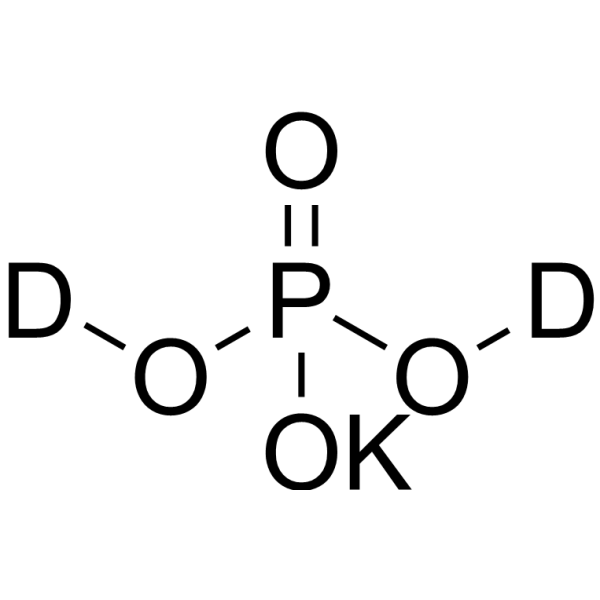
Phosphate monobasic-d2 (potassium) is the deuterium labeled Potassium phosphate monobasic . Potassium phosphate monobasic (DiA) is a commonly used in biological assay buffers. Potassium phosphate monobasic is moderate to highly concentrated aqueous solutions of potassium phosphate monobasic for the production of phosphate buffers and other laboratory applications.
loading...
    loading...
Cat. No.: HY-D2984
CAS No.: 1308789-62-9
Synonyms: SNAP-PEG-NH2
BG-PEG-NH2 is an amine terminated phenylguanine derivative with a polyethylene glycol (PEG) chain. BG-PEG-NH2 is an important building block for synthesizing SNAP tag labeled probes. BG-PEG-NH2 is suitable for coupling reactions in aqueous or buffer solutions, coupling of markers, and labeling of intracellular or cell surface proteins .
loading...
    loading...
Cat. No.: HY-N16152
CAS No.: 106918-69-8
Synonyms: C6-NBD-PE
Target:  

Fluorescent Dye

Research Areas:  

Others

16:0-06:0 NBD PE (C6-NBD-PE) is a commonly used fluorescent phospholipid analog and membrane-disrupting agent for investigating membrane lipid structure and dynamics. In aqueous buffers, the self-assembly of 16:0-06:0 NBD PE can be disrupted via binding to methylated α-, β-, and γ-cyclodextrins. 16:0-06:0 NBD PE can be selectively extracted from lipid vesicles upon the addition of methylated cyclodextrins, with an extraction efficiency lower than that of NBD-PC and NBD-SM analogs .
loading...
    loading...
Cat. No.: HY-D3200
CAS No.: 3112200-59-3
Dns-LLC is a cell-permeable Cu +-selective fluorescent probe that forms a 1:1 complex with Cu +. The thiol group of Dns-LLC plays a key binding role, while the sulfonamide and amide groups jointly contribute to the stabilization of the complex. Upon binding to Cu + in aqueous buffer solutions, Dns-LLC generates a turn-on fluorescence response, which can be used for the detection of Cu + in the Golgi apparatus .
loading...
    loading...
Cat. No.: HY-W698583A
CAS No.: 214211-69-5
BNN5Na is a guanylate cyclase activator and vasorelaxant inducer. BNN5Na undergoes photolytic uncaging to release nitric oxide. BNN5Na remains stable in pH 7.4 phosphate buffer at 37°C for over 1 day in the dark and does not react noticeably with cysteine under these conditions. BNN5Na is water-soluble but membrane-impermeant, remaining in extracellular aqueous compartments. BNN5Na shows no cytotoxicity toward rat aortic strip contractile apparatus .
loading...
    loading...
Cat. No.: HY-W711011
CAS No.: 87816-74-8
Target:  

Drug Derivative

Research Areas:  

Metabolic Disease

Flufenamic acid glucuronide is an acyl-linked glucuronide of Flufenamic acid (HY-B1221). Flufenamic acid glucuronide can be used for the research of acyl glucuronide rearrangement and drug metabolism .
loading...
    loading...
Cat. No.: HY-183740
CAS No.: 3020685-33-7
Synonyms: N-Acryloylindole-alkyne
Research Areas:  

Others

NAIA (N-Acryloylindole-alkyne) is a cysteine-reactive probe. NAIA can be used as an imaging agent, proteome profiling agent, and covalent ligand screening tool .
loading...
    loading...
Cat. No.: HY-D3233
Ctrl-BDPS1 is a BODIPY-based control probe that shows no response to copper ions (exhibiting two emission peaks at 575 nm and 708 nm; the maximum excitation wavelength is at 627 nm). Ctrl-BDPS1 has no fluorescent response to Cu + .
loading...
    loading...
Cat. No.: HY-172754
ICAAc is a solvatochromic fluorophore with reduced basicity. ICAAc demonstrates significant solvatochromic behavior across solvents of varying polarity, with a large dipole moment difference and low quantum yield in water, making it a tunable solvatochromic fluorophore. ICAAc enables pH sensing via UV-vis/fluorescence detection and in microenvironments including sodium lauryl sulfate micelle Stern layers. ICAAc acts as a supravital cell stain for epifluorescence imaging of live cancer cells .
loading...
    loading...
  • 1

