1. Search Result
Search Result
Results for "

bean plants

" in MedChemExpress (MCE) Product Catalog:

11

Inhibitors & Agonists

4

Biochemical Assay Reagents

6

Natural
Products

Cat. No. Product Name Target Research Areas Chemical Structure
  • HY-P2149
    Concanavalin A
    5 Publications Verification

    Mitosis Infection Metabolic Disease Inflammation/Immunology Cancer
    Concanavalin A can be coupled to agarose to form Concanavalin A (agarose) (HY-P2149A). Concanavalin A (ConA) is a selective, competitive binding agent that targets specific carbohydrate structures containing glucose and mannose; it acts as a mitogen and exhibits varying degrees of cytotoxicity, hepatotoxicity, and teratogenicity. Concanavalin A is also utilized for in vivo blood glucose monitoring in the context of diabetes .
    Concanavalin A
  • HY-136633

    Environmental Pollutants Herbicide Others
    Pyroxasulfone is a broad-spectrum pyrazole Herbicide. Pyroxasulfone is effective against a variety of annual grass weeds and some broadleaf weeds. Pyroxasulfone causes reduced plant height, decreased above-ground dry weight and yield loss in pinto beans and red Mexican beans .
    Pyroxasulfone
  • HY-116831

    Drug Metabolite Others
    4′-Dihydrophaseic acid is a metabolite of the plant hormone abscisic acid and is present in legume seeds .
    4′-Dihydrophaseic acid
  • HY-125923
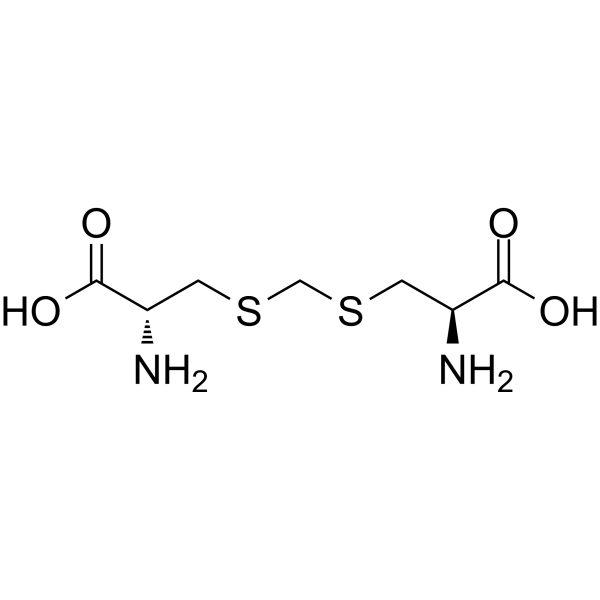
    Djenkolic acid
    2 Publications Verification

    Bacterial Infection Endocrinology
    Djenkolic acid is a sulfur-containing amino acid. Djenkolic acid can be isolated from the djenkol beans of the Southeast Asian plant Archidendron jiringa. Djenkolic acid de-inhibits the SO4 2- uptake system in Pseudomonas fluorescens. Djenkolic acid causes supersaturation of the urinary system with djenkolic acid crystals, leading to urinary tract obstruction and acute kidney injury .
    Djenkolic acid
  • HY-B2020

    Environmental Pollutants Herbicide Others
    Fenuron is a water-soluble herbicide used to control annual broad-leaved weeds and woody plants, which is widely applied in the fields of beans, spinach, sugar beet, and other fruits .
    Fenuron
  • HY-W016187

    2-Naphthylacetic acid

    Biochemical Assay Reagents Metabolic Disease
    2-(Naphthalen-2-yl)acetic acid (2-Naphthylacetic acid) is a plant growth regulator that can improve the quality and yield of crops such as bean sprouts. In addition, 2-(Naphthalen-2-yl)acetic acid can be used as a probe to study the distribution of amino acid conjugation mechanisms in different species .
    2-(Naphthalen-2-yl)acetic acid
  • HY-B2020R

    Herbicide Reference Standards Others
    Fenuron (Standard) is the analytical standard of Fenuron. This product is intended for research and analytical applications. Fenuron is a water-soluble herbicide used to control annual broad-leaved weeds and woody plants, which is widely applied in the fields of beans, spinach, sugar beet, and other fruits .
    Fenuron (Standard)
  • HY-N8357R

    Reference Standards Endogenous Metabolite Others
    Fenuron (Standard) is the analytical standard of Fenuron. This product is intended for research and analytical applications. Fenuron is a water-soluble herbicide used to control annual broad-leaved weeds and woody plants, which is widely applied in the fields of beans, spinach, sugar beet, and other fruits .
    Vitamin D3 octanoate (Standard)
  • HY-125923R

    Reference Standards Bacterial Infection Endocrinology
    Djenkolic acid (Standard) is the analytical standard of Djenkolic acid (HY-125923). This product is intended for research and analytical applications. Djenkolic acid is a sulfur-containing amino acid. Djenkolic acid can be isolated from the djenkol beans of the Southeast Asian plant Archidendron jiringa. Djenkolic acid de-inhibits the SO4 2- uptake system in Pseudomonas fluorescens. Djenkolic acid causes supersaturation of the urinary system with djenkolic acid crystals, leading to urinary tract obstruction and acute kidney injury .
    Djenkolic acid (Standard)
  • HY-W017143

    Fungal Infection
    Antifungal agent 158 is an α-pyrone derivative that can be found in Trichoderma harzianum, exhibiting antifungal activity against select plant-pathogenic fungi, including Chaetomium spp., Curvularia lunata, and Aspergillus flavus. Antifungal agent 158 is non-toxic to greenhouse-grown bean, corn, and tobacco plants. Antifungal agent 158 can be used for research on Aspergillus flavus infection .
    Antifungal agent 158
  • HY-W612164

    Drug Derivative Infection
    2-Methyl-3-phenylpropanal is a volatile aromatic compound found in the flowers of legume host plants such as cowpeas and lentils. 2-Methyl-3-phenylpropanal can specifically bind to the odor-binding protein MvitOBP3 of the bean pod moth and exert potential oviposition attraction activity. 2-Methyl-3-phenylpropanal can be used for pest control .
    2-Ethoxypropan-1-ol

Inquiry Online

Your information is safe with us. * Required Fields.

Salutation


Country or Region *

Applicant Name *


Organization Name *

Department *


Email Address *


Product Name *

Cat. No.


Requested quantity *

Phone Number *


Remarks

Inquiry Online

Inquiry Information

Product Name:
Cat. No.:
Quantity:
MCE Japan Authorized Agent:

