
12 Results for "

cell rounding

" in MedChemExpress (MCE) Product Catalog:
Products (12)

12 Results for "cell rounding" in MCE Product Catalog:

Cat. No.: HY-D1612
CAS No.: 133867-53-5
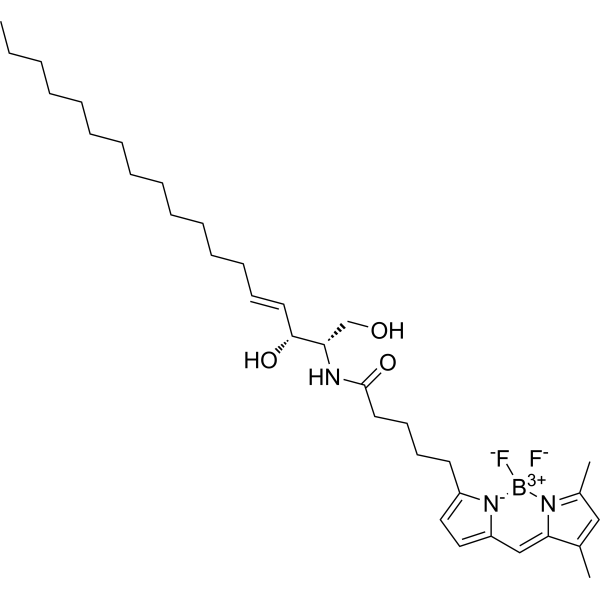
The Golgi apparatus is composed of flattened vesicles superimposed on each other by unit membranes. The flattened vesicles are round with expanded and perforated edges. The Golgi fluorescent probe is a BODIPY-labeled ceramide derivative, the synthesis of which occurs in the endoplasmic reticulum and can then be transported to the Golgi via ceramide transport protein (CERT) or vesicular translocation, allowing specific labeling of the dye . BODIPY Fl C5-Ceramide is a Golgi-specific green fluorescent dye, which can visualise individual cells . Ex/Em= 505 nm/512 nm.
loading...
    loading...
Cat. No.: HY-Y1366
CAS No.: 116-09-6
Hydroxyacetone is a toxic compound. Hydroxyacetone can be isolated from e-cigarette aerosols. Hydroxyacetone reduces the activity of cellular Mitochondrial reductase (with an IC50 of 5.53 mg/mL for mitochondrial reductase in BEAS-2B cells) and increases ROS levels. Hydroxyacetone induces mitochondrial stress and oxidative damage. Hydroxyacetone induces destabilization of F-actin. At high concentrations, Hydroxyacetone promotes cell rounding and Apoptotic body formation. Hydroxyacetone exerts toxic effects on cells including airway epithelial cells and possesses respiratory toxicity potential .\n


loading...
    loading...
Cat. No.: HY-118773
CAS No.: 22816-60-0
Purity:  99.3%
Synonyms: A22 hydrochloride
Target:  

Bacterial

Research Areas:  

Infection

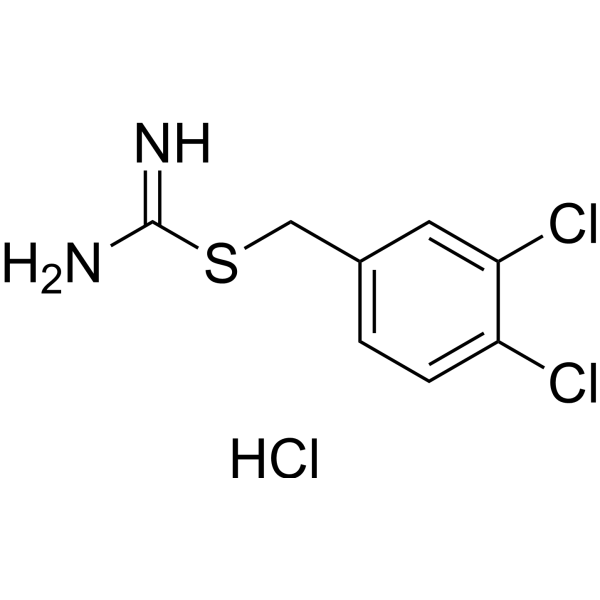
MreB Perturbing Compound A22 hydrochloride (A22 hydrochloride) is a reversible MreB inhibitor and antimicrobial agent that exhibits bacteriostatic activity against Escherichia coli, with low activity against Gram-positive bacteria. MreB Perturbing Compound A22 hydrochloride rapidly and reversally delocalizes MreB from the helical/circular structures in cells, impairs MreB function, and reduces the binding of MreB to the chromosomal region proximal to the replication origin. MreB Perturbing Compound A22 hydrochloride alters the cell morphology of caulobacters to round/lemon-shaped, slows caulobacter growth, blocks their cell division, and induces the formation of spherical morphology, asymmetric division, and anucleate cells in Escherichia coli. MreB Perturbing Compound A22 hydrochloride is used for studies related to bacterial rod-shaped morphology determination, chromosome segregation, and cell division mechanisms .
loading...
    loading...
Cat. No.: HY-D1735
CAS No.: 571186-05-5
Synonyms: Golgi-Red Tracke
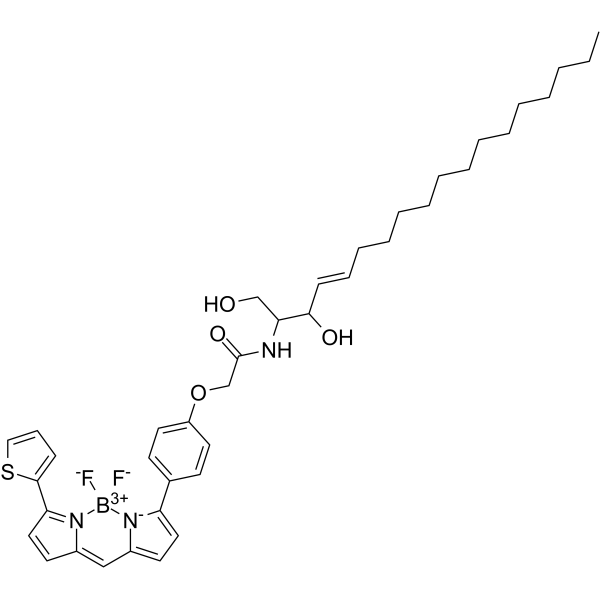
The Golgi apparatus is composed of flattened vesicles superimposed on each other by unit membranes. The flattened vesicles are round with expanded and perforated edges. The Golgi fluorescent probe is a BODIPY-labeled ceramide derivative, the synthesis of which occurs in the endoplasmic reticulum and can then be transported to the Golgi via ceramide transport protein (CERT) or vesicular translocation, allowing specific labeling of the dye. BODIPY TR Ceramide (Golgi-Red Tracke) is a Golgi-specific fluorescent dye, which can visualise individual cells . Ex/Em=589 nm/616 nm.
loading...
    loading...
Cat. No.: HY-150187
CAS No.: 1246430-04-5
Research Areas:  

Neurological Disease

20:4 Lyso PI acts as an activator of GPR55 and RhoA. 20:4 Lyso PI activates the GPR55-RhoA-ROCK pathway, thereby inducing morphological changes, cytoskeleton assembly, cell rounding and stress fiber formation. 20:4 Lyso PI can be used in research related to diseases such as those of the nervous system .
loading...
    loading...
Cat. No.: HY-121683
CAS No.: 22644-96-8
Synonyms: 16:1 Aldehyde; trans-2-Hexadecenal
Research Areas:  

Cancer

(E)-2-Hexadecenal (trans-2-Hexadecenal) is an MLK3 activator that induces cytoskeletal remodeling, leading to cell rounding, detachment, and ultimately apoptosis in human and mouse cells. (E)-2-Hexadecenal activates the MLK3 signaling pathway, phosphorylating MKK4/7 and JNK, subsequently activating downstream targets of JNK, such as c-Jun phosphorylation, cytochrome c release, Bax activation, Bid cleavage, and Bim translocation to mitochondria. (E)-2-Hexadecenal has potential applications in research related to sphingolipid signaling pathways .
loading...
    loading...
Cat. No.: HY-P11114
CAS No.: 2206807-06-7
Periplanetasin-4 is an antimicrobial peptide that can be derived from the American cockroach (Periplaneta americana). Periplanetasin-4 reduces cell rounding and apoptosis. Periplanetasin-4 blocks Clostridium difficile toxin A-induced ROS production and the activation of downstream p38 MAPK and p21. Periplanetasin-4 significantly increases mitochondrial calcium level, reduces DPH fluorescence intensity and vacuolar dysfunction in Candida albicans ATCC 90028 cells. Periplanetasin-4 significantly ameliorates toxin A-induced mucosal damage in the mouse gut. Periplanetasin-4 can be used for the study of colitis .
loading...
    loading...
Cat. No.: HY-158736
CAS No.: 1246681-32-2
Synonyms: Psychosine 3′-O-sulfate ammonium; Psychosine 3′-sulfate ammonium
Target:  

Phospholipase

Research Areas:  

Cancer

Lyso-sulfatide (bovine) ammonium, a derivative of the glycosphingolipid sulfatide, acts as an extracellular signal regulating the migration of a neural precursor cell line (B35 neuroblastoma cells) by rapidly promoting process retraction and cell rounding .
loading...
    loading...
Cat. No.: HY-118773R
CAS No.: 22816-60-0
Synonyms: A22 hydrochloride (Standard)
Research Areas:  

Infection

MreB Perturbing Compound A22 hydrochloride (Standard) is the analytical standard for MreB Perturbing Compound A22 hydrochloride (HY-118773). This product is intended for research and analytical applications. MreB Perturbing Compound A22 hydrochloride (A22 hydrochloride) is a reversible MreB inhibitor and antimicrobial agent that exhibits bacteriostatic activity against Escherichia coli, with low activity against Gram-positive bacteria. MreB Perturbing Compound A22 hydrochloride rapidly and reversally delocalizes MreB from the helical/circular structures in cells, impairs MreB function, and reduces the binding of MreB to the chromosomal region proximal to the replication origin. MreB Perturbing Compound A22 hydrochloride alters the cell morphology of caulobacters to round/lemon-shaped, slows caulobacter growth, blocks their cell division, and induces the formation of spherical morphology, asymmetric division, and anucleate cells in Escherichia coli. MreB Perturbing Compound A22 hydrochloride is used for studies related to bacterial rod-shaped morphology determination, chromosome segregation, and cell division mechanisms .
loading...
    loading...
Cat. No.: HY-162924
CAS No.: 2244671-47-2
Target:  

SARS-CoV

Research Areas:  

Infection

SARS-CoV-IN-6 (Compound 17) is an inhibitor of SARS-CoV-1 and SARS-CoV-2 RdRp, with an IC50 value of 7.8 μM against SARS-CoV-2 RdRp. SARS-CoV-IN-6 reduces cytopathic effects in cells infected with SARS-CoV-1 and SARS-CoV-2 replicon-based single-round infectious particles (SRIPs), and inhibits SARS-CoV N protein expression, with EC50 values of 0.12 µM for SARS-CoV-1 replicon-based SRIPs and 1.47 µM for SARS-CoV-2 replicon-based SRIPs .
loading...
    loading...
Cat. No.: HY-120267
CAS No.: 19231-60-8
Target:  

Casein Kinase

Research Areas:  

Cardiovascular Disease

TID43 is a CK2 inhibitor, with an IC50 of 0.3 μM. TID43 can be used for anti-angiogenic research .
loading...
    loading...
Cat. No.: HY-138135
CAS No.: 1030825-28-5
Synonyms: Fidaxomicin metabolite OP-1118
Research Areas:  

Infection

OP-1118 (Fidaxomicin metabolite OP-1118) is an orally active dual inhibitor of NF-κB and ERK1/2, with low systemic plasma exposure, no accumulation, and primary excretion via feces. By inhibiting the phosphorylation of NF-κB and ERK1/2 and reducing the expression of pro-inflammatory cytokines, OP-1118 exerts significant anti-inflammatory, cytoprotective, anti-apoptotic and antibacterial activities. In Clostridium difficile infection models, OP-1118 effectively blocks toxin-mediated intestinal inflammation, cell rounding, histological damage and apoptosis, and its protective effect can be reversed by PMA (HY-18739) .
loading...
    loading...
  • 1

