


11 Results for "

classical complement pathway activation

" in MedChemExpress (MCE) Product Catalog:
Products (11)

11 Results for "classical complement pathway activation" in MCE Product Catalog:

3
3 Cited Publications
Cat. No.: HY-P1036
CAS No.: 206645-99-0
Target:  

Complement System

Research Areas:  

Others

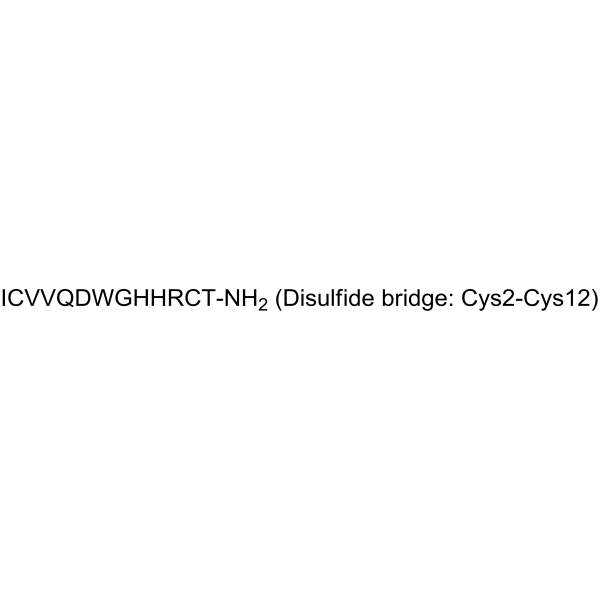
Compstatin, a 13-residue cyclic peptide, is a potent inhibitor of the complement system C3 with species specificity. Compstatin binds to baboon C3 and is resistant to proteolytic cleavage in baboon blood (similar to humans). Compstatin inhibits only the activation of primates’ complement system. Compstatin exhibits IC50 values of 63 μM and 12 μM for classical and alterative complement pathway, respectively .
loading...
    loading...
3
3 Cited Publications
Cat. No.: HY-P1036A
Target:  

Complement System

Research Areas:  

Others

Compstatin TFA, a 13-residue cyclic peptide, is a potent inhibitor of the complement system C3 with species specificity. Compstatin TFA binds to baboon C3 and is resistant to proteolytic cleavage in baboon blood (similar to humans). Compstatin TFA inhibits only the activation of primates’ complement system. Compstatin TFA exhibits IC50 values of 63 μM and 12 μM for classical and alterative complement pathway, respectively .
loading...
    loading...
Cat. No.: HY-P990091
CAS No.: 2756228-76-7
Synonyms: SAR 445088
Riliprubart (SAR 445088) is a selective anti-C1s humanized IgG4 monoclonal antibody with mutations that enhance its binding to the neonatal Fc receptor. Riliprubart blocks activation of the classical complement pathway, prevents the formation of the C3 convertase C4b2a, and inhibits complement-mediated hemolytic activity. Riliprubart can be used in research related to classical complement-mediated diseases, cold agglutinin disease, and chronic inflammatory demyelinating polyneuropathy. For the isotype control of Riliprubart, refer to Human IgG4 (S228P) kappa, Isotype Control (HY-P99003) .
loading...
    loading...
Cat. No.: HY-P99358
CAS No.: 1662664-56-3
Synonyms: GSK 2398852; Anti-Serum Amyloid P/SAP Reference Antibody (dezamizumab)

Target:  

Complement System

Research Areas:  

Inflammation/Immunology

Dezamizumab (GSK 2398852) is a fully humanized clonal IgG1 antibody against serum amyloid P component (SAP) with complement activation and amyloid clearance-inducing activities. Dezamizumab binds to SAP associated with amyloid deposits to form complexes that activate complement and mediate phagocytic clearance, triggering activation of the classical complement pathway. Dezamizumab can be used for the research of systemic amyloidosis .
loading...
    loading...
Cat. No.: HY-P990025
CAS No.: 2579031-19-7
Synonyms: ARGX-117

Target:  

Complement System

Research Areas:  

Inflammation/Immunology

Empasiprubar (ARGX-117) is a humanized inhibitory monoclonal antibody targeting complement C2. Empasiprubar binds to the Sushi-2 domain of C2, preventing the formation of C3 pre convertase and inhibiting the activation of classical and lectin pathways upstream of C3 activation. Empasiprubar can prevent complement mediated autoimmune hemolytic anemia and antibody mediated organ transplant rejection. Empasiprubar can prevent neuroglial lymphoconjunctival injury in GM1 antibody mediated mouse models .
loading...
    loading...
Cat. No.: HY-P10827
CAS No.: 1356469-36-7
Target:  

Complement System

Research Areas:  

Inflammation/Immunology

PIC1 PA, a 15 amino-acid peptide, is a potent PIC1 analog that inhibits classical pathway mediated complement activation. PIC1 PA functionally disrupts the C1s-C1r-C1r-C1s/MASPs interaction with collagen-like region (CLR) of C1q/MBL, respectively. PIC1 PA specifically binds to the CLR of C1q and bounds to purified C1q with a mean equilibrium dissociation constant (KD) of 33.3 nM .
loading...
    loading...
Cat. No.: HY-P991886

Target:  

Complement System

Research Areas:  

Neurological Disease

ANX-M1 is a blood-brain barrier-permeable anti-C1q antibody. ANX-M1 can slow down the progression of retinal degeneration following photo-oxidative damage. ANX-M1 has been incorporated into nanocarriers to evaluate its brain delivery efficacy in a mouse model of Alzheimer's disease. ANX-M1 is applicable for research on age-related macular degeneration and Alzheimer's disease [1] .
loading...
    loading...
Cat. No.: HY-P992463

Target:  

Ser/Thr Protease

Research Areas:  

Endocrinology

SHR-2010 is a fully humanized monoclonal antibody targeting MASP-2. SHR-2010 selectively inhibits lectin pathway activation without affecting classical or alternative complement pathways. SHR-2010 can be used for the research of IgA nephropathy .
loading...
    loading...
Cat. No.: HY-184031
CAS No.: 133-65-3
Synonyms: Solapsone; Sulfetrone
Research Areas:  

Cancer

Solasulfone (Solapsone; Sulfetrone) is an inhibitor of complement protein C1q and β-lactamase. Solasulfone also acts as a chemotherapeutic agent and can be used in cancer research .
loading...
    loading...
Cat. No.: HY-P991954

Target:  

Complement System Syk

Research Areas:  

Inflammation/Immunology Cancer

GT103 is a human-derived monoclonal antibody targeting complement factor H (CFH). GT103 binds to a conformationally distinct epitope of CFH on tumor cells. GT103 activates the classical complement pathway, induces complement-dependent cytotoxicity, and triggers antibody-dependent cellular phagocytosis (ADCP) of tumor cells. GT103 increases calreticulin translocation to tumor cell plasma membranes. GT103 mediates B-cell activation via Syk kinase phosphorylation. GT103 inhibits tumor growth and metastasis in animal models. GT103 can be used for the research of non-small cell lung cancer .
loading...
    loading...
Cat. No.: HY-P992512

Target:  

Complement System

Research Areas:  

Neurological Disease

ANX-M1 Mouse IgG1 is a brain-penetrant C1q inhibitor. ANX-M1 Mouse IgG1 blocks classical complement pathway activation, reduces C1q concentrations in brain and plasma, and inhibits microglia-mediated synapse engulfment. ANX-M1 Mouse IgG1 can be used for the research of Huntington's disease, Alzheimer's disease, retinopathy and neuropathic pain .
loading...
    loading...
  • 1

