19 Results for "

cullin-RING ligase

" in MedChemExpress (MCE) Product Catalog:
Products (19)

19 Results for "cullin-RING ligase" in MCE Product Catalog:

226
226 Publications Verification
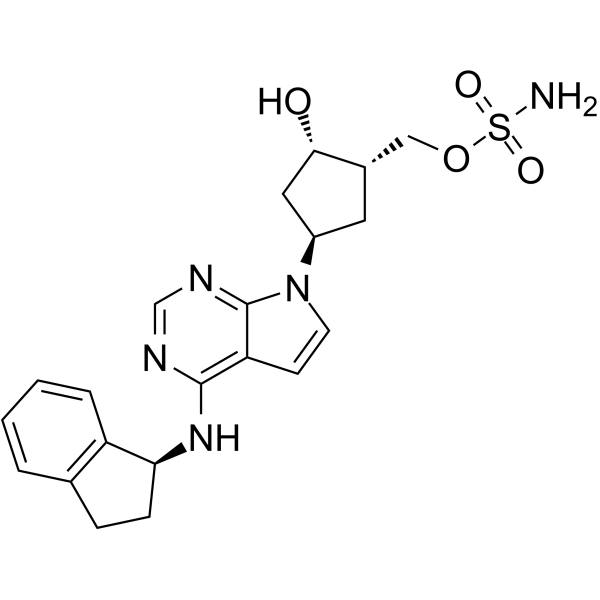
Cat. No.: HY-70062
CAS No.: 905579-51-3
Synonyms: MLN4924
Research Areas:  

Cancer

Pevonedistat (MLN4924) is a potent and selective NEDD8-activating enzyme (NAE) inhibitor with an IC50 of 4.7 nM. Pevonedistat induces the deregulation of S-phase DNA synthesis, thereby disrupting protein turnover mediated by cullin-RING ligase, leading to apoptosis of human tumor cells. Pevonedistat suppresses the growth of human tumour xenografts in mice .
loading...
    loading...
226
226 Publications Verification
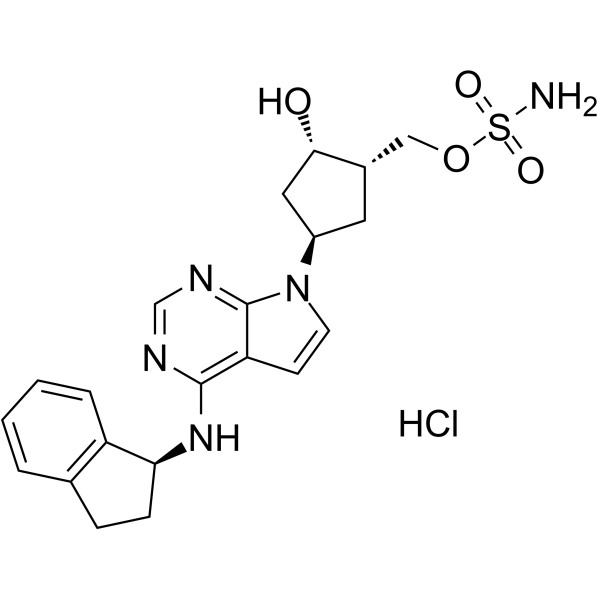
Cat. No.: HY-10484
CAS No.: 1160295-21-5
Purity:  98.58%
Synonyms: MLN4924 hydrochloride
Research Areas:  

Cancer

Pevonedistat (MLN4924) hydrochloride is a potent and selective NEDD8-activating enzyme (NAE) inhibitor, with an IC50 of 4.7 nM. Pevonedistat hydrochloride induces the deregulation of S-phase DNA synthesis, thereby disrupting protein turnover mediated by cullin-RING ligase, leading to apoptosis of human tumor cells. Pevonedistat hydrochloride suppresses the growth of human tumour xenografts in mice .
loading...
    loading...
10
10 Cited Publications
Cat. No.: HY-128586A
CAS No.: 1848959-11-4
Purity:  98.91%
TAS4464 hydrochloride is a long-acting, highly selective covalent inhibitor targeting NEDD8-activating enzyme (NAE) (IC50=0.955 nM), and also inhibits CAII with an IC50 of 0.73 μM, which is less potent than MLN4924 (HY-70062). The IC50 values of TAS4464 hydrochloride against other E1 enzymes UAE and SAE are 449 nM and 1280 nM, respectively. TAS4464 hydrochloride targets NEDD8 in an ATP-dependent manner to inhibit NAE, blocks the neddylation pathway, causes accumulation of CRL ubiquitin ligase substrates (such as CDT1, p27, phosphorylated IκBα), and further induces tumor cell apoptosis. TAS4464 hydrochloride exhibits antiproliferative and cytotoxic effects, and has broad-spectrum antitumor activity against various hematologic and solid tumor cell lines as well as patient-derived tumor cells. TAS4464 hydrochloride has a wide therapeutic window, without obvious toxicity. TAS4464 hydrochloride can be used in the research of hematologic malignancies (leukemia, lymphoma, multiple myeloma, etc.) and solid tumors (small cell lung cancer, colorectal cancer, sarcoma, endometrial cancer, ovarian cancer, etc.) .
loading...
    loading...
1
1 Cited Publications
Cat. No.: HY-174138
Target:  

NF-κB

Research Areas:  

Inflammation/Immunology

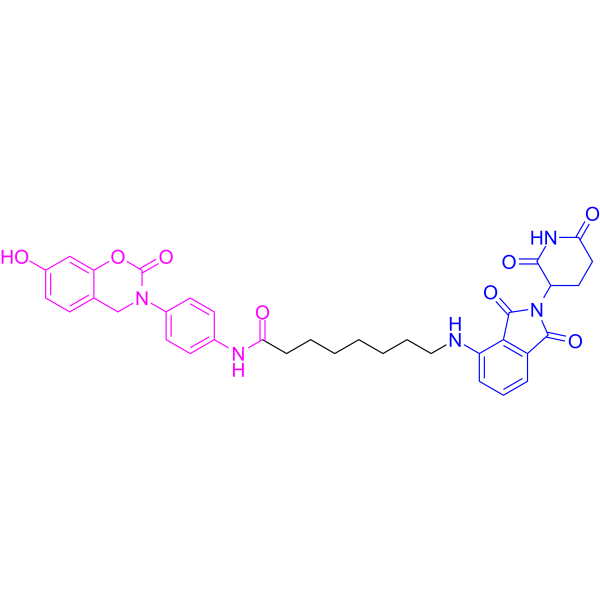
NF-κB degrader 1 (Compound MD-1) is a NF-κB1 p105 subunit degrader. NF-κB degrader 1 shows anti-inflammatory activity (IC50 for inhibiting TNF-α is 2.02 μM, and for inhibiting NO is 5.40 μM). NF-κB degrader 1 induces p105 degradation dependent on the Cullin-RING ligase (CRL) SCFBTCP, suppressing NF-κB transcriptional activity. NF-κB degrader 1 is promising for research of inflammation-related diseases .
loading...
    loading...
Cat. No.: HY-160525
Target:  

Molecular Glues

Research Areas:  

Cancer

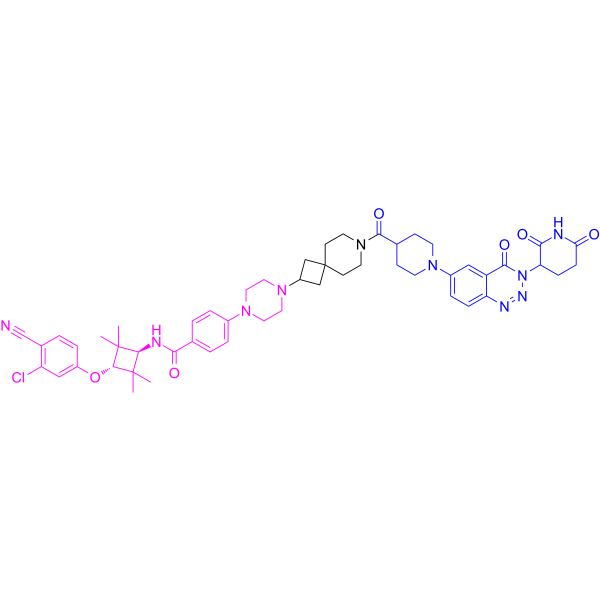
NVS-VHL720 is a selective VHL-based cysteine dioxygenase (CDO1) molecular glue degrader. NVS-VHL720 recruits CDO1 to the VHL E3 ligase complex, driving ubiquitin-dependent proteasomal degradation of CDO1. NVS-VHL720 can be used for the research of cancer .
loading...
    loading...
Cat. No.: HY-172615
CAS No.: 3033019-04-1
Research Areas:  

Cancer

AMPTX-1 is a selective, orally active, covalent reversible BRD9 molecular glue degrader with a DC50 of 0.05 nM. AMPTX-1 selectively recruits BRD9 to the E3 ligase DCAF16. AMPTX-1 forms a ternary complex with BRD9 and a reversible covalent adduct with Cys58 on the surface of DCAF16. AMPTX-1 mediates BRD9 degradation via the proteasome and Cullin RING E3 ligase pathways. AMPTX-1 can be used in the research of solid tumors and hematological malignancies .
loading...
    loading...
Cat. No.: HY-148117
CAS No.: 2758431-97-7
Purity:  99.96%
MD13 is a MIF PROTAC degrader with a DC50 of approximately 100 nM. MD13 induces ubiquitination and degradation of MIF by recruiting the Cereblon Cullin RING E3 ubiquitin ligase complex. MD13 inactivates the MAPK pathway and induces G2/M phase cell cycle arrest. MD13 exhibits antiproliferative effects in 3D tumor spheroid models. MD13 can be used in lung cancer-related research .
loading...
    loading...
Cat. No.: HY-129610
CAS No.: 2384184-40-9
Purity:  99.25%
Target:  

PROTACs FKBP

Research Areas:  

Cancer

KB02-SLF is a nuclear FKBP12 covalent PROTAC degrader. KB02-SLF covalently modifies cysteine residues in DCAF16, forms a ternary complex with nuclear FKBP12, and mediates degradation via the CUL4-DDB1 E3 ubiquitin ligase pathway. KB02-SLF promotes polyubiquitination and proteasomal degradation of nucleus-localized FKBP12. KB02-SLF can be used in breast cancer research .
loading...
    loading...
Cat. No.: HY-173002
CAS No.: 3107482-42-5
Research Areas:  

Cancer

MS9024 is a selective DNMT1 Molecular glue degrader with a DC50 of 35 nM. MS9024 degrades DNMT1 in a concentration-, time- and proteasome-dependent manner without altering DNMT1 transcription. MS9024 mediates degradation via HECT E3 ligase and/or UHRF1, but not via lysosomes or Cullin RING E3 ligase. MS9024 can be used in the research of colorectal cancer, breast cancer and non-small cell lung cancer .
loading...
    loading...
Cat. No.: HY-146397
CAS No.: 2760703-21-5
Research Areas:  

Cancer

TD-802 is a CRBN-recruiting PROTAC androgen receptor (AR) degrader with liver microsomal stability and in vivo pharmacokinetic properties. TD-802 exhibits weak degrading activity against the AR-V7 splice variant, and its degradation process depends on the ubiquitin-proteasome system and Cullin-Ring ubiquitin ligase. TD-802 inhibits the proliferation of AR-dependent prostate cancer cells and the growth of AR-positive prostate cancer tumors in in vivo xenograft models .
loading...
    loading...
Cat. No.: HY-172770
CAS No.: 3113750-79-8
Target:  

Molecular Glues

Research Areas:  

Cancer

KMG-1068 is a molecular glue degrader that induces proteasomal degradation of GSPT1 and GSPT2 with DC50 values of 126.7 nM and 42.2 nM, respectively. KMG-1068 binds to the C-terminal IMiD-binding site of CRBN, forms ternary complexes with GSPT1 and GSPT2, and mediates proteasomal degradation of target proteins via the CRL4 ubiquitination pathway. KMG-1068 is applicable to research related to acute myeloid leukemia .
loading...
    loading...
Cat. No.: HY-170983
Target:  

FKBP

Research Areas:  

Cancer

MC-25B is a DCAF16-recruiting FKBP12 PROTAC degrader with a DC50 of 0.35 μM. MC-25B promotes the formation of a ternary complex with DCAF16 and nuclear-localized FKBP12_NLS, thereby mediating DCAF16-dependent degradation of FKBP12_NLS via the proteasome and Cullin-RING ligase pathway .
loading...
    loading...
Cat. No.: HY-162240
Research Areas:  

Cancer

SJH1-51B is a SKP1-recruiting BRD4 PROTAC degrader. SJH1-51B binds to SKP1 in the SKP1-FBXO7-CUL1-RBX1 complex, but shows no or weak binding to monomeric SKP1. SJH1-51B induces proteasome- and SKP1-dependent degradation of BRD4, and this degradation process relies on the neddylation modification of Cullin-RING E3 ligase. SJH1-51B induces proteasome-mediated degradation of the short isoform of BRD4 in non-cancer cells, while it induces proteasome-mediated degradation of both the long and short isoforms of BRD4 in breast cancer cells. SJH1-51B can be used for breast cancer research .
loading...
    loading...
Cat. No.: HY-70062R
CAS No.: 905579-51-3
Synonyms: MLN4924 (Standard)
Pevonedistat (Standard) is the analytical standard of Pevonedistat. This product is intended for research and analytical applications. Pevonedistat (MLN4924) is a potent and selective NEDD8-activating enzyme (NAE) inhibitor with an IC50 of 4.7 nM. Pevonedistat induces the deregulation of S-phase DNA synthesis, thereby disrupting protein turnover mediated by cullin-RING ligase, leading to apoptosis of human tumor cells. Pevonedistat suppresses the growth of human tumour xenografts in mice .
loading...
    loading...
Cat. No.: HY-178321
Research Areas:  

Cancer

UNC10088 is a molecular glue targeting NSD2. UNC10088 mediates the formation of a stable ternary complex between SCFFBXO22 and the NSD2 PWWP1 domain. UNC10088 promotes ubiquitination of the SCFFBXO22-dependent NSD2 PWWP1 domain through reversible covalent bonding with the C326 region of FBXO22. UNC10088 could be used in cancer research .
loading...
    loading...
Cat. No.: HY-161650
CAS No.: 3050769-37-1
Research Areas:  

Cancer

PROTAC BRD4 Degrader-26 is a light-regulated BRD4 PROTAC degrader. PROTAC BRD4 Degrader-26 induces targeted degradation of BRD4 via the ubiquitin-proteasome system. PROTAC BRD4 Degrader-26 is a degrader that can be inactivated in response to ultraviolet light. PROTAC BRD4 Degrader-26 can be used in breast cancer-related research .
loading...
    loading...
Cat. No.: HY-184151
Research Areas:  

Cancer

KBD-1 is a muscle-specific BRD4 PROTAC degrader with human KDs of 27.04 nM and 37.36 µM against BRD4 and KLHL4L, respectively. KBD-1 recruits the muscle-specific E3 ligase KLHL41, mediating Cullin-RING ligase (CRL)-dependent ubiquitination and proteasome degradation of BRD4. KBD-1 can be used for the research of myosarcoma .
loading...
    loading...
Cat. No.: HY-183755
Target:  

Molecular Glues

Research Areas:  

Cancer

YSA64 is an orally active RBM39-targeting molecular glue. YSA64 promotes degradation via formation of a DCAF15/DDB1 ternary complex, dependent on Cullin-RING E3 ligase and proteasome activity. YSA64 can be used for the research of acute myeloid leukemia and Ewing sarcoma .
loading...
    loading...
Cat. No.: HY-10484R
CAS No.: 1160295-21-5
Synonyms: MLN4924 hydrochloride (Standard)
Pevonedistat hydrochloride (Standard) is the analytical standard of Pevonedistat hydrochloride (HY-10484). This product is intended for research and analytical applications. Pevonedistat (MLN4924) hydrochloride is a potent and selective NEDD8-activating enzyme (NAE) inhibitor, with an IC50 of 4.7 nM. Pevonedistat hydrochloride induces the deregulation of S-phase DNA synthesis, thereby disrupting protein turnover mediated by cullin-RING ligase, leading to apoptosis of human tumor cells. Pevonedistat hydrochloride suppresses the growth of human tumour xenografts in mice .
loading...
    loading...
  • 1

