17 Results for "

cytoplasmic leakage

" in MedChemExpress (MCE) Product Catalog:
Products (17)

17 Results for "cytoplasmic leakage" in MCE Product Catalog:

1
1 Cited Publications
Cat. No.: HY-16485
CAS No.: 560130-42-9
Synonyms: TD-6424 hydrochloride
Target:  

Antibiotic Bacterial

Research Areas:  

Infection

Telavancin hydrochloride (TD-6424 hydrochloride) is a bactericidal agent that exhibits inhibitory activity against Staphylococcus aureus. Telavancin hydrochloride inhibits bacterial cell wall synthesis by binding to the lipid-linked N-acetylglucosamine-N-muramyl pentapeptide (with a D-Ala-D-Ala terminus), a peptidoglycan precursor, and blocks the transglycosylation and transpeptidation steps. Telavancin hydrochloride disrupts bacterial membrane barrier function, induces dissipation of bacterial membrane potential, and causes leakage of cytoplasmic ATP and potassium ions, with its activity restricted exclusively to bacterial membranes. Telavancin hydrochloride can be used in research on bacterial infections, central venous catheter-related bloodstream infections, and Gram-positive bacterial pneumonia .
loading...
    loading...
Cat. No.: HY-N125722
CAS No.: 33538-71-5
Synonyms: Aabomycin A1
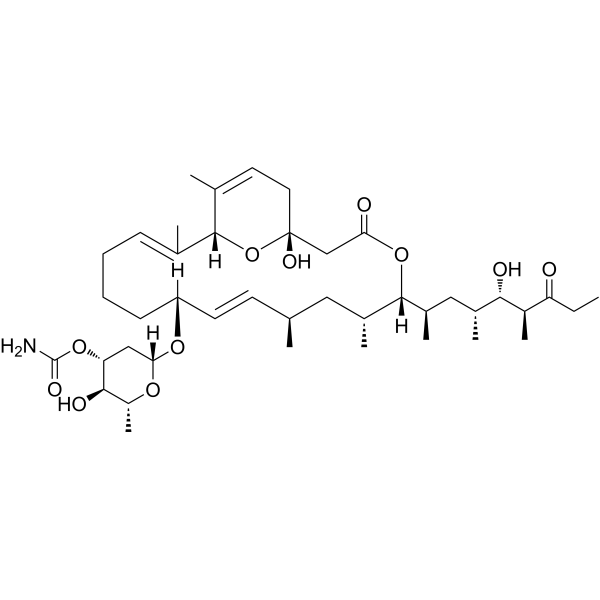
Venturicidin A (Aabomycin A1) is a natural product derived from Streptomyces, possessing antifungal, anti-Trypanosoma brucei, anti-Leishmania donovani, and ATP synthase inhibitory activities. Venturicidin A acts as an antibiotic adjuvant, promoting the uptake of aminoglycoside antibiotics and enhancing bactericidal efficacy. Venturicidin A inhibits ATP synthesis by blocking proton translocation through the FO subunit. In bloodstream-form Trypanosoma brucei, Venturicidin A causes collapse of the mitochondrial membrane potential; in fungi, it disrupts cell membrane integrity, induces leakage of cytoplasmic contents, elevates ROS levels, and downregulates the expression of fungal pathogenicity-related genes. Venturicidin A exhibits antifungal activity against Botrytis cinerea. Venturicidin A is used in research on bacterial infections, trypanosome/leishmania infections, and gray mold disease .
loading...
    loading...
Cat. No.: HY-B2053
CAS No.: 57018-04-9
Research Areas:  

Infection

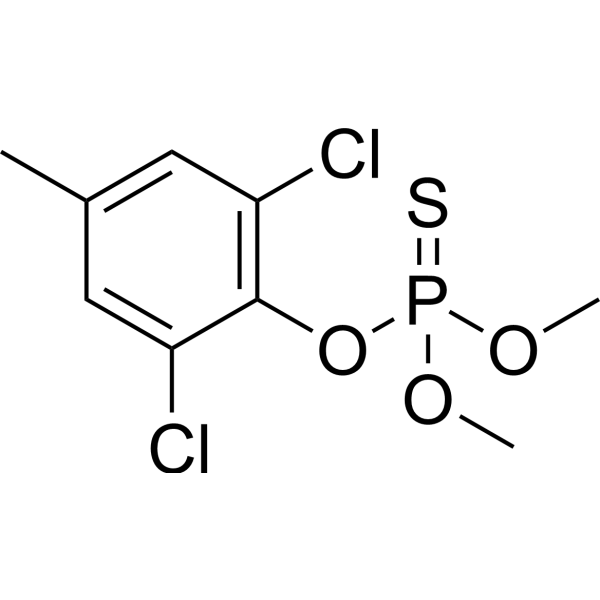
Tolclofos-methyl is an organophosphorus fungicide. Tolclofos-methyl undergoes photoinduced oxidative degradation to form oxo-analog derivatives. Tolclofos-methyl inhibits spore division in fungi and oomycetes, induces cytoplasmic leakage, and interferes with flagellar movement. Tolclofos-methyl is rapidly metabolized and excreted in rodents. Tolclofos-methyl can be used in studies related to fungal infections .
loading...
    loading...
Cat. No.: HY-N15548
CAS No.: 1206881-47-1
Synonyms: Armeniaspirole A
Target:  

Bacterial

Armeniaspirol A (Armeniaspirole A) is an antibacterial agent targeting Helicobacter pylori cell membranes. Armeniaspirol A induces membrane permeabilization, cytoplasmic leakage, and biofilm inhibition/eradication. Armeniaspirol A is promising for research of H. pylori infection .
loading...
    loading...
Cat. No.: HY-B2053R
CAS No.: 57018-04-9
Research Areas:  

Infection

Tolclofos-methyl (Standard) is the analytical standard of Tolclofos-methyl (HY-B2053). This product is intended for research and analytical applications. Tolclofos-methyl is an organophosphorus fungicide. Tolclofos-methyl undergoes photoinduced oxidative degradation to form oxo-analog derivatives. Tolclofos-methyl inhibits spore division in fungi and oomycetes, induces cytoplasmic leakage, and interferes with flagellar movement. Tolclofos-methyl is rapidly metabolized and excreted in rodents. Tolclofos-methyl can be used in studies related to fungal infections .
loading...
    loading...
Cat. No.: HY-170991
Research Areas:  

Infection

C12-rrw-NH2 (Compound Lip7) is an antibacterial agent against gram-positive bacteria, especially against Methicillin (HY-121544)-resistant Staphylococcus aureus (MRSA). C12-rrw-NH2 induces bacterial death via depolarizing the bacterial cytoplasmic membrane, disrupting the integrity of the bacterial membrane, leading to leakage of nucleic acid and protein and promoting the generation of Reactive Oxygen Species. C12-rrw-NH2 is potential to be used for research of developing high-stability antimicrobial peptides .
loading...
    loading...
Cat. No.: HY-175647
Target:  

Myosin Fungal

Research Areas:  

Infection

Myosin-5-IN-2 (Compound G19) is a Myosin-5 inhibitor. Myosin-5-IN-2 has an antifungal activity against Fusarium graminearum (Fg), Botrytis cinerea and Rhizoctonia solani with an EC50 s of 0.326 μg/mL for Fg. Myosin-5-IN-2 has effective protective and curative control efficiency for wheat leaves. Myosin-5-IN-2 severely damages the surface integrity of mycelial cells and induces cytoplasmic leakage. Myosin-5-IN-2 can be used for fungal infections like fusarium head blight (FHB) research .
loading...
    loading...
Cat. No.: HY-K1044

MCE Polymyxin B (1,000×), Sterile (50 mg/mL) is a filtered and sterilized antibiotic solution that can be used directly in cell culture. Polymixin B is a mixture of B1 and B2 polypeptides obtained from different strains of Bacillus polymyxa, with antibacterial activity against gram-negative bacteria. It can bind lipopolysaccharide (LPS) of the outer membrane of gram-negative bacteria and disrupts the cytoplasmic membrane by inducing large pores to allow nucleotide leakage in bacterial walls. This disrupts the permeability of the cytoplasmic membrane.

loading...
    loading...
Cat. No.: HY-189257
CAS No.: 848488-07-3
Target:  

Fungal

Research Areas:  

Infection

Antifungal agent 178 is an indole-oxazole alkaloid analog and a fungal cell membrane disruptor that exhibits low phytotoxicity toward plants. Antifungal agent 178 disrupts the integrity of hyphal cell membranes, leading to cytoplasmic leakage and inhibition of hyphal growth, and induces morphological changes in hyphae. Antifungal agent 178 can be used in research related to fungal plant diseases .
loading...
    loading...
Cat. No.: HY-183966
Target:  

Bacterial Fungal

Research Areas:  

Infection

Antibacterial agent 348 is an antimicrobial agent containing piperazine-isopropanolamine bifunctional groups. Antibacterial agent 348 suppresses virulence factor expression in plant pathogens. Antibacterial agent 348 compromises bacterial membrane integrity, leading to cytoplasmic leakage. Antibacterial agent 348 inhibits cellular proliferation of plant pathogens, diminishes colonization and infectivity of plant pathogens in host plants. Antibacterial agent 348 can be used for the research of rice bacterial leaf blight, pepper phytophthora blight .
loading...
    loading...
Cat. No.: HY-180125
Research Areas:  

Infection

Antibacterial agent 307 is an antibacterial agent. Antibacterial agent 307 shows MICs of 1-4 μg/mL against Gram-positive bacteria, moderate activity against Gram-negative bacteria, low hemolytic toxicity, and excellent plasma stability. Antibacterial agent 307 compromises bacterial membrane integrity via increased permeability and depolarization, induces endogenous ROS accumulation, causes cytoplasmic protein and nucleic acid leakage, and drives rapid bacterial cell death. Antibacterial agent 307 can be used for the research of bacterial infection .
loading...
    loading...
Cat. No.: HY-180125A
Research Areas:  

Infection

Antibacterial agent 307 hydrochloride is an antibacterial agent. Antibacterial agent 307 hydrochloride shows MICs of 1-4 μg/mL against Gram-positive bacteria, moderate activity against Gram-negative bacteria, low hemolytic toxicity, and excellent plasma stability. Antibacterial agent 307 hydrochloride compromises bacterial membrane integrity via increased permeability and depolarization, induces endogenous ROS accumulation, causes cytoplasmic protein and nucleic acid leakage, and drives rapid bacterial cell death. Antibacterial agent 307 hydrochloride can be used for the research of bacterial infection .
loading...
    loading...
Cat. No.: HY-182798
Research Areas:  

Infection

Antibacterial agent 337 is an antibacterial agent. Antibacterial agent 337 specifically interacts with PG in bacterial cell membranes, triggering membrane disruption, membrane depolarization, increased permeability, cytoplasmic leakage, ROS accumulation and rapid bacterial death. Antibacterial agent 337 inhibits biofilm formation and disrupts mature biofilms. Antibacterial agent 337 exhibits potent in vivo antibacterial efficacy in a mouse model of Staphylococcus aureus skin abscess. Antibacterial agent 337 can be used in studies of Gram-positive bacterial infections, including methicillin-resistant Staphylococcus aureus infections, vancomycin-resistant Enterococcus faecalis infections and bacterial biofilm infections .
loading...
    loading...
Cat. No.: HY-P11582
Target:  

Bacterial

Research Areas:  

Infection

CyLip-20 is a cyclic lipopeptide antimicrobial peptide that targets Gram-positive and Gram-negative bacteria. CyLip-20 exhibits low hemolytic activity and mild in vivo toxicity. CyLip-20 disrupts the integrity of bacterial outer membrane, inner membrane and cytoplasmic membrane by binding to bacterial lipopolysaccharide (LPS), triggering membrane permeabilization, depolarization and leakage of intracellular contents, and inhibits bacterial biofilm formation. In animal models, CyLip-20 reduces the bacterial load in skin wounds of mice infected with MRSA, promotes wound healing, decreases the levels of inflammatory cytokines and reduces inflammatory cell infiltration. CyLip-20 can be used in research related to MRSA skin wound infections .
loading...
    loading...
Cat. No.: HY-111989
CAS No.: 103923-27-9
Target:  

Bacterial Fungal

Research Areas:  

Infection Inflammation/Immunology

Pirtenidine free base is a broad-spectrum antibacterial and anti-plaque agent. Pirtenidine free base exhibits bactericidal activity against oral plaque bacteria in vitro and inhibits plaque formation. Pirtenidine free base inhibits the growth, budding, germ tube formation and buccal epithelial cell adhesion of Candida albicans and Saccharomyces cerevisiae, reduces the oxygen uptake rate of yeast, and impairs mitochondrial respiratory function. Pirtenidine free base disrupts the integrity of fungal cell wall and membrane, leading to cytoplasmic leakage, cell shrinkage, and lysis. Pirtenidine free base binds tightly to mucosal surfaces in vivo with low systemic exposure. Pirtenidine free base can be used in studies related to dental plaque, fungal infections and oral candidiasis .
loading...
    loading...
Cat. No.: HY-182022
CAS No.: 3083425-49-1
ZLWH-67 is a β-Carboline derivative and Antibacterial agent. ZLWH-67 inhibits DNA synthesis, suppresses biofilm formation, and increases reactive oxygen species (ROS) levels. ZLWH-67 exhibits potent in vitro antibacterial activity against MRSA (MIC = 0.5-4 μg/mL), S. epidermidis (MIC = 4 μg/mL), E. faecalis (MIC = 4-8 μg/mL), and S. pneumoniae (MIC = 16 μg/mL). ZLWH-67 displays anti-MRSA effects in murine skin and pneumonia infection models .
loading...
    loading...
Cat. No.: HY-189259
CAS No.: 3105221-19-7
Target:  

Fungal

Research Areas:  

Infection

Antifungal agent 179 is an indole-oxazole alkaloid analog with broad-spectrum antifungal activity against plant pathogenic fungi. Antifungal agent 179 disrupts the integrity of fungal hyphal cell membranes, increases membrane permeability, and causes leakage of intracellular electrolytes and cytoplasm. Antifungal agent 179 exhibits protective and curative activity in a tomato in vivo model infected with Botrytis cinerea, with low toxicity to mung bean plants. Antifungal agent 179 can be used for research on crop fungal infections .
loading...
    loading...
  • 1

